

What are Prepositions of Place?
Prepositions of place are words that show the position or location of something. They answer the question ‘Where?’
These small words are very important for making clear sentences in English. They help you describe where objects, people, or animals are.
🎓 Apprenez l'anglais grâce à la méthode mixte
Petits groupes · Tuteur IA disponible 24 h/24, 7 j/7 · Préparation aux examens de Cambridge
Plans provenant de $39 $79 par mois
Using 'In'
Nous utilisons in to talk about something that is inside a container, a room, a building, or a large area.
- Utilisation in for things inside a box, bag, or room.
- Think of in as 'inside'.
Using 'On'
Nous utilisons on to talk about something that is on a surface.
- Utilisation on for things on a table, a wall, or the floor.
- Think of on as 'touching the top surface'.
Using 'Under'
Nous utilisons under to talk about something that is below another object or surface.
- Utilisation under for things below a table, a bed, or a tree.
- Think of under as 'below something else'.
Using 'Behind'
Nous utilisons behind to talk about something that is at the back of another object.
- Utilisation behind for things at the back of a door, a person, or a building.
- Think of behind as 'at the back'.
Using 'In Front Of'
Nous utilisons in front of to talk about something that is at the forward part of another object or person.
- Utilisation in front of for things at the front of a car, a house, or a screen.
- Think of in front of as 'at the face side'.
Using 'Next To'
Nous utilisons next to to talk about something that is beside another object or person.
- Utilisation next to for things very close to a chair, a window, or a friend.
- Think of next to as 'beside' or 'very near'.
Using 'Between'
Nous utilisons between to talk about something that is in the middle of two other objects or people.
- Utilisation between for things in the middle of two books, two people, or two buildings.
- Think of between as 'in the middle of two things'.
| Préposition | Signification | Exemple |
|---|---|---|
| in | Inside a space or container | The book is in the bag. |
| on | On a surface | The cat is on the chair. |
| under | Below something else | The ball is under the table. |
| behind | At the back of something | The teacher is behind the desk. |
| in front of | At the forward part of something | The dog is in front of the door. |
| next to | Beside or very near something | The lamp is next to the bed. |
| between | In the middle of two things | The shop is between the bank and the cafe. |
Exemples
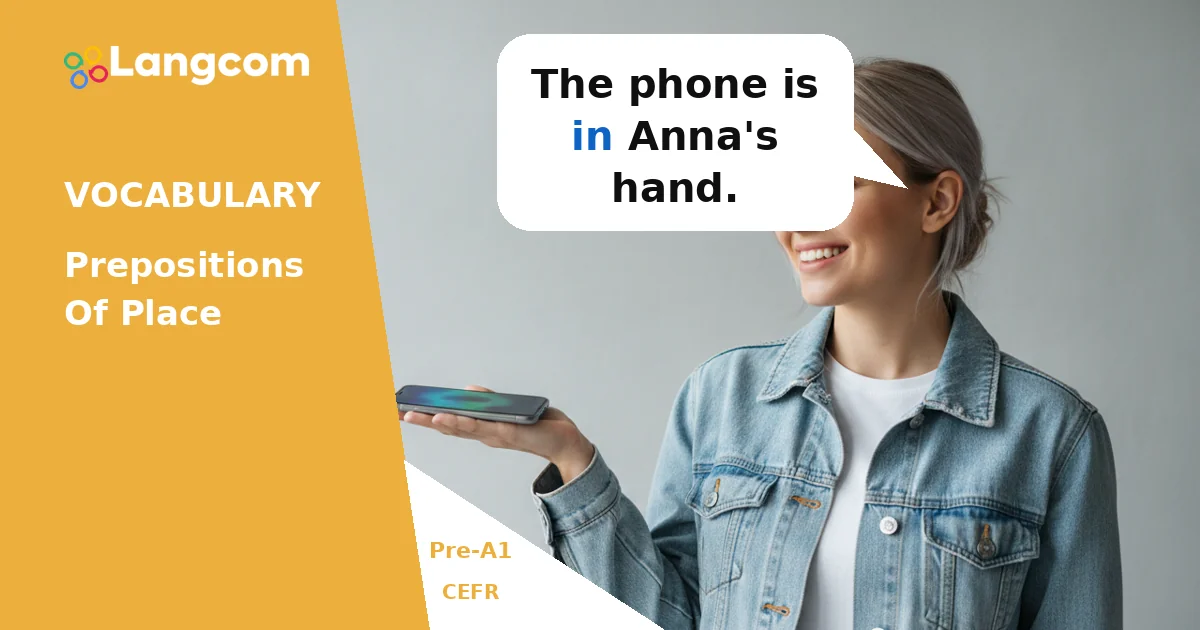
- The phone is in Anna's hand.
- The table is under the mirror.
- The monster is behind Anna.
- The chair is between the table and the blue door.
- The big lamp is next to the white door.
- The mat is in front of the monster.
- The books are next to the small lamp.
- My keys are in my bag.
- The picture is on the wall.
- The cat is under the bed.
Entraînement
💬 Vous avez besoin de conseils personnalisés ?
En tant que centre de préparation agréé par Cambridge, nous pouvons vous aider à choisir la formation et la certification qui vous conviennent. Discutez-en dès aujourd'hui avec nos conseillers.
Discutez avec un conseiller sur WhatsAppErreurs courantes chez les hispanophones
Sometimes, Spanish speakers use in when English uses on, or vice-versa. It is important to remember the difference.
- In vs. On for surfaces: In Spanish, you might say 'en la mesa' for 'on the table'. But for things on a surface, English always uses on.
- The book is on the table. (Correct)
- The book is in the table. (Incorrect)
- In vs. On for rooms/buildings: You say in the room, in the house. Not on the room.
- I am in the classroom. (Correct)
- I am on the classroom. (Incorrect)
N'oubliez pas que, in means inside a space, and on means on a surface.
Questions fréquemment posées
What is a preposition of place?
A preposition of place is a word that tells you the location or position of something. For example, in, on, under.
When do I use 'in'?
Vous utilisez in when something is inside a container, a room, or a large area. For example, The apple is in the box.
When do I use 'on'?
Vous utilisez on when something is on a surface. For example, The pen is on the desk.
What is the difference between 'behind' and 'in front of'?
Behind means at the back of something. In front of means at the forward part of something. For example, The tree is behind the house, but The car is in front of the house.




0 commentaire