
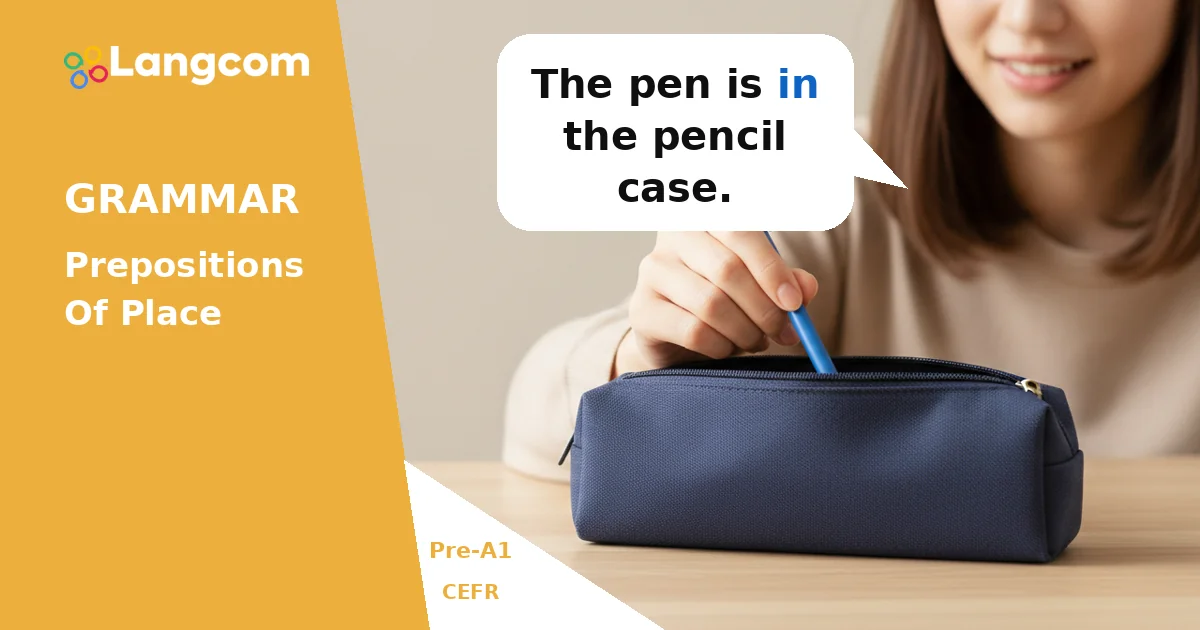

What Are Prepositions of Place?
Prepositions of place are small words that tell us the position of a person or an object. They answer the question, “Where is it?”
These words help you describe locations simply and clearly.
🎓 Apprenez l'anglais grâce à la méthode mixte
Petits groupes · Tuteur IA disponible 24 h/24, 7 j/7 · Préparation aux examens de Cambridge
Plans provenant de $39 $79 par mois
When Do We Use 'In'?
Nous utilisons in when something is inside a container, a room, or an enclosed space.
- The keys are in my pocket. (Inside the pocket)
- The children are in the classroom. (Inside the room)
- My phone is in my bag. (Inside the bag)
When Do We Use 'On'?
Nous utilisons on when something is on a surface. It means it is touching the top of something.
- The book is on the table. (On the surface of the table)
- The picture is on the wall. (On the surface of the wall)
- My hat is on my head. (On the surface of my head)
When Do We Use 'Under'?
Nous utilisons under when something is below another object. It means it is covered by something else.
- The dog is under the bed. (Below the bed)
- The ball is under the chair. (Below the chair)
- My shoes are under the desk. (Below the desk)
When Do We Use 'Next To'?
Nous utilisons next to when something is beside another object. It means they are very close to each other, side-by-side.
- The lamp is next to the sofa. (Beside the sofa)
- She is sitting next to her friend. (Beside her friend)
- The car is next to the tree. (Beside the tree)
| Préposition | Meaning | Exemple |
|---|---|---|
| in | Inside a space or container | The juice is in the fridge. |
| on | On a surface | The picture is on the wall. |
| under | Below something else | The cat is under the table. |
| next to | Beside; very close to | The chair is next to the window. |
Exemples
- The pen is in the pencil case.
- The cat is on the roof.
- The remote control is under the cushion.
- The bicycle is next to the door.
- My keys are in my bag.
- The clock is on the wall.
- The blanket is under the bed.
- The restaurant is next to the bank.
Entraînement
💬 Vous avez besoin de conseils personnalisés ?
En tant que centre de préparation agréé par Cambridge, nous pouvons vous aider à choisir la formation et la certification qui vous conviennent. Discutez-en dès aujourd'hui avec nos conseillers.
Discutez avec un conseiller sur WhatsAppErreurs courantes chez les hispanophones
Spanish speakers often use "en" for both in et on. In English, it's important to choose the correct preposition:
- Incorrect : The book is in the table.
- Correct : The book is on the table. (Because the book is on the surface of the table, not inside it.)
- Incorrect : I am on the room.
- Correct : I am in the room. (Because you are inside the room.)
Remember: in for inside, on for surfaces.
Questions fréquemment posées
What is a preposition?
A preposition is a word that connects a noun or pronoun to other words in a sentence. Prepositions of place tell us about location, like in, on, ou under.
How do I choose between 'in' and 'on'?
Utilisation in when something is inside an enclosed space (like in the box). Use on when something is on a surface (like on the table).
Can I use 'near' instead of 'next to'?
Yes, but they are slightly different. Next to means immediately beside, very close. Near means close, but not necessarily touching or right beside. For example, The park is near my house (it's close), but My bike is next to the wall (it's right beside the wall).




0 commentaire