
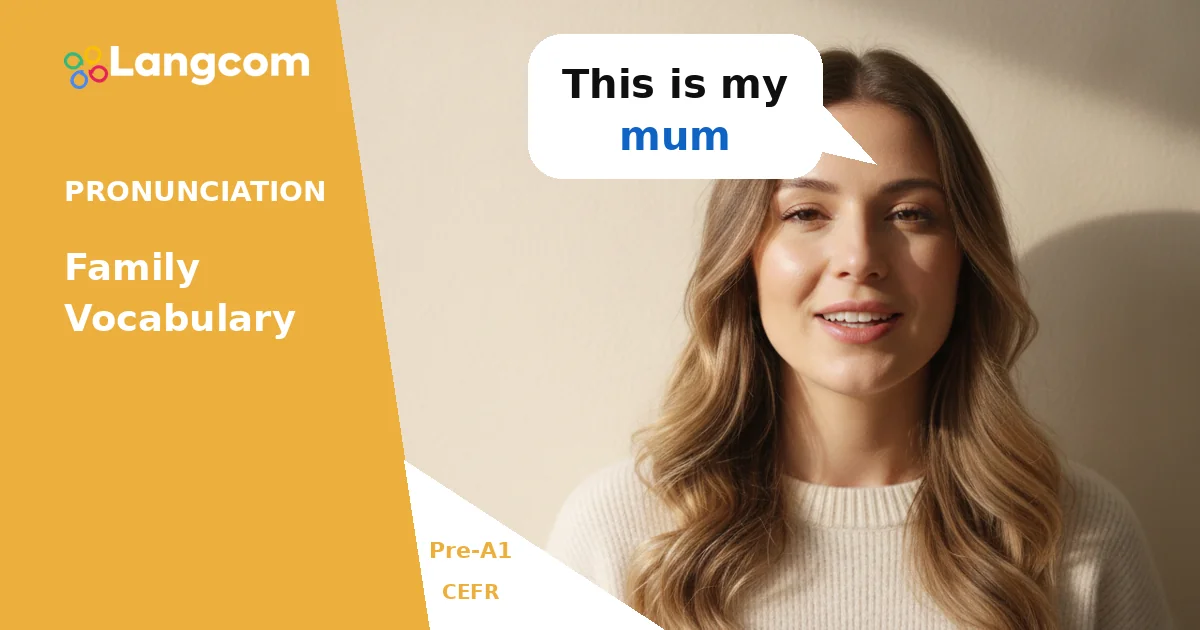

How Do We Say ‘My Mum’?
Le mot mum is a common way to say mother in British English. It is a warm and friendly word.
Listen carefully to the sound of the ‘u’ in mum. It sounds like the ‘u’ in words like cup ou sun. It is a short, central sound.
- Say: m-UH-m
- Do not say: moom (like ‘moon’)
🎓 Apprenez l'anglais grâce à la méthode mixte
Petits groupes · Tuteur IA disponible 24 h/24, 7 j/7 · Préparation aux examens de Cambridge
Plans provenant de $39 $79 par mois
What About 'My Brother' and 'My Sister'?
These are two very common family words. Let's look at their sounds.
'My Brother'
For brother, the 'o' sound is like the 'u' in mum ou cup. The 'th' sound is soft, like in the. The 'er' at the end is a soft sound, almost like 'uh'.
- Say: br-UH-th-er
- Do not say: bro-ther (with a hard 'o' like 'go')
'My Sister'
For sister, the first 'i' sound is short, like the 'i' in sit ou in. The 'er' at the end is a soft sound, like in brother.
- Say: s-IH-st-er
- Do not say: see-ster (with a long 'ee' sound)
How to Pronounce 'My Grandpa' and 'My Grandma'?
These words are short forms for grandfather et grandmother. They are friendly and common.
'My Grandpa'
For grandpa, the first 'a' sound is long, like the 'a' in car ou father. The 'nd' sounds are clear. The 'pa' at the end has a soft 'uh' sound for the 'a'.
- Say: gran-PAH
- Do not say: gran-pay (with a long 'ay' sound)
'My Grandma'
For grandma, it is similar to grandpa. The first 'a' sound is long, like in car. The 'nd' sounds are clear. The 'ma' at the end has a soft 'uh' sound for the 'a'.
- Say: gran-MAH
- Do not say: gran-may (with a long 'ay' sound)
Why is Pronunciation Important for Beginners?
Good pronunciation helps people understand you easily. When you say words correctly, your message is clear.
- It builds your confidence to speak English.
- It helps you understand native speakers better.
- It makes your English sound more natural.
Practice these sounds often. Listen to English speakers and try to copy their sounds.
Exemples
- This is my mum.
- I love my brother.
- She is my sister.
- My grandpa tells good stories.
- My grandma cooks delicious food.
Entraînement
💬 Vous avez besoin de conseils personnalisés ?
En tant que centre de préparation agréé par Cambridge, nous pouvons vous aider à choisir la formation et la certification qui vous conviennent. Discutez-en dès aujourd'hui avec nos conseillers.
Discutez avec un conseiller sur WhatsAppErreurs courantes chez les hispanophones
Les hispanophones commettent parfois les erreurs suivantes :
- 'U' sound in mum et brother: You might say it like the 'u' in Spanish 'luna' (moom, broo-ther). In English, it's a shorter, more open sound like the 'u' in cup. Correct: mum, brother.
- 'I' sound in sister: You might say it like the 'ee' in Spanish 'sí' (see-ster). In English, it's a short 'i' sound, like in sit. Correct: sister.
- 'A' sound at the end of grandpa/grandma: You might say it like the 'a' in Spanish 'casa' (gran-pah, gran-mah). In English, it's a softer, quicker 'uh' sound, almost like the 'a' in 'sofa'. Correct: grandpa, grandma.
Questions fréquemment posées
What is the difference between 'mum' and 'mom'?
Mum is common in British English. Mom is common in American English. Both mean mother.
How can I practice these pronunciations?
Listen to native speakers say the words. Then, repeat them many times. You can record yourself and listen back to compare.
Are 'grandpa' and 'grandma' formal words?
Non, grandpa et grandma are informal and friendly ways to say grandfather et grandmother. They are very common.
Why is it important to learn family words at Pre-A1 level?
Family words are basic vocabulary. They help you talk about yourself and your loved ones. This is a common topic for beginners.

0 commentaire