

What Are Prepositional Phrases?
A prepositional phrase is a group of words that starts with a preposition and includes its object (a noun or pronoun) and any modifiers. These phrases work together as a single unit in a sentence.
At the C1 level, many prepositional phrases are fixed expressions. This means their meaning is idiomatic and you cannot change the words or the preposition.
- to the full (meaning ‘completely’ or ‘to the maximum extent’)
- in no time at all (meaning ‘very quickly’)
- by and large (meaning ‘generally’ or ‘mostly’)
✍️ Vous ne savez pas quel est votre niveau ?
Passez notre test de niveau gratuit et recevez des commentaires personnalisés de la part d'examinateurs certifiés par Cambridge.
Passez notre test de niveau GRATUITWhy Are Prepositional Phrases Important for C1 English?
Mastering prepositional phrases is key to achieving C1 fluency and accuracy. They help you express yourself more naturally and precisely, like a native speaker.
- They add specific details and nuances that single words often cannot.
- Using them correctly demonstrates a sophisticated understanding of English.
- They are frequently tested in advanced English exams, including the C1 Advanced.
How to Learn and Use Prepositional Phrases
Learning prepositional phrases effectively requires a specific approach. Do not try to translate them word-for-word from Spanish, as this often leads to errors.
- Learn as Chunks: Always learn the entire phrase together, for example, for good, not just the word good.
- Use Context: Pay attention to how these phrases are used in sentences. Reading and listening to authentic English will help you understand their natural usage.
- Keep a Vocabulary Notebook: Write down new phrases with example sentences that are meaningful to you.
- Practice Regularly: Try to incorporate new phrases into your speaking and writing. The more you use them, the more natural they will become.
| Phrase | Signification |
|---|---|
| all at once | simultaneously; suddenly |
| by and large | generally; mostly |
| by chance | accidentally; unexpectedly |
| for good | permanently; forever |
| in no time at all | very quickly; immediately |
| in turn | as a result; as a consequence |
| on hold | temporarily delayed or suspended |
| to the full | completely; to the maximum extent |
Exemples
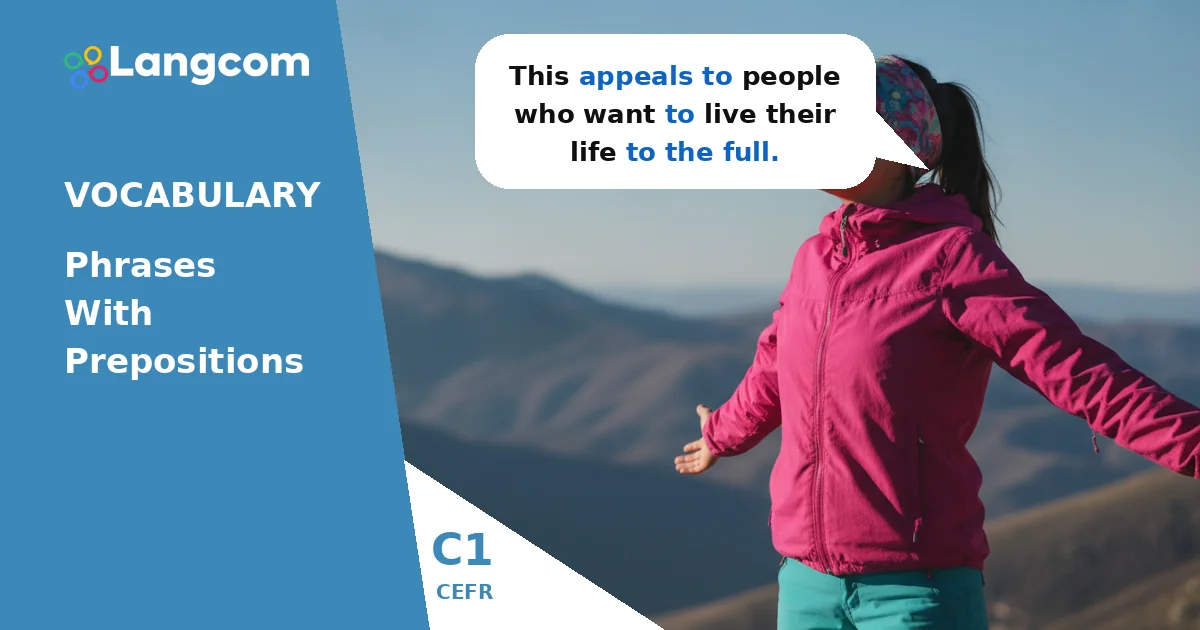
- This appeals to people who want to live their life to the full.
- We can send a message or photos to hundreds of friends around the world in no time at all.
- I've started eating more healthily, and this in turn has given me more energy.
- By and large, it's been easy to adapt to my new lifestyle.
- Everyone started talking all at once, making it hard to understand anything.
- Our plans to go on holiday are on hold until we've saved up more money.
- I found out by chance that she's moved to Canada.
- He's gone to live abroad for good; he's not coming back.
Entraînement
Prêt à obtenir votre certificat ?
Le cours Langcom prépare les étudiants aux examens de Cambridge, IELTS, TOEFL, DELE, SIELE et Michigan.
Commencez avec LangcomErreurs courantes chez les hispanophones
Spanish speakers often make mistakes with prepositional phrases due to direct translation or confusion with similar-looking expressions.
- Traduction littérale : Avoid translating phrases word-for-word from Spanish. For example, for good (meaning 'permanently') is not for always ou for well.
- Wrong Preposition: Using the incorrect preposition is a common error. For instance, you say by chance, et non with chance.
- Changing the Phrase: Remember that many prepositional phrases are fixed. You cannot change the words within them. For example, it's all at once, et non all in one time.
Questions fréquemment posées
What is a prepositional phrase in English?
A prepositional phrase is a group of words that begins with a preposition (like in, on, by) and includes its object, usually a noun or pronoun. For example, in the morning ou by chance.
Why is it important to learn prepositional phrases at C1 level?
At C1, learning prepositional phrases helps you sound more natural and fluent. Many are fixed expressions with idiomatic meanings, essential for advanced communication and for achieving a high score in exams like the C1 Advanced.
How can I remember so many prepositional phrases?
The best way is to learn them as complete "chunks" rather than individual words. Always learn them with an example sentence, like She left for good. Use them in your own speaking and writing to make them stick.
Are all prepositional phrases idiomatic?
No, not all prepositional phrases are idioms. Some simply describe location or time, like under the table. However, at the C1 level, you focus more on the fixed, idiomatic ones, such as in no time at all, which have a meaning that isn't obvious from the individual words.
How do prepositional phrases appear in the C1 Advanced exam?
You will encounter prepositional phrases in various parts of the C1 Advanced exam. They are common in the Reading and Use of English paper (e.g., Part 1 Multiple-choice cloze, Part 4 Key word transformations), where you need to choose the correct preposition or complete a fixed phrase. They are also crucial for demonstrating a wide range of vocabulary in the Writing and Speaking papers.


0 commentaire