

What are common ‘at’ phrases for time?
Many common phrases with at help us talk about time. These expressions specify when something happens or its duration.
-
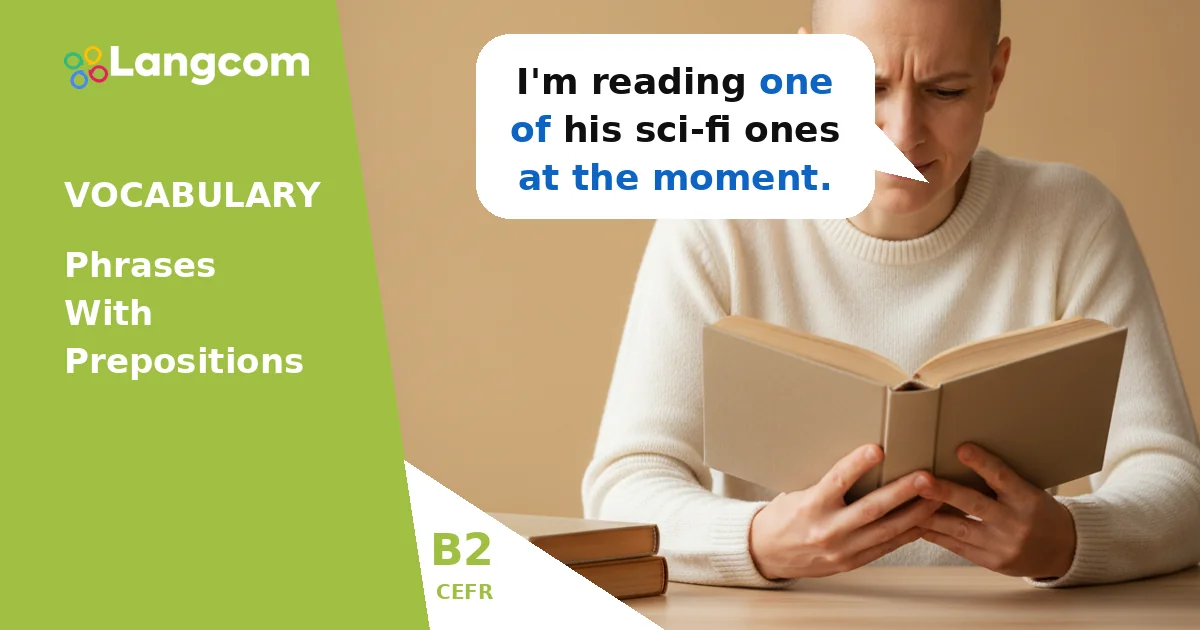
At the moment / At present: These mean ‘now’ or ‘currently’. They describe something happening right now or in the current period.
-
At once: This means ‘immediately’ or ‘without delay’. It suggests something should happen very quickly.
-
At first: This refers to the beginning of a situation or event, often contrasting with what happened later.
-
At last: This expresses relief that something desired or expected has finally happened after a long wait.
-
At the same time: This indicates that two or more things are happening simultaneously or concurrently.
✍️ Vous ne savez pas quel est votre niveau ?
Passez notre test de niveau gratuit et recevez des commentaires personnalisés de la part d'examinateurs certifiés par Cambridge.
Passez notre test de niveau GRATUITHow do we use 'at' for states or conditions?
Some phrases with at describe the condition or state of a person, group, or thing. These are often used to talk about how things are.
-
At war / At peace: These describe a country or group involved in fighting or, conversely, in a state of harmony without conflict.
-
At rest: This means not moving or working; in a state of stillness or relaxation.
-
At his/her/its/their best / worst: These phrases describe someone or something performing or being in their optimal or poorest condition.
-
At his/her/its/their laziest: This describes someone or something being in their most inactive or unwilling state.
When do we use 'at' for quantity or degree?
The preposition at can also be part of phrases that refer to amounts, limits, or degrees.
-
At least: This means 'not less than' or 'a minimum of'. It indicates the lowest possible number or amount.
-
At most: This means 'not more than' or 'a maximum of'. It indicates the highest possible number or amount.
| Phrase | Signification | Exemple |
|---|---|---|
| At the moment | Currently; now | She's busy at the moment. |
| At once | Immediately | Please reply at once. |
| At first | In the beginning | At first, I was scared. |
| At last | Finally, after a long wait (often with relief) | The bus arrived at last! |
| At the same time | Simultaneously | They spoke at the same time. |
| At war / At peace | In a state of conflict / harmony | The nations were at war. |
| At rest | Not moving or working | The engine is at rest. |
| At their best / worst | In their optimal / poorest condition | The band was at their best. |
| At least | A minimum of | You need at least two. |
| At most | A maximum of | It will cost at most $50. |
Exemples
- I'm reading one of his sci-fi ones at the moment.
- They live for at least three hundred years.
- There will always be some country at war with another.
- Please send the report at once; it's urgent.
- At first, I found English difficult, but now I love it.
- After hours of searching, we found the keys at last!
- She can sing and play the guitar at the same time.
- The country has been at peace for fifty years.
- The machine is at rest when the light is off.
- The team was at their best during the final match.
- He is at his laziest on Sunday mornings.
- You should drink at least eight glasses of water a day.
- The room can hold at most twenty people.
Entraînement
Prêt à obtenir votre certificat ?
Le cours Langcom prépare les étudiants aux examens de Cambridge, IELTS, TOEFL, DELE, SIELE et Michigan.
Commencez avec LangcomErreurs courantes chez les hispanophones
Spanish speakers sometimes make mistakes with phrases using at due to direct translation or confusion with other prepositions:
-
Using in the moment instead of at the moment: While in the moment exists, it means 'experiencing the present fully', not 'currently'. For 'currently', always use at the moment.
Incorrect : I am busy in the moment.
Correct : I am busy at the moment. -
Confusing at once with at the same time: At once means 'immediately'. At the same time means 'simultaneously'.
Incorrect : He answered two questions at once. (If he answered them simultaneously, not immediately after each other)
Correct : He answered two questions at the same time. (If he answered them simultaneously)
Correct : He answered at once. (If he answered immediately) -
Overusing finally instead of at last: Both are correct, but at last often carries a stronger sense of relief or impatience after a long wait.
Exemple : At last, the train arrived! (Implies a long wait and relief)
Questions fréquemment posées
What is the difference between 'at the moment' and 'now'?
At the moment et now are very similar and often interchangeable. However, at the moment can sometimes refer to a slightly broader current period, not just the exact second. For example, I'm working on a big project at the moment could mean 'this week' or 'this month', whereas I'm working now usually means 'right this second'.
Can I use 'at least' and 'at the minimum' interchangeably?
Oui, at least et at the minimum are very similar in meaning and can often be used interchangeably to indicate a lowest possible amount or number. At least is much more common in everyday conversation and writing. At the minimum might sound slightly more formal or technical.
How important are these phrases for the B2 First exam?
Understanding and using these phrases with at is very important for the B2 First (FCE) exam. They appear in all parts: Reading, Listening, Writing, and Speaking. For example, in the Speaking test, using phrases like at the moment ou at least will help you express yourself more naturally and precisely, contributing to a higher score in vocabulary and fluency. In the Use of English paper, you might need to choose the correct prepositional phrase to complete a sentence.


0 commentaire