

¿Para qué sirve ‘s»?
En ‘s La forma en inglés nos ayuda a poner de manifiesto dos aspectos principales:
- Posesión: Quien es dueño de algo. Por ejemplo, This is Kit’s book. (El libro es de Kit.)
- Relaciones: Quién está relacionado con quién. Por ejemplo, Fiz is Kit’s friend. (Fiz es amigo de Kit.)
Nos indica que un sustantivo (el propietario) está relacionado con otro sustantivo (la cosa que posee o la persona relacionada).
🎓 Aprende inglés con el método mixto
Grupos reducidos · Tutor de IA disponible las 24 horas del día, los 7 días de la semana · Preparación para los exámenes de Cambridge
Planes de $39 $79 al mes
¿Cómo se usa el apóstrofo?
Uso de 's Es muy sencillo en el caso de los sustantivos en singular (una persona, un animal, una cosa).
- Se toma el sustantivo en singular (como Kit o dog).
- Se añade 's al final de ese sustantivo.
- A continuación, se añade el sustantivo que designa la cosa que se posee o con la que está relacionada.
El patrón es el siguiente: Owner (singular noun) + 's + Thing owned/Person related.
¿Se puede usar ''s» con los nombres?
Sí, utilizamos 's muy a menudo con los nombres de las personas.
- Indica que algo pertenece a esa persona.
- Además, pone de manifiesto una relación con esa persona.
Por ejemplo, si un juguete es de Bandit, decimos Bandit's toy.
¿Y qué hay de las cosas que no son personas?
También utilizamos 's con animales.
- Por ejemplo, the dog's bed.
- O the cat's food.
A veces, utilizamos 's con objetos, aunque esto es menos habitual en el caso de los alumnos de nivel Pre-A1. Por ahora, céntrate en las personas y los animales.
| Propietario (sustantivo en singular) | Forma posesiva | Lo que poseen o con lo que están relacionados |
|---|---|---|
| Kit | Kit's | friend |
| Bandit | Bandit's | toy |
| Mum | Mum's | car |
| dog | dog's | tail |
| teacher | teacher's | desk |
Ejemplos
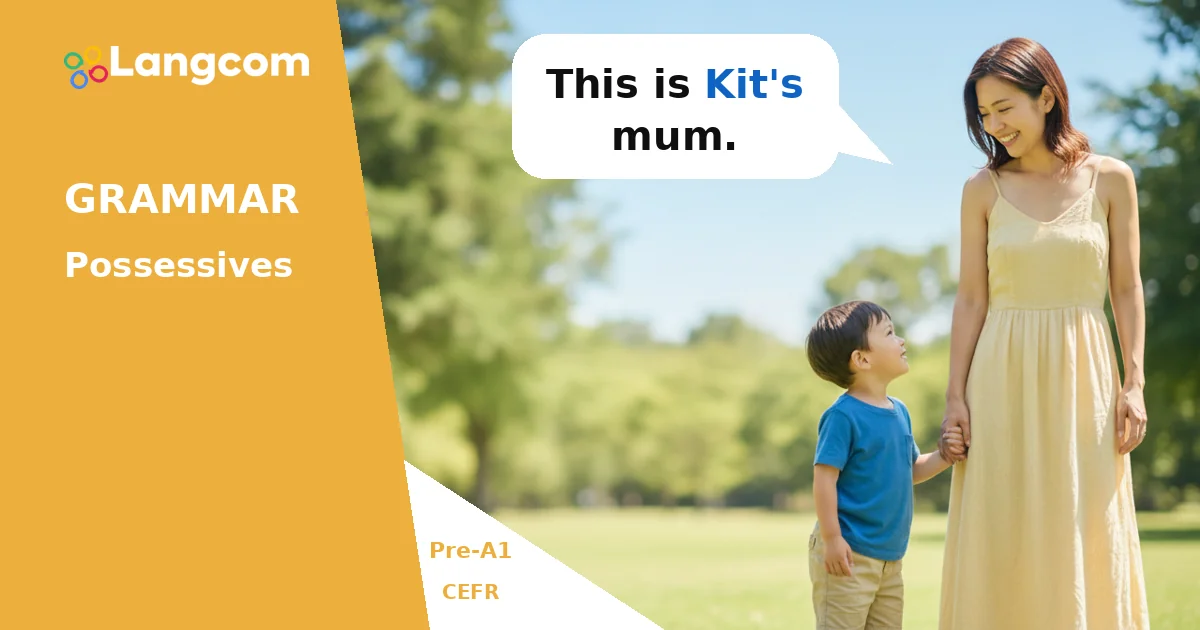
- This is Kit's mum.
- Fiz is Kit's new friend.
- The zapper isn't Bandit's toy.
- This is the dog's ball.
- That is my sister's bike.
- Where is the cat's bowl?
Práctica
💬 ¿Necesitas asesoramiento personalizado?
Como centro autorizado de preparación para los exámenes de Cambridge, podemos orientarte para que elijas el curso y la certificación más adecuados. Habla hoy mismo con nuestros asesores.
Chatea con un asesor por WhatsAppErrores habituales de los hispanohablantes
Los hispanohablantes a veces utilizan una estructura como "el amigo de Kit" (el amigo de Kit).
- En inglés, tanto para las personas como para los animales, resulta mucho más natural y habitual utilizar 's.
- Incorrecto: Fiz is the friend of Kit.
- Correcto: Fiz is Kit's friend.
Intenta siempre utilizar 's cuando se habla de posesión o de relaciones con personas o animales en singular.
Preguntas más frecuentes
¿Qué significa 's»?
En 's significa que algo pertenece a alguien o a algo, o que existe una relación entre dos cosas. Por ejemplo, Kit's friend significa que el amigo es amigo de Kit o está emparentado con Kit.
¿Es 's» solo para personas?
No, 's se aplica principalmente a personas y animales. Por ejemplo, the boy's name o the bird's nest.
¿''s' es lo mismo que «is»?
¡No, son diferentes! 's puede ser una contracción de is (p. ej., She's happy significa She is happy). Pero cuando indica posesión, no es is. Por ejemplo, Kit's friend significa que el amigo es de Kit, no que "Kit es amigo"."
¿En qué se diferencia ''s' de «of the»?
Tanto para las personas como para los animales, 's es la forma más habitual y natural de expresar posesión o relación. Por ejemplo, decimos the girl's book, no the book of the girl. La estructura "de" se utiliza más para objetos inanimados o para frases más complejas.


0 Comentarios