

What is the Possessive ‘s for?
The possessive ‘s is a small but powerful part of English grammar. We use it to show ownership or a relationship between a person and a thing.
- It answers the question “Whose is it?”
- It tells us who something belongs to.
Think of it as a shortcut to say “the book of John” or “the car of my father.”
🎓 Aprende inglés con el método mixto
Grupos reducidos · Tutor de IA disponible las 24 horas del día, los 7 días de la semana · Preparación para los exámenes de Cambridge
Planes de $39 $79 al mes
How do we form the Possessive 's?
It is very simple to form the possessive 's with singular nouns and names.
- Take the name of the person or the singular noun.
- Add an apostrophe (') and then the letter s.
- Then, add the thing they own.
Fíjate en estos ejemplos:
Possessive 's with Names
When someone's name is singular, we add 's to the end of their name.
- This is Mary's bag. (The bag belongs to Mary.)
- That is Tom's ball. (The ball belongs to Tom.)
Even if a name ends in s, como James, we still add 's. For example: James's car.
Possessive 's with Singular Nouns
También utilizamos 's with singular nouns that are not names, like teacher o dog.
- This is the teacher's desk. (The desk belongs to the teacher.)
- That is the dog's bone. (The bone belongs to the dog.)
Remember, this rule is for singular nouns only. We will learn about plural nouns later.
| Owner | Form | Example |
|---|---|---|
| A singular person's name | Name + 's | John's book |
| A singular noun (person/animal) | Noun + 's | The girl's hat |
Ejemplos
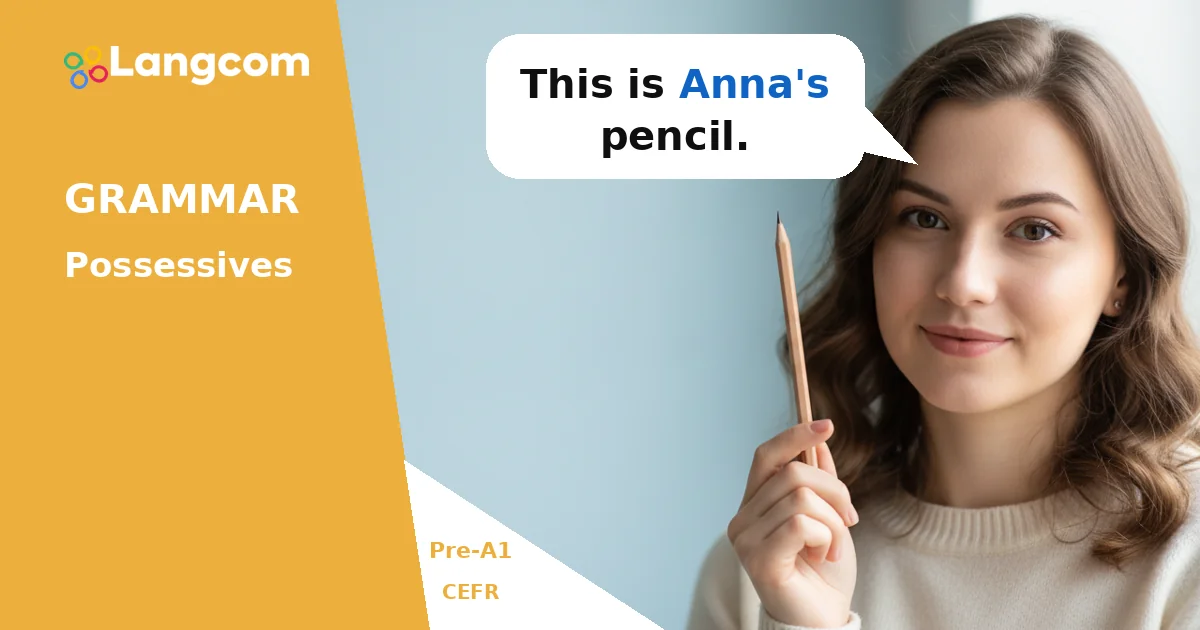
- This is Anna's pencil.
- That is my father's car.
- Where is the cat's toy?
- Is this Peter's book?
- The girl's hat is red.
Práctica
💬 ¿Necesitas asesoramiento personalizado?
Como centro autorizado de preparación para los exámenes de Cambridge, podemos orientarte para que elijas el curso y la certificación más adecuados. Habla hoy mismo con nuestros asesores.
Chatea con un asesor por WhatsAppErrores habituales de los hispanohablantes
Los hispanohablantes a veces cometen estos errores:
- Using "of" instead of 's: In Spanish, you might say "el libro de Juan." In English, we use 's.
- Wrong: The book of John.
- Right: John's book.
- Forgetting the apostrophe: The apostrophe ' is very important. Without it, Johns book looks like a plural word, not a possessive.
- Wrong: This is Marias bag.
- Right: This is Maria's bag.
- Confuso it's y its: It's means it is o it has. Its is a possessive pronoun (like his o her).
- Wrong: The dog wants it's bone.
- Right: The dog wants its bone.
- Right: It's a big dog. (It is a big dog.)
Preguntas más frecuentes
What does the possessive 's mean?
The possessive 's means that something belongs to someone. For example, Sarah's phone means "the phone of Sarah."
Can I use 's for things that are not people?
Sí, puedes usar 's for animals, like the dog's toy. Sometimes you can use it for places or time, but for Pre-A1, focus on people and animals.
Is "its" the same as "it's"?
No, they are different! It's is a short form for it is o it has. Its shows possession for things or animals, like The cat likes its food.
Why is the apostrophe important in 's?
The apostrophe ' tells you that 's means possession. Without it, the word might look like a plural (more than one) or a verb. For example, dogs means many dogs, but dog's means something belonging to one dog.

0 Comentarios