

What is the Present Perfect Positive?
The Present Perfect positive describes an action that happened at an unspecified time in the past, but it has a connection to the present. We often use it to talk about experiences or recent events.
The exact time of the action is not important. What is important is the action itself or its result now.
- I have seen that movie. (The experience of seeing the movie is important, not when I saw it.)
- They have lived here for five years. (They started living here five years ago and still live here.)
🎓 Aprenda inglês com o método misto
Grupos pequenos · Tutor de IA 24 horas por dia, 7 dias por semana · Preparação para os exames de Cambridge
Planos de $39 $79 por mês
How Do We Form the Present Perfect Positive?
To make the Present Perfect positive, we use the auxiliary verb have ou has, followed by the past participle of the main verb.
- For I, you, we, they, use have.
- For he, she, it, use has.
The structure is: Subject + have/has + Past Participle.
Contractions are very common in spoken and informal English:
- I have → I’ve
- You have → You’ve
- He has → He’s
- She has → She’s
- It has → It’s
- We have → We’ve
- They have → They’ve
When Do We Use the Present Perfect Positive?
We use this tense in a few main situations:
- Experiences: To talk about things you have done in your life, without saying exactly when.
- She has traveled to many countries.
- I have never eaten sushi.
- Actions with a result in the present: When an action in the past has an important effect now.
- He has lost his keys. (He doesn’t have them now.)
- We have finished the project. (The project is complete now.)
- Actions that started in the past and continue now: Often with for (duration) or since (starting point).
- They have studied English for three years. (They started three years ago and still study.)
- She has worked here since 2020. (She started in 2020 and still works here.)
| Base Form | Past Simple | Past Participle |
|---|---|---|
| work | worked | worked |
| live | lived | lived |
| visit | visited | visited |
| see | saw | seen |
| eat | ate | eaten |
| go | went | gone |
| write | wrote | written |
| lose | lost | lost |
| do | did | done |
Exemplos
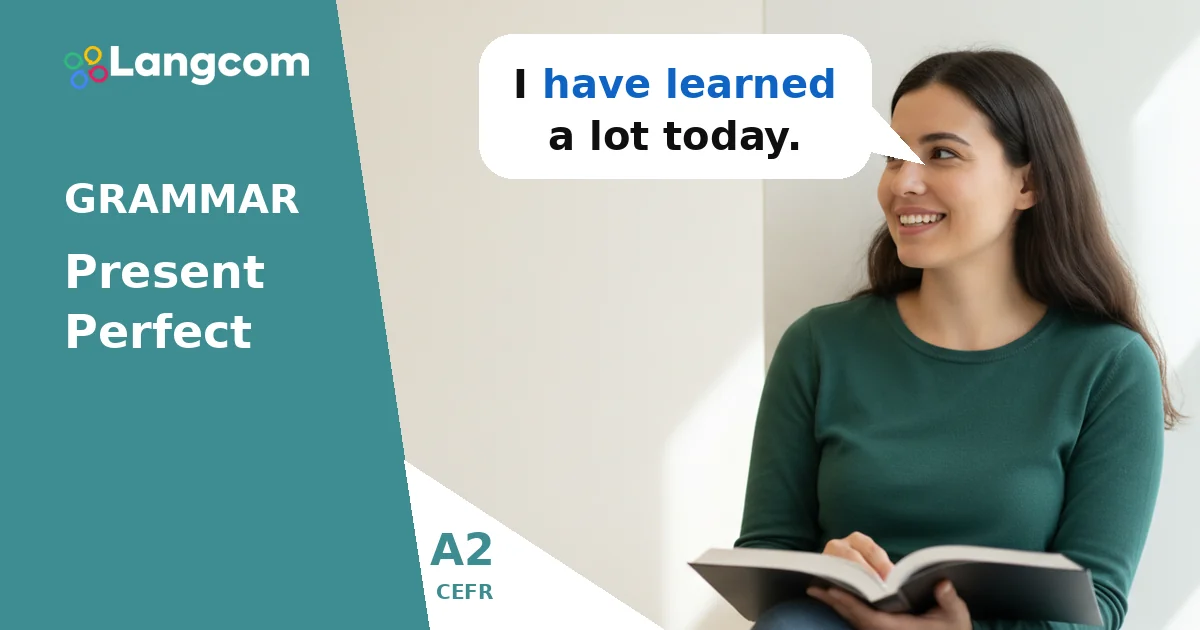
- I have learned a lot today.
- You have grown so much!
- He has visited Paris twice.
- She has written a new book.
- It has rained all week.
- We have bought a new car.
- They have seen that play before.
Prática
💬 Precisa de orientação personalizada?
Como Centro Autorizado de Preparação para os Exames de Cambridge, podemos orientá-lo na escolha do curso e da certificação mais adequados. Entre em contato com nossos orientadores hoje mesmo.
Converse com um consultor pelo WhatsAppErros comuns entre falantes de espanhol
Many Spanish speakers sometimes use the Simple Past instead of the Present Perfect when no specific time is mentioned. Remember, if you don’t say “when,” the Present Perfect is usually correct for experiences or results connected to the present.
- Incorreto: I went to London. (If you mean “at some point in your life” and not a specific trip last year.)
- Correto: I have been to London.
- Incorreto: She lost her keys. (If you mean “she doesn’t have them now” and not “she lost them yesterday.”)
- Correto: She has lost her keys.
Also, don’t forget the auxiliary verb have ou has. It’s essential!
- Incorreto: I eaten breakfast.
- Correto: I have eaten breakfast.
Perguntas frequentes
What is a “past participle”?
The past participle is the third form of a verb. For regular verbs, it’s the same as the past simple (e.g., work → worked → worked). For irregular verbs, it’s often different (e.g., go → went → gone, see → saw → seen).
Can I use “yesterday” with the Present Perfect?
No, you cannot use specific past time expressions like yesterday, last week, in 2010 with the Present Perfect. These expressions require the Simple Past.
How does the Present Perfect help my English communication?
It helps you talk about your life experiences, recent news, and actions that have a current impact. This makes your conversations more natural and allows you to express a wider range of ideas.

0 Comentários