

What Are High Numbers in English?
High numbers are numbers bigger than 100. They help us talk about large amounts of things.
For example, we use them for:
- Money: £500 (five hundred pounds)
- People: 1,000 people (one thousand people)
- Distances: 1,000,000 miles (one million miles)
🎓 Aprenda inglês com o método misto
Grupos pequenos · Tutor de IA 24 horas por dia, 7 dias por semana · Preparação para os exames de Cambridge
Planos de $39 $79 por mês
How Do We Say Numbers in the Hundreds?
To say numbers from 101 para 999, we use the word hundred.
- Start with the number of hundreds.
- Then add hundred.
- Depois de hundred, we often use and before the last two digits (especially in British English).
Exemplos:
- 100: one hundred
- 250: two hundred and fifty
- 705: seven hundred and five
- 999: nine hundred and ninety-nine
How Do We Say Numbers in the Thousands?
For numbers from 1,000 para 999,999, we use the word thousand.
- Start with the number of thousands.
- Then add thousand.
- Depois de thousand, you can add hundred and other numbers, using and if needed.
Exemplos:
- 1,000: one thousand
- 5,000: five thousand
- 10,000: ten thousand
- 25,400: twenty-five thousand, four hundred
- 123,456: one hundred and twenty-three thousand, four hundred and fifty-six
How Do We Say Millions and Billions?
For even bigger numbers, we use million e billion.
- 1,000,000 é one million.
- 1,000,000,000 é one billion. (Be careful! This is different from Spanish "billón".)
Exemplo:
- 3,000,000: three million
- 5,200,000: five million, two hundred thousand
Important Rules for Big Numbers
Remember these two important rules when saying high numbers:
- Não -s for plural: When you use a number before hundred, thousand, million, ou billion, these words stay singular.
- Correct: two hundred
- Incorrect: two hundreds
- Uso and: In British English, we use and after hundred (and sometimes thousand) before the tens and units.
- Correct: one hundred and fifty
- Correct: one thousand, two hundred and thirty-four
Exemplos
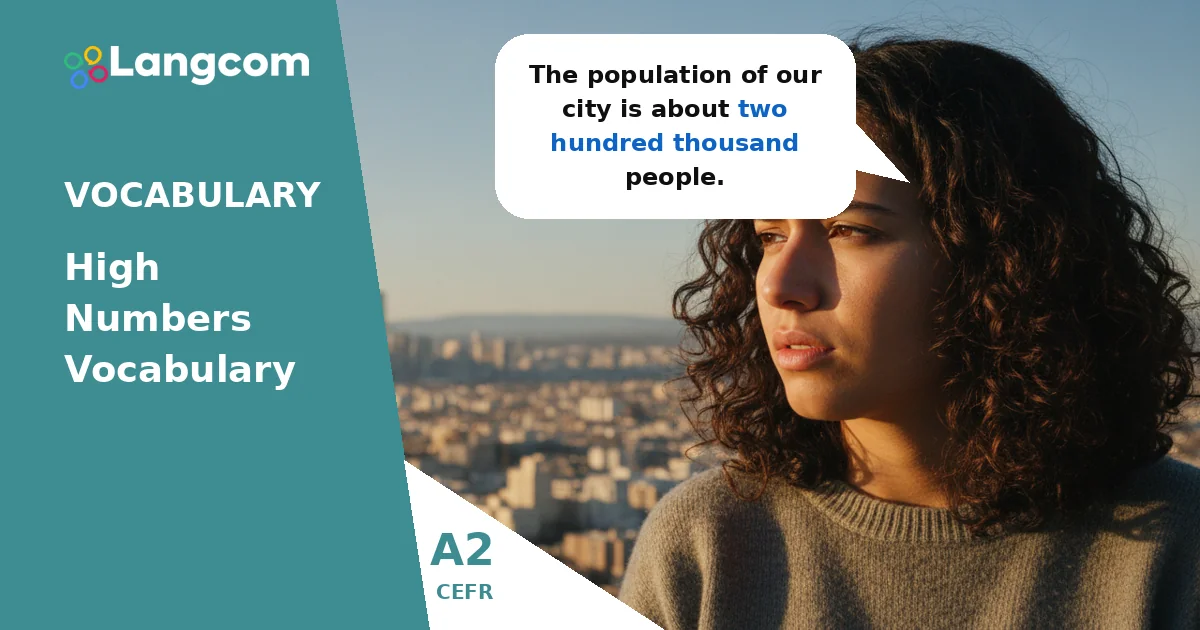
- The population of our city is about two hundred thousand people.
- I need to save five hundred and fifty euros for my trip.
- The company made one million dollars last year.
- The book has three hundred and twelve pages.
- There are one thousand, four hundred and forty minutes in a day.
Prática
💬 Precisa de orientação personalizada?
Como Centro Autorizado de Preparação para os Exames de Cambridge, podemos orientá-lo na escolha do curso e da certificação mais adequados. Entre em contato com nossos orientadores hoje mesmo.
Converse com um consultor pelo WhatsAppErros comuns entre falantes de espanhol
Spanish speakers often make a few common mistakes with high numbers in English.
- Adicionando -s: In Spanish, you might say "doscientos" (two hundreds). But in English, hundred, thousand, million, e billion do not take an -s when a number comes before them.
- Wrong: five thousands
- Right: five thousand
- A palavra billion: This is a very important difference! In Spanish, "un billón" means one trillion (1,000,000,000,000) in English. In English, one billion means one thousand million (1,000,000,000).
- Spanish: un billón = English: one trillion
- Spanish: mil millones = English: one billion
- Missing and: Sometimes learners forget to add and after hundred, especially in British English.
- Wrong: two hundred fifty
- Right: two hundred and fifty
Perguntas frequentes
What is the difference between million and billion?
One million é 1,000,000 (a one with six zeros). One billion é 1,000,000,000 (a one with nine zeros). Remember that Spanish "billón" is much larger than English billion.
Do I always use 'and' when saying numbers?
In British English, it is common and correct to use and after hundred (e.g., one hundred and twenty). In American English, and is often omitted (e.g., one hundred twenty), but it is not wrong to use it.
Is it 'two hundreds' or 'two hundred'?
It is always two hundred. The words hundred, thousand, million, e billion do not take an -s when they are preceded by a number.
How do I write large numbers in English?
We use commas (,) to separate groups of three digits from the right. For example, 1,000 (one thousand), 10,000 (ten thousand), 1,000,000 (one million).




0 Comentários