
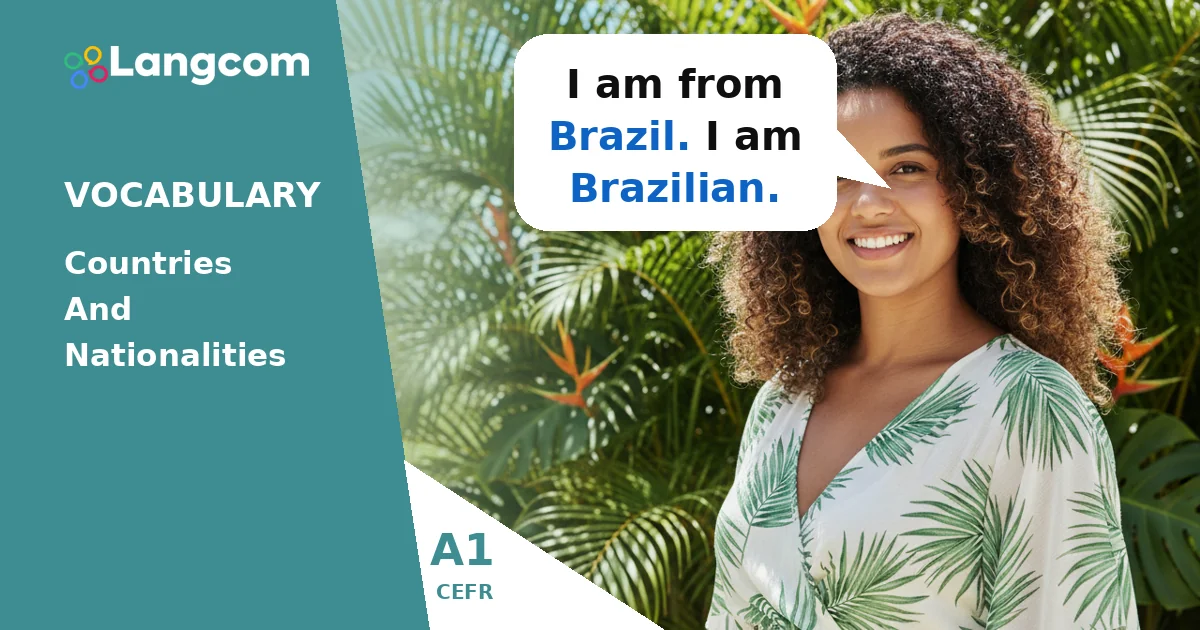

What are Countries and Nationalities?
A country is a place, like Mexico oppure Japan. It is a nation with its own government.
A nationality describes a person from that country. For example, someone from Mexico è Mexican. Someone from Japan è Japanese.
- We always write countries and nationalities with a capital letter.
- Mexico (country) → Mexican (nationality)
- Japan (country) → Japanese (nationality)
🎓 Impara l'inglese con il metodo misto
Piccoli gruppi · Tutor IA disponibile 24 ore su 24, 7 giorni su 7 · Preparazione agli esami di Cambridge
Piani da $39 $79 al mese
How Do We Use Them in Sentences?
You can use countries and nationalities to say where you or other people are from. There are two common ways to do this.
- To talk about your country:
I am from [Country].
Esempio: I am from Colombia. - To talk about your nationality:
I am [Nationality].
Esempio: I am Colombian.
You can also use these phrases for other people:
- She is from the United States.
- He is American.
- They are from China.
- They are Chinese.
Important Rules for Countries and Nationalities
Remember these simple rules for using countries and nationalities correctly:
- Always Capitalize: The first letter of every country and nationality word is always big (capital).
Errato: i am spanish.
Corretto: I am Spanish. - Nationality as an Adjective: Nationalities often work like adjectives. They describe people.
Esempio: He is a Spanish student. (Spanish describes the student.)
| Country | Nationality |
|---|---|
| Spain | Spanish |
| Mexico | Mexican |
| United States | American |
| Colombia | Colombian |
| China | Chinese |
| France | French |
| Germany | German |
| Italy | Italian |
| Japan | Japanese |
| Brazil | Brazilian |
Esempi
- I am from Brazil. I am Brazilian.
- She is from France. She is French.
- He is from Germany. He is German.
- They are from Italy. They are Italian.
- Are you from the UK? Are you British?
Esercitazione
💬 Hai bisogno di una consulenza personalizzata?
In qualità di Centro autorizzato di preparazione agli esami Cambridge, possiamo aiutarti a scegliere il corso e la certificazione più adatti alle tue esigenze. Contatta oggi stesso i nostri consulenti.
Chatta con un consulente su WhatsAppErrori comuni per chi parla spagnolo
Chi parla spagnolo a volte commette questi errori:
- Not capitalizing: In Spanish, nationalities are not always capitalized. In English, they always are.
Errato: i am mexican.
Corretto: I am Mexican. - Using the country name instead of the nationality:
Errato: I am Spain.
Corretto: I am Spanish.
Ricordate, Spain is the country, Spanish is the nationality. - Using 'of' incorrectly:
Errato: I am a person of Spain.
Corretto: I am from Spain. oppure I am Spanish.
Domande frequenti
Do I always capitalize countries and nationalities?
Yes, always. In English, both countries (like Canada) and nationalities (like Canadian) always start with a capital letter.
What is the difference between 'I am from...' and 'I am...'?
Si utilizza 'I am from...' with a country name, for example, 'I am from Argentina.' Si utilizza 'I am...' with a nationality, for example, 'I am Argentinian.' Both mean the same thing.
Can I use a nationality to describe a thing?
Yes, you can! Nationalities can describe things too. For example, 'Spanish food' oppure 'Japanese cars.'



0 Commenti