
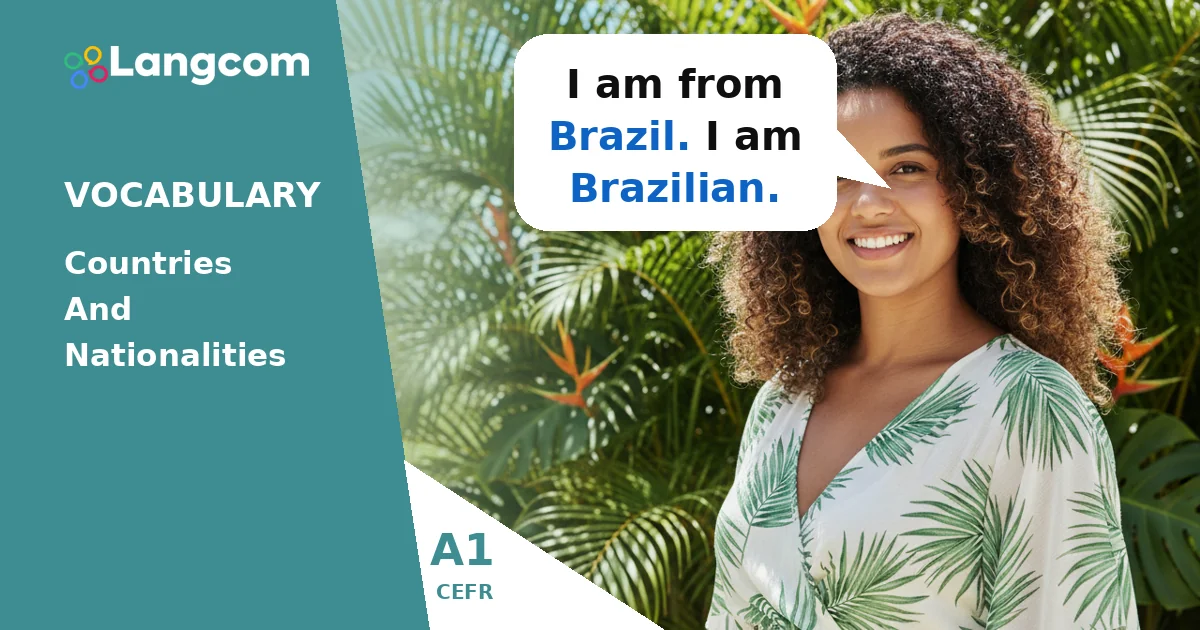

What are Countries and Nationalities?
A country is a place, like Mexico oder Japan. It is a nation with its own government.
A nationality describes a person from that country. For example, someone from Mexico ist Mexican. Someone from Japan ist Japanese.
- We always write countries and nationalities with a capital letter.
- Mexico (country) → Mexican (nationality)
- Japan (country) → Japanese (nationality)
🎓 Englisch lernen mit der Blended-Methode
Kleingruppen · KI-Tutor rund um die Uhr · Vorbereitung auf die Cambridge-Prüfungen
Pläne von $39 $79 pro Monat
How Do We Use Them in Sentences?
You can use countries and nationalities to say where you or other people are from. There are two common ways to do this.
- To talk about your country:
I am from [Country].
Beispiel: I am from Colombia. - To talk about your nationality:
I am [Nationality].
Beispiel: I am Colombian.
You can also use these phrases for other people:
- She is from the United States.
- He is American.
- They are from China.
- They are Chinese.
Important Rules for Countries and Nationalities
Remember these simple rules for using countries and nationalities correctly:
- Always Capitalize: The first letter of every country and nationality word is always big (capital).
Falsch: i am spanish.
Richtig: I am Spanish. - Nationality as an Adjective: Nationalities often work like adjectives. They describe people.
Beispiel: He is a Spanish student. (Spanish describes the student.)
| Country | Nationality |
|---|---|
| Spain | Spanish |
| Mexico | Mexican |
| United States | American |
| Colombia | Colombian |
| China | Chinese |
| France | French |
| Germany | German |
| Italy | Italian |
| Japan | Japanese |
| Brazil | Brazilian |
Beispiele
- I am from Brazil. I am Brazilian.
- She is from France. She is French.
- He is from Germany. He is German.
- They are from Italy. They are Italian.
- Are you from the UK? Are you British?
Übung
💬 Benötigen Sie eine individuelle Beratung?
Als autorisiertes Cambridge-Vorbereitungszentrum können wir Ihnen helfen, den richtigen Kurs und die passende Zertifizierung zu finden. Chatten Sie noch heute mit unseren Beratern.
Chatten Sie mit einem Berater auf WhatsAppHäufige Fehler bei Spanischsprechern
Spanish speakers sometimes make these mistakes:
- Not capitalizing: In Spanish, nationalities are not always capitalized. In English, they always are.
Falsch: i am mexican.
Richtig: I am Mexican. - Using the country name instead of the nationality:
Falsch: I am Spain.
Richtig: I am Spanish.
Remember, Spain is the country, Spanish is the nationality. - Using 'of' incorrectly:
Falsch: I am a person of Spain.
Richtig: I am from Spain. oder I am Spanish.
Häufig gestellte Fragen
Do I always capitalize countries and nationalities?
Yes, always. In English, both countries (like Canada) and nationalities (like Canadian) always start with a capital letter.
What is the difference between 'I am from...' and 'I am...'?
Du verwendest 'I am from...' with a country name, for example, 'I am from Argentina.' Du verwendest 'I am...' with a nationality, for example, 'I am Argentinian.' Both mean the same thing.
Can I use a nationality to describe a thing?
Yes, you can! Nationalities can describe things too. For example, 'Spanish food' oder 'Japanese cars.'



0 Kommentare