

What Does ‘Have to’ Mean?
Have to means that something is necessary. It shows an obligation, often because of a rule, a law, or a situation.
This obligation usually comes from outside the speaker. It’s not a personal feeling, but something required by others or circumstances.
- Par exemple, Students have to study for exams. (This is a rule from the school.)
- Another example: I have to go to work early tomorrow. (This is an obligation from your job.)
✍️ Vous ne savez pas quel est votre niveau ?
Passez notre test de niveau gratuit et recevez des commentaires personnalisés de la part d'examinateurs certifiés par Cambridge.
Passez notre test de niveau GRATUITHow Do We Form 'Have to'?
The structure of have to changes depending on the subject and whether it's positive, negative, or a question.
Positive Sentences
- For I, You, We, They, utilisez have to + base verb.
Exemple : We have to finish this report today.
- For He, She, It, utilisez has to + base verb.
Exemple : She has to wake up early for her flight.
Negative Sentences
To say something is not necessary, we use don't have to ou doesn't have to.
- For I, You, We, They, utilisez don't have to + base verb.
Exemple : You don't have to pay for this. It's free.
- For He, She, It, utilisez doesn't have to + base verb.
Exemple : He doesn't have to work on weekends.
Questions
Nous utilisons Do ou Does to ask questions with have to.
- For I, You, We, They, utilisez Do + subject + have to + base verb?
Exemple : Do we have to bring our passports?
- For He, She, It, utilisez Does + subject + have to + base verb?
Exemple : Does she have to wear a uniform?
Short Answers
Nous utilisons do/don't ou does/doesn't in short answers.
- Yes, I do. / No, I don't.
- Yes, he does. / No, he doesn't.
When Do We Use 'Have to'?
You will use have to in many everyday situations to talk about different types of necessity and obligation.
- Rules and Laws: When something is required by law or a general rule.
Exemple : You have to stop at a red light.
- Obligations from Others: When someone else (like a boss, a teacher, or parents) requires you to do something.
Exemple : My children have to clean their rooms every Saturday.
- Necessity: When an action is simply necessary because of a situation.
Exemple : I have to buy some food; the fridge is empty.
- Lack of Obligation: Utilisation don't have to ou doesn't have to when something is not necessary or optional.
Exemple : We don't have to go to the meeting if we are busy.
| Objet | Positive | Negative | Question |
|---|---|---|---|
| I / You / We / They | have to go | don't have to go | Do I have to go? |
| He / She / It | has to go | doesn't have to go | Does he have to go? |
Exemples
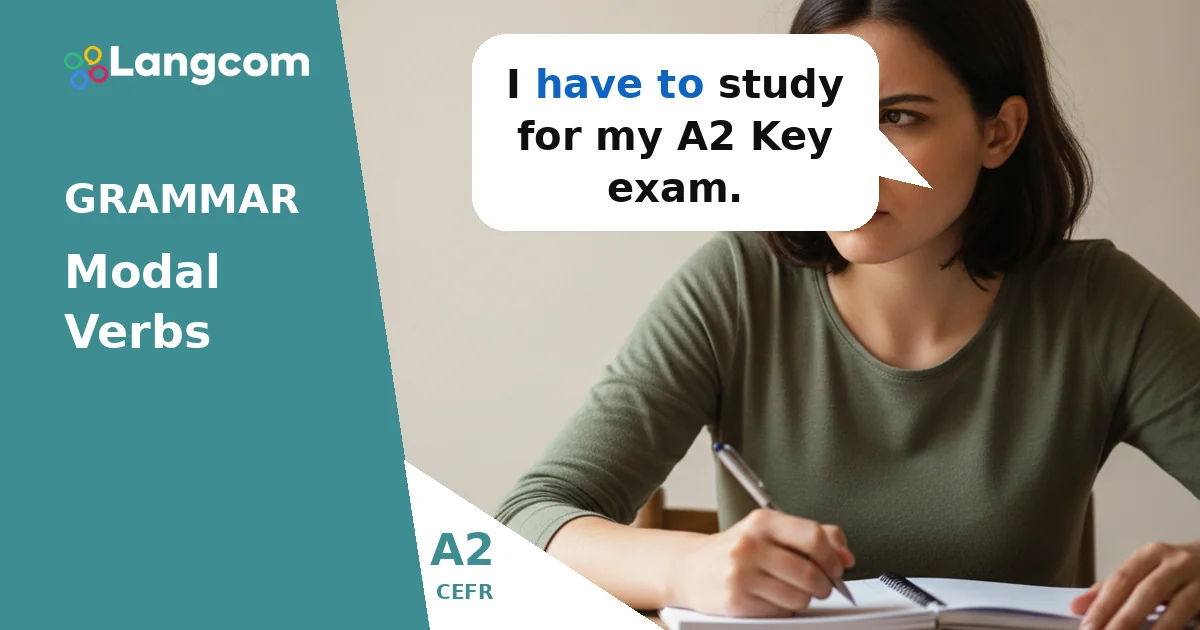
- I have to study for my A2 Key exam.
- She has to finish her homework before dinner.
- We don't have to work on public holidays.
- Does he have to wear a tie for the interview?
- They have to be at the airport by 7 AM.
- You don't have to apologize; it was not your fault.
Entraînement
Prêt à obtenir votre certificat ?
Le cours Langcom prépare les étudiants aux examens de Cambridge, IELTS, TOEFL, DELE, SIELE et Michigan.
Commencez avec LangcomErreurs courantes chez les hispanophones
Confusing 'Don't Have to' with 'Mustn't'
Many Spanish speakers confuse don't have to with mustn't. They have very different meanings:
- Don't have to means 'it is not necessary'.
- Mustn't means 'it is forbidden' or 'you are not allowed'.
Incorrect : You mustn't go to school on Saturday. (This means it is forbidden to go.)
Correct : You don't have to go to school on Saturday. (This means it is not necessary to go; it's optional.)
Incorrect Auxiliary Verbs for Questions and Negatives
Remember that have to is not a true modal verb. It uses do/does for questions and negatives.
Incorrect : Has she to work? ou She hasn't to work.
Correct : Does she have to work? ou She doesn't have to work.
Forgetting 's' for Third Person Singular
Like regular verbs, have to changes for he/she/it.
Incorrect : He have to go.
Correct : He has to go.
Questions fréquemment posées
Is 'have to' a modal verb?
Have to is often called a "semi-modal" or "modal-like expression." It expresses obligation like modal verbs (must, should), but it uses do/does for questions and negatives, and changes form for the third person singular (has to). True modal verbs do not do this.
What is the difference between 'have to' and 'must'?
For A2 learners, remember that have to usually expresses an obligation that comes from outside (a rule, a law, another person's authority). For example, I have to wear a helmet when I ride my bike (it's the law). Must often expresses a strong personal obligation or a rule that the speaker feels is important. For example, I must call my mother tonight (I feel it's important).
How do I use 'have to' in the A2 Key exam?
In the A2 Key (KET) exam, you might see have to in Reading and Writing tasks. For example, you might need to complete sentences, choose the correct option in multiple-choice questions, or understand conversations where people talk about rules, duties, or things they need to do. Pay attention to the correct form (have to, has to, don't have to, doesn't have to) and the context.
Can I use 'had to' for the past?
Yes! To talk about past obligations or necessities, we use had to. For example, Yesterday, I had to work late. The negative is didn't have to, and the question is Did you have to...?



0 commentaire