

What Are Comparative Adverbs?
Comparative adverbs are words that describe how an action is performed. They help us compare two actions.
- They tell us if someone does something faster, more carefully, ou less often than someone else.
- They always modify verbs, not nouns.
✍️ Vous ne savez pas quel est votre niveau ?
Passez notre test de niveau gratuit et recevez des commentaires personnalisés de la part d'examinateurs certifiés par Cambridge.
Passez notre test de niveau GRATUITHow Do We Form Comparative Adverbs?
The way we form comparative adverbs depends on the adverb's length.
- Short Adverbs (usually one syllable): Add -er to the end.
- Par exemple : fast → faster, hard → harder, late → later.
- Long Adverbs (usually two or more syllables, often ending in -ly): Utilisation more ou less before the adverb.
- Par exemple : carefully → more carefully, slowly → less slowly, easily → more easily.
- Irregular Adverbs: Some adverbs have special comparative forms.
- Par exemple : well → better, badly → worse, far → farther / further.
Using 'Than' with Comparative Adverbs
When we compare two actions directly, we often use the word than after the comparative adverb.
- This word helps to clearly show what two things or people are being compared.
- Par exemple, She runs faster than her brother.
| Adverb Type | Comparative Form | Exemple |
|---|---|---|
| Short Adverbs (1 syllable) | adverb + -er | fast → faster |
| Long Adverbs (-ly ending) | more / less + adverb | carefully → more carefully |
| Irregular Adverbs | Special forms | well → better |
Exemples
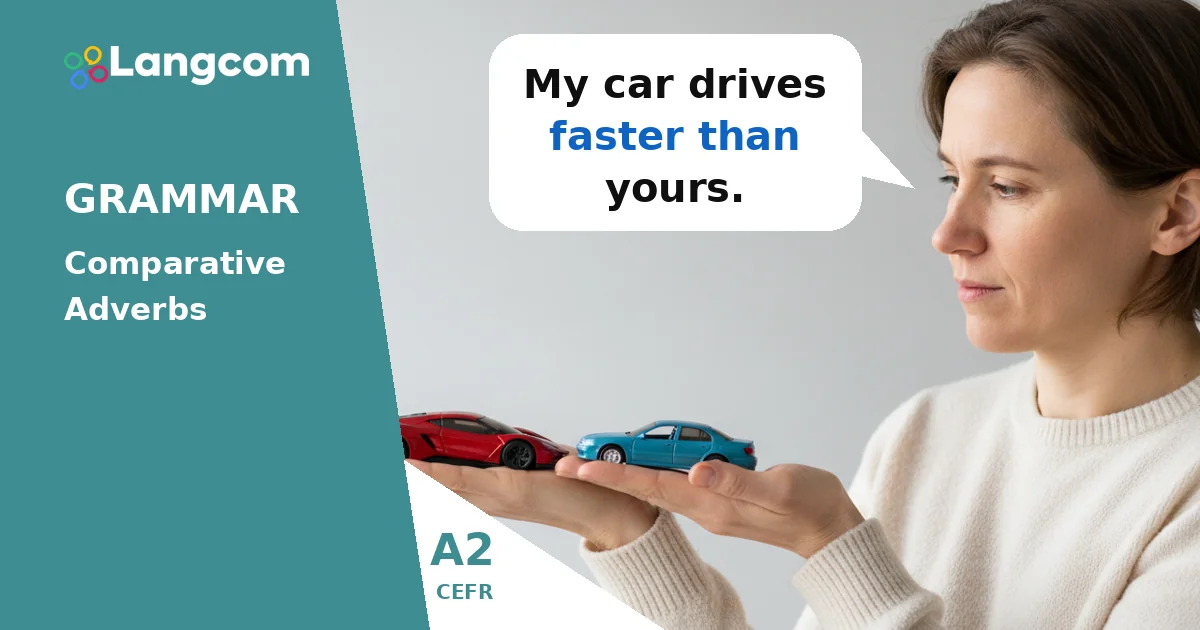
- My car drives faster than yours.
- He speaks English more fluently now.
- She arrived later than everyone else.
- You should work harder if you want to pass the exam.
- The new student writes more neatly than the old one.
- I sleep better after exercising.
- They performed worse in the second half of the game.
Entraînement
Prêt à obtenir votre certificat ?
Le cours Langcom prépare les étudiants aux examens de Cambridge, IELTS, TOEFL, DELE, SIELE et Michigan.
Commencez avec LangcomErreurs courantes chez les hispanophones
Spanish speakers sometimes make common mistakes with comparative adverbs:
- Confusing Adjectives and Adverbs: Remember, adverbs describe verbs (actions), while adjectives describe nouns (things/people).
- Incorrect : He drives more careful. (Careful is an adjective)
- Correct : He drives more carefully. (Carefully is an adverb)
- Using 'More' with Short Adverbs: Do not use more with short adverbs that take -er.
- Incorrect : She runs more fast.
- Correct : She runs faster.
- Direct Translation of 'Más': Avoid directly translating 'más' before an adverb if it's a short adverb.
- Incorrect : He works more hard.
- Correct : He works harder.
Questions fréquemment posées
What is the main purpose of a comparative adverb?
The main purpose of a comparative adverb is to compare two actions, showing how one action is done differently or to a greater or lesser degree than another. For example, He learns faster than she does.
How do I form comparative adverbs for words ending in -ly?
For adverbs ending in -ly, you form the comparative by placing more ou less before the adverb. For example, quickly becomes more quickly, et loudly becomes less loudly.
Are there any irregular comparative adverbs?
Yes, there are a few irregular comparative adverbs. The most common ones are well which becomes better, badly which becomes worse, et far which can become farther ou further.
Can I use 'more' with short adverbs like 'fast'?
No, you should not use more with short adverbs like fast. For these adverbs, you simply add -er to the end. So, fast becomes faster, et non more fast.
How are comparative adverbs used in the A2 Key exam?
In the A2 Key (KET) exam, you might encounter comparative adverbs in Reading and Writing tasks, such as sentence transformation exercises where you need to rewrite a sentence using a comparative adverb to maintain the original meaning, or in gap-fill activities.


0 commentaire