

What are comparative adjectives?
Comparative adjectives are special words that help us compare two things. They show how one thing is different from another in terms of a specific quality.
For example, if you have two books, you can say This book is bigger than that book.
✍️ Vous ne savez pas quel est votre niveau ?
Passez notre test de niveau gratuit et recevez des commentaires personnalisés de la part d'examinateurs certifiés par Cambridge.
Passez notre test de niveau GRATUITHow do we form comparative adjectives?
The way we form a comparative adjective depends on the number of syllables in the original adjective:
- Short adjectives (one syllable): Add -er to the end. If the adjective ends in a consonant-vowel-consonant (CVC) pattern, double the last consonant before adding -er.
- old → older
- fast → faster
- big → bigger (CVC: b-i-g)
- hot → hotter (CVC: h-o-t)
- Adjectives ending in -y (usually two syllables): Change the -y à -i and then add -er.
- happy → happier
- easy → easier
- Long adjectives (two or more syllables, not ending in -y): Put the word more before the adjective.
- beautiful → more beautiful
- interesting → more interesting
- expensive → more expensive
What about irregular comparative adjectives?
Some common adjectives have special, irregular comparative forms. You need to learn these by heart:
- good → better
- bad → worse
- far → farther / further
- little (amount) → less
- much/many → more
When do we use 'than'?
Nous utilisons than after a comparative adjective to introduce the second item in the comparison. It helps to clearly show what two things you are comparing.
- My new phone is faster than my old one.
- This movie is more exciting than that TV show.
Sometimes, if it is very clear from the situation, you can leave out than and the second item. For example, if someone asks, "Do you like this coffee or that coffee?" you can just say, This one is better.
| Adjectif | Comparative Form |
|---|---|
| short | shorter |
| big | bigger |
| happy | happier |
| expensive | more expensive |
| good | better |
| bad | worse |
Exemples
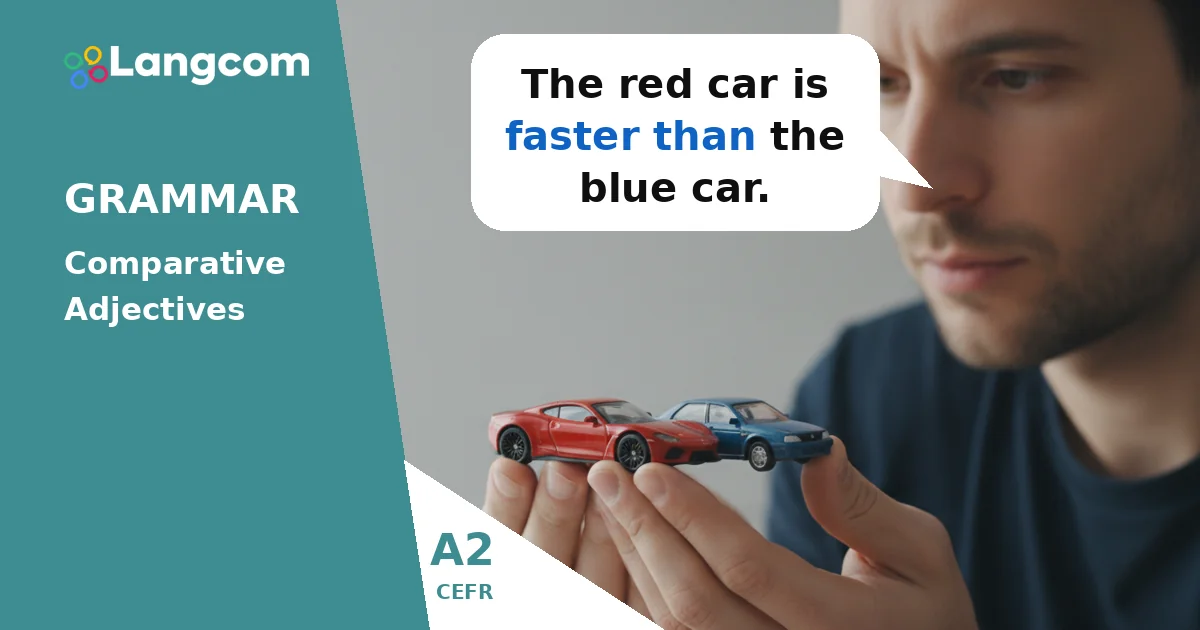
- The red car is faster than the blue car.
- My new phone is more expensive than my old one.
- She is happier now than she was last year.
- This exercise is easier than the last one.
- Today's weather is better than yesterday's.
- The city is more crowded than the countryside.
Entraînement
Prêt à obtenir votre certificat ?
Le cours Langcom prépare les étudiants aux examens de Cambridge, IELTS, TOEFL, DELE, SIELE et Michigan.
Commencez avec LangcomErreurs courantes chez les hispanophones
Erreurs courantes chez les hispanophones
- Using more with short adjectives: In Spanish, you often use "más" for all comparisons. In English, remember to add -er for short adjectives.
Incorrect : This house is more big.
Correct : This house is bigger. - Forgetting than: Spanish uses "que" directly after the adjective. English needs than.
Incorrect : He is taller me.
Correct : He is taller than me. - Direct translation of "más...que": Do not combine more with -er.
Incorrect : This car is more faster than that one.
Correct : This car is faster than that one.
Questions fréquemment posées
Can I use "less" with comparative adjectives?
Yes, you can use less for the opposite meaning of more. For example, This book is less interesting than that one. You can use less with all adjectives, both short and long.
Do I always need to use "than" after a comparative adjective?
Not always. You use than when you explicitly mention the second item you are comparing. If the second item is clear from context, you can omit than. For example, if someone asks, "Which shirt do you prefer?" you can simply say, The blue one is nicer.
How are comparative adjectives important for the A2 Key exam?
Comparative adjectives are very useful in the A2 Key exam, especially in the Speaking Part 1 or 2, where you might need to describe people, places, or things and compare them. For example, you might say My town is smaller than the capital city. ou This activity is more fun. They also appear in Reading and Writing tasks, helping you understand and create descriptions of differences.


0 commentaire