
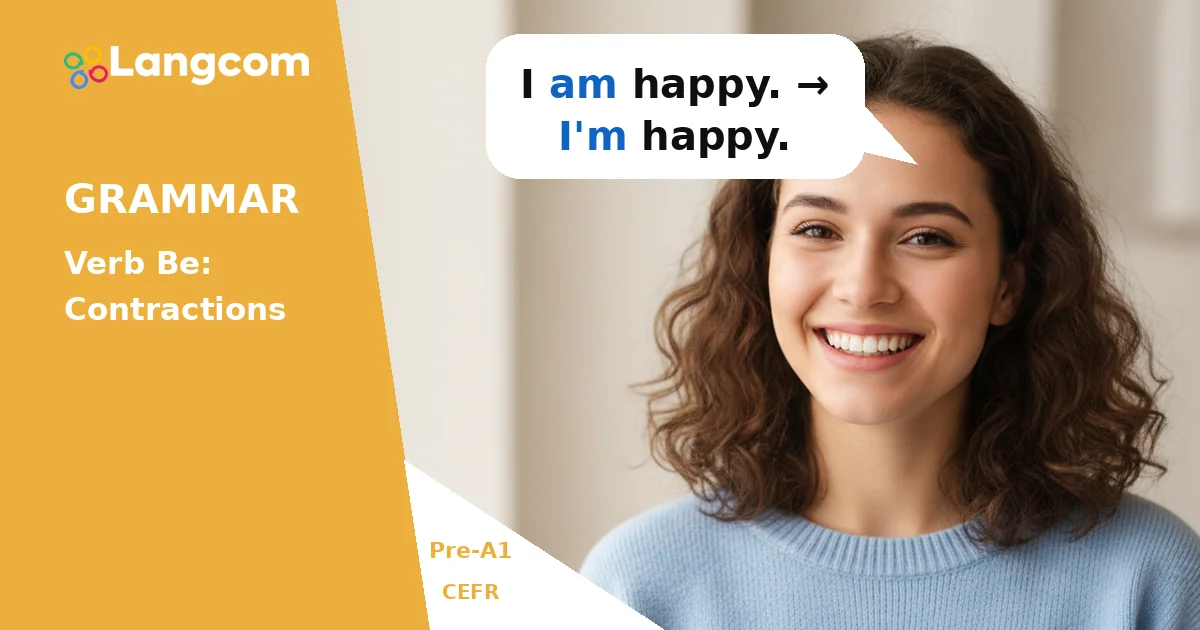

What Are ‘To Be’ Contractions?
Contractions are short ways to say or write two words together. For the verb to be, we combine the subject pronoun with the verb. This makes one shorter word.
We use a special mark called an apostrophe (‘). The apostrophe replaces the missing letters.
- Instead of I am, we say I’m.
- Instead of you are, we say you’re.
- Instead of he is, we say he’s.
🎓 Apprenez l'anglais grâce à la méthode mixte
Petits groupes · Tuteur IA disponible 24 h/24, 7 j/7 · Préparation aux examens de Cambridge
Plans provenant de $39 $79 par mois
Why Do We Use Contractions?
English speakers use contractions all the time. They are very common in daily life.
- Sound Natural: Contractions help your English sound more like a native speaker's.
- Speak Faster: They make sentences shorter and quicker to say.
- Common in Conversation: You will hear them in almost every conversation, movie, or song.
- Informal Writing: We use them often in emails, messages, and casual writing.
How Do We Form 'To Be' Contractions?
It is simple to form contractions with to be. You just combine the pronoun and the verb, and add an apostrophe.
- For I: I am becomes I'm.
- For you: You are becomes You're.
- For he, she, it:
- He is becomes He's.
- She is becomes She's.
- It is becomes It's.
- For we, they:
- We are becomes We're.
- They are becomes They're.
| Long Form | Short Form (Contraction) |
|---|---|
| I am | I'm |
| You are | You're |
| He is | He's |
| She is | She's |
| It is | It's |
| We are | We're |
| They are | They're |
Exemples
- I am happy. → I'm happy.
- You are a student. → You're a student.
- He is my brother. → He's my brother.
- She is from Spain. → She's from Spain.
- It is a big dog. → It's a big dog.
- We are friends. → We're friends.
- They are in the park. → They're in the park.
Entraînement
💬 Vous avez besoin de conseils personnalisés ?
En tant que centre de préparation agréé par Cambridge, nous pouvons vous aider à choisir la formation et la certification qui vous conviennent. Discutez-en dès aujourd'hui avec nos conseillers.
Discutez avec un conseiller sur WhatsAppErreurs courantes chez les hispanophones
A common mistake for learners is forgetting the apostrophe or writing the words separately when a contraction is expected.
- Incorrect : Im happy.
- Correct : I'm happy. (Remember the apostrophe!)
Another mistake is using the long form when the short form sounds more natural in speaking. While I am happy is grammatically correct, I'm happy is much more common in everyday conversation.
Questions fréquemment posées
What is an apostrophe?
An apostrophe (') is a punctuation mark. In contractions, it shows that one or more letters are missing. For example, in I'm, the apostrophe replaces the letter a from am.
When should I use contractions?
You should use contractions in most everyday conversations and informal writing (like texts or emails to friends). They make your English sound more natural and fluent. In very formal writing, like academic essays, it's often better to use the full forms (e.g., I am instead of I'm).
Can I always use contractions with 'to be'?
Almost always! Contractions are very common. The main exceptions are in very formal writing or when you want to emphasize the verb. For example, if someone asks, 'Are you sure?' you might say, 'Yes, I AM sure!' to stress your certainty. Otherwise, contractions are usually fine.

0 commentaire