

Why are there different verbs for sports?
In English, we often use specific verbs with certain types of sports. This is different from some other languages, where one verb might be used for many sports.
It is important to learn these combinations. Using the correct verb will make your English sound more natural and correct.
🎓 Apprenez l'anglais grâce à la méthode mixte
Petits groupes · Tuteur IA disponible 24 h/24, 7 j/7 · Préparation aux examens de Cambridge
Plans provenant de $39 $79 par mois
When do we use 'play'?
Nous utilisons le verbe play for competitive games. These are usually team sports or sports that use a ball.
- For sports with a ball: football, tennis, volleyball, golf, basketball.
- For competitive board games or card games: play chess, play cards.
When do we use 'go'?
Nous utilisons le verbe go pour les activités qui se terminent par -ing. These are often individual activities or sports that you do outdoors.
- Pour les activités se terminant par -ing: swimming, cycling, sailing, windsurfing, horse riding.
- These sports often involve movement from one place to another.
When do we use 'do'?
Nous utilisons le verbe do for individual sports, martial arts, or general exercise.
- For martial arts: do karate, do judo.
- For individual exercise or fitness activities: do yoga, do aerobics, do exercise.
- For some non-team sports that don't end in -ing: do gymnastics.
Common Sports Vocabulary
Here are some common sports words and their meanings:
- Football: A team sport played with a ball, popular worldwide.
- Tennis: A racket sport played by two or four players.
- Sailing: Traveling over water in a boat with sails.
- Swimming: Moving through water using your body.
- Cycling: Faire du vélo.
- Windsurfing: A sport combining surfing and sailing.
- Horse riding: The sport of riding a horse.
- Volleyball: A team sport where two teams hit a ball over a net.
- Golf: A game played by hitting a small ball into holes with clubs.
- Basketball: A team sport where players score by shooting a ball through a hoop.
| Verbe | Type of Sport | Exemples |
|---|---|---|
| Play | Team sports, sports with a ball, competitive games | football, tennis, volleyball, golf, basketball |
| Go | Activities ending in -ing, often individual or outdoors | swimming, cycling, sailing, windsurfing, horse riding |
| Do | Individual sports, martial arts, general exercise | yoga, karate, exercise, gymnastics |
Exemples
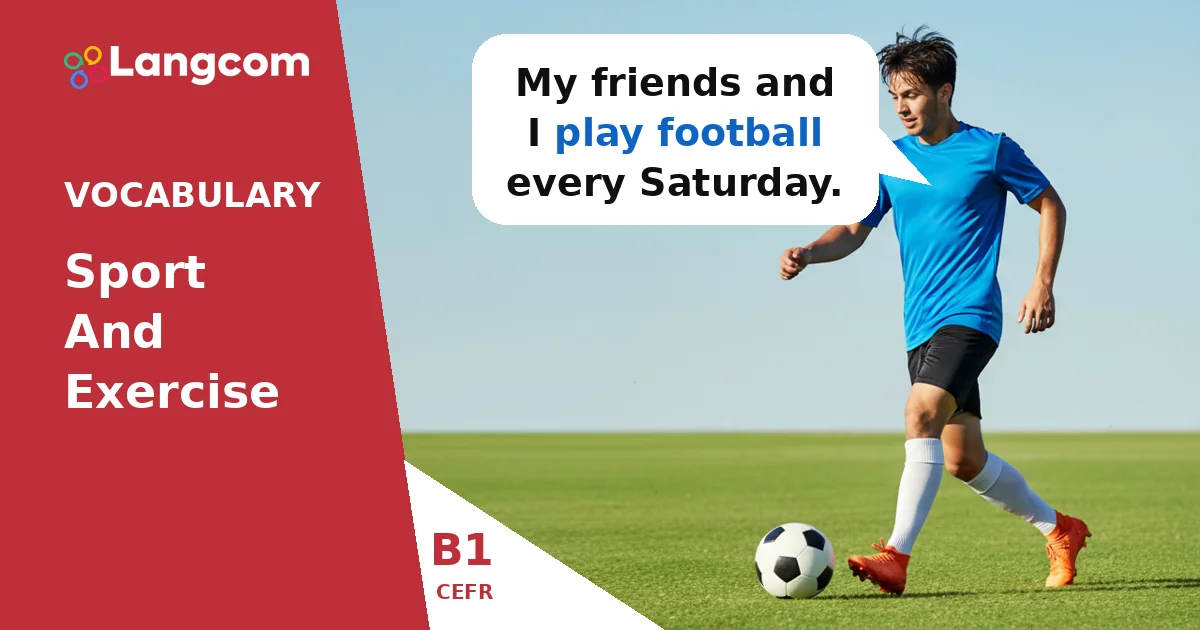
- My friends and I play football every Saturday.
- Do you want to play tennis this afternoon?
- She loves to go sailing on the lake in summer.
- We often go swimming at the local pool.
- He goes cycling in the mountains every weekend.
- They go windsurfing when the weather is good.
- My sister wants to go horse riding on her holiday.
- Our team plays volleyball very well.
- My father plays golf every Sunday morning.
- The children play basketball after school.
- I do yoga to relax and stay flexible.
- He does martial arts twice a week.
Entraînement
✍️ Vous ne savez pas quel est votre niveau ?
Passez notre test de niveau gratuit et recevez des commentaires personnalisés de la part d'examinateurs certifiés par Cambridge.
Passez notre test de niveau GRATUITErreurs courantes chez les hispanophones
Spanish speakers sometimes make mistakes because their language might use one verb for many sports. Here are common errors:
- Using do for ball sports: Incorrect : I do football. Correct : I play football.
- Using play for -ing activities: Incorrect : She plays swimming. Correct : She goes swimming.
- Using go for martial arts: Incorrect : He goes karate. Correct : He does karate.
Questions fréquemment posées
What is the main rule for 'play', 'go', and 'do' with sports?
The main rule is: play for ball/team sports, go for -ing activities, and do for individual exercise or martial arts.
Can I use 'go' with 'football'?
Non, vous ne pouvez pas utiliser go with football. Football is a team sport with a ball, so you must use play football.
What if a sport ends in -ing but is a team sport?
Most team sports use play. If an -ing sport is clearly a competitive team game (like playing bowling in a league, not just casually), play might be used, but go bowling is more common. For the B1 level, stick to go for -ing activities and play for ball/team sports.
Do I need to learn all sports vocabulary for B1?
For B1, you should know common sports and the correct verbs (play, go, do) to use with them. Focus on the most frequent ones like football, swimming, tennis, et yoga.




0 commentaire