
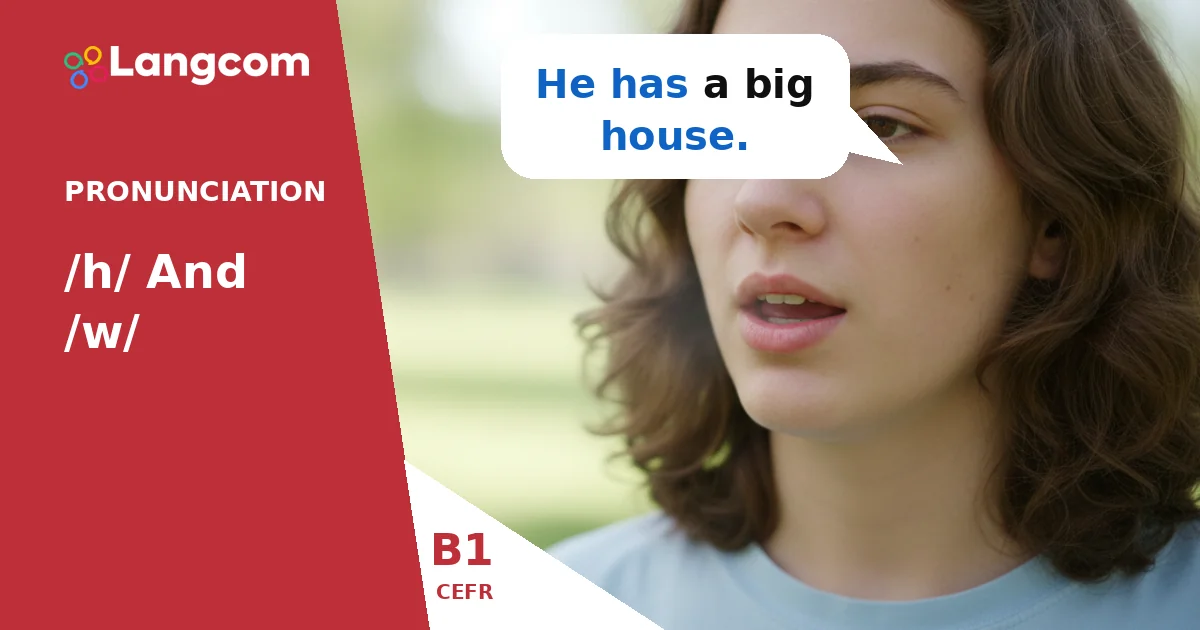

What is the English /h/ sound?
The English /h/ sound is a soft, voiceless sound. It is made by pushing air out of your mouth, almost like a sigh.
- Your mouth should be slightly open.
- Your tongue should be relaxed and low in your mouth.
- You should feel air coming from your throat, not your lips or tongue.
- It is never silent in English words, unlike in some other languages.
Think of it as a gentle puff of air. You can feel it if you put your hand in front of your mouth when you say words like hat ou hello.
🎓 Apprenez l'anglais grâce à la méthode mixte
Petits groupes · Tuteur IA disponible 24 h/24, 7 j/7 · Préparation aux examens de Cambridge
Plans provenant de $39 $79 par mois
How do you make the English /w/ sound?
The English /w/ sound is a voiced sound. It is made by rounding your lips tightly and then quickly opening them as you make a sound.
- Your lips should be rounded and pushed forward, like you are going to whistle or blow a kiss.
- Your tongue should be high and back in your mouth.
- The sound comes from your vocal cords, so you should feel a vibration in your throat.
- Les /w/ sound always comes before a vowel sound in English.
Practice making your lips very round for words like water ou where. It is similar to the 'u' sound in Spanish 'agua' but with more lip rounding at the start.
Why is it important to distinguish /h/ and /w/?
Distinguishing between /h/ et /w/ is crucial for clear communication. Mispronouncing these sounds can change the meaning of words.
- Par exemple, heel (part of your foot) is very different from wheel (part of a car).
- Another example is hair (on your head) versus wear (to put on clothes).
Correct pronunciation helps listeners understand you easily and avoids confusion in conversations.
Exemples
- He has a big house.
- We went to the park.
- What is your favorite color?
- She wears a hat.
- I hope you are well.
- The weather was warm.
- Where did you hide it?
- How was your holiday?
Entraînement
✍️ Vous ne savez pas quel est votre niveau ?
Passez notre test de niveau gratuit et recevez des commentaires personnalisés de la part d'examinateurs certifiés par Cambridge.
Passez notre test de niveau GRATUITErreurs courantes chez les hispanophones
Les hispanophones commettent souvent des erreurs spécifiques avec /h/ et /w/:
- Silent /h/: In Spanish, 'h' is usually silent (e.g., hola). In English, /h/ is always pronounced. Do not say appy for happy, ou eard for heard. Remember to always breathe out for the /h/ son.
- Confusing /w/ with /v/: The Spanish 'v' sound is made with your top teeth touching your bottom lip (labiodental). The English /w/ sound is made with both lips rounded (bilabial). Do not say very for worry, ou vine for wine. Make sure your lips are rounded and not touching your teeth for /w/.
- Confusing /w/ with /gu/: Sometimes, Spanish speakers might pronounce /w/ like the 'gu' in Spanish agua. While similar, the English /w/ requires more active lip rounding and protrusion at the beginning of the sound.
Questions fréquemment posées
Is the 'h' always pronounced in English?
Yes, the letter 'h' is almost always pronounced as the /h/ sound in English. There are very few exceptions, like in the word hour ou honest, where it is silent. But generally, you should always pronounce it.
How can I practice the /w/ sound?
To practice the /w/ sound, try making a 'kissing' face by rounding your lips tightly and pushing them forward. Then, quickly open your lips while making a voiced sound. Repeat words like water, we, where, et why, focusing on the lip movement.
Are there minimal pairs to help me distinguish /h/ and /w/?
Yes, minimal pairs are excellent for practice. Try saying these pairs aloud: heel / wheel, hair / wear, hat / what (though 'what' often has a silent 'h' in some accents, the 'w' sound is key). Focus on the different mouth positions for each sound.
Does the /h/ sound ever change in English?
Les /h/ sound itself does not change, but it can sometimes be dropped in very fast, informal speech, especially in unstressed words like him ou her. However, for clear B1 communication, it's best to always pronounce it.

0 commentaire