
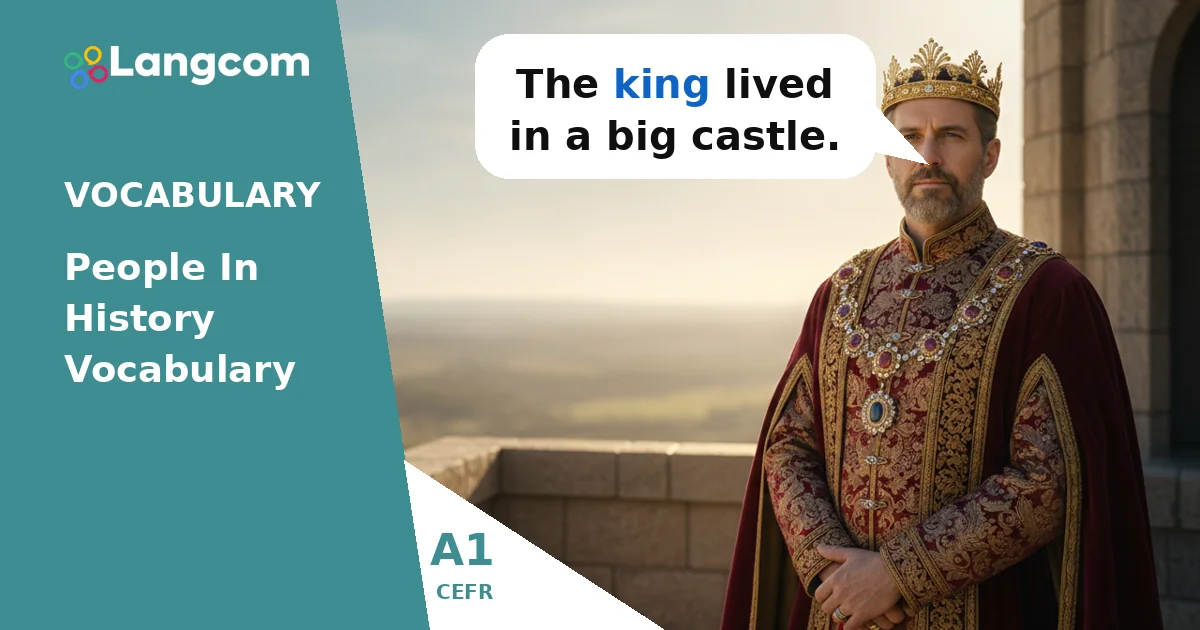

What are ‘People in History’ words?
These words help us talk about important individuals from the past. They tell us about their roles, power, or what they did.
You will learn words for leaders, fighters, and other significant people.
- King
- Queen
- Emperor
- Pharaoh
- Soldier
- Gladiator
🎓 Apprenez l'anglais grâce à la méthode mixte
Petits groupes · Tuteur IA disponible 24 h/24, 7 j/7 · Préparation aux examens de Cambridge
Plans provenant de $39 $79 par mois
Who are these important people?
Let's look at each word and its simple meaning:
- A king is a man who rules a country. For example, King Arthur was a famous king.
- A queen is a woman who rules a country. For example, Queen Elizabeth II was a queen.
- Un emperor is a ruler of an empire, which is a very big group of countries. For example, Emperor Nero ruled the Roman Empire.
- A pharaoh was a king or queen in ancient Egypt. For example, Pharaoh Tutankhamun was famous.
- A soldier is a person who works in the army and fights in wars. Many soldiers fought in history.
- A gladiator was a fighter in ancient Rome who fought for entertainment. Gladiators were strong.
Why is this vocabulary important for A1 learners?
At A1 level, you are learning basic words to describe the world around you and simple concepts. People in history vocabulary helps you:
- Understand simple stories and texts about the past.
- Talk about famous people from different cultures.
- Build a stronger foundation for more advanced English.
These words are common and useful in many contexts, from books to movies.
| Mot anglais | Simple Meaning |
|---|---|
| King | A man who rules a country. |
| Queen | A woman who rules a country. |
| Emperor | A ruler of a very large group of countries (an empire). |
| Pharaoh | A king or queen in ancient Egypt. |
| Soldier | A person who fights in an army. |
| Gladiator | A fighter in ancient Rome for entertainment. |
Exemples
- The king lived in a big castle.
- She was a powerful queen.
- The Roman emperor had much power.
- Ancient Egypt had many pharaohs.
- A brave soldier protected the city.
- The gladiator fought in the arena.
Entraînement
💬 Vous avez besoin de conseils personnalisés ?
En tant que centre de préparation agréé par Cambridge, nous pouvons vous aider à choisir la formation et la certification qui vous conviennent. Discutez-en dès aujourd'hui avec nos conseillers.
Discutez avec un conseiller sur WhatsAppErreurs courantes chez les hispanophones
Erreurs courantes chez les hispanophones
Spanish speakers sometimes confuse similar words or use direct translations that don't fit.
- King contre. Emperor: In Spanish, "rey" and "emperador" are distinct. Remember that an emperor (emperador) rules a larger area (an empire) than a king (rey) who rules a country. For example, Julius Caesar was an emperor, not a king.
- Pharaoh for any ancient ruler: While a pharaoh (faraón) was a ruler, this word is specific to ancient Egypt. Do not use pharaoh for a king from another ancient culture. For example, King David was a king, not a pharaoh.
Questions fréquemment posées
How can I remember these new words?
You can remember new words by making flashcards with the English word on one side and a simple picture or definition on the other. Try to use them in simple sentences, like The queen wore a crown.
Are these words used today?
Yes, some of these words are still used today, like king, queen, et soldier. Others, like pharaoh et gladiator, are used when talking about ancient history.
Will I see these words on an A1 English exam?
Yes, basic vocabulary like king, queen, et soldier can appear in A1 reading or listening tasks. You might need to identify them in a short text or understand a simple description.




0 commentaire