

What Are Hobbies and Free Time Activities?
Hobbies are things you enjoy doing regularly when you are not working or studying. They help you relax and learn new skills.
Free time activities are similar, but they can be less regular. For example, watching a movie is a free time activity, but it might not be a hobby unless you do it very often and have a special interest in films.
✍️ Vous ne savez pas quel est votre niveau ?
Passez notre test de niveau gratuit et recevez des commentaires personnalisés de la part d'examinateurs certifiés par Cambridge.
Passez notre test de niveau GRATUITCommon Hobbies and Their Verbs
Here are some popular hobbies and the verbs we use with them:
- Chess: You play chess.
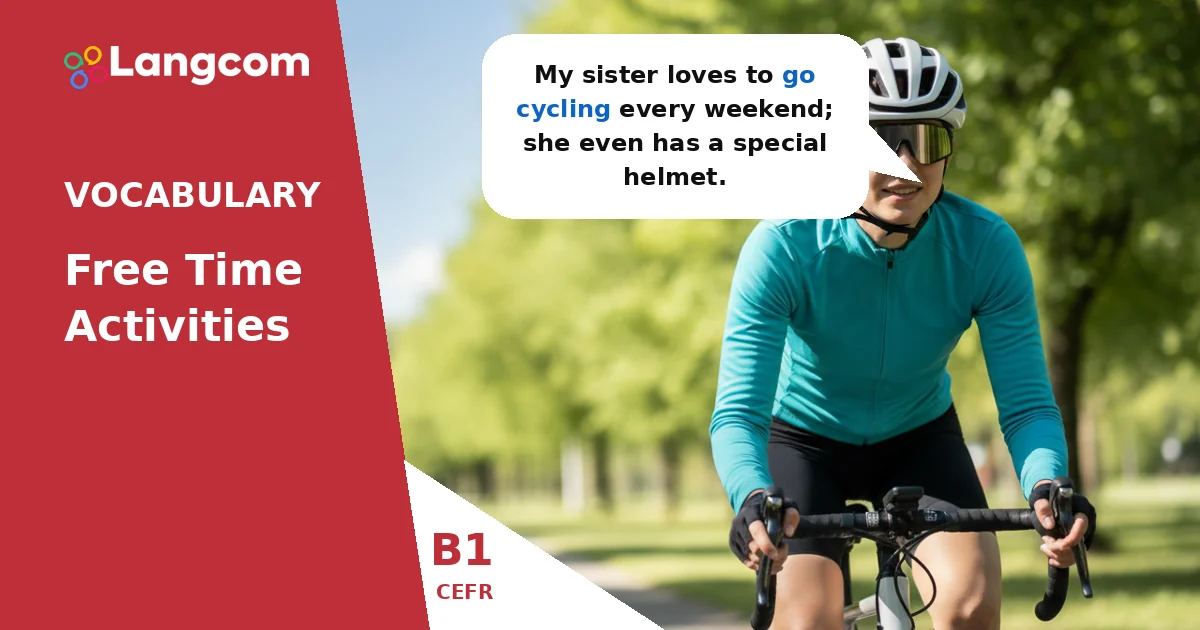
- Cycling: You go cycling ou ride a bike.
- Painting: You paint a picture ou do some painting.
- Cooking: You cook a meal ou do some cooking.
- Music: You play an instrument (like a guitar) or listen to music.
- Photography: You take photos ou do photography.
- Volunteering: You do volunteer work ou volunteer.
- Camping: You go camping.
How Do We Talk About Hobbies?
Use these phrases to talk about your hobbies and ask others about theirs:
- To state your hobby: My hobby is cycling. ou I like cycling.
- To express enjoyment: I love cooking., I enjoy painting.
- To show interest: I'm interested in photography.
- To describe how you spend time: I spend my free time playing chess.
- To ask someone: What do you do in your free time? ou Do you have any hobbies?
Vocabulary for Hobby Equipment and People
Many hobbies need special equipment or have specific names for the people who do them:
- For Chess: You need a board et pieces. A person who plays is a chess player.
- For Cycling: You need a bike and a helmet for safety. A person who cycles is a cyclist.
- For Painting: You use a brush et paint. The artist is a painter.
- For Cooking: You might use a cooker or an oven. The person is a cook.
- For Music: You might play an instrument. A person who plays music is a musician.
- For Photography: You need a camera. The person is a photographer.
- For Camping: You need a tent and a backpack. A person who camps is a camper.
| Hobby | Common Verb Phrase | Related Nouns / People |
|---|---|---|
| Chess | play chess | board, pieces, chess player |
| Cycling | go cycling | bike, helmet, cyclist |
| Painting | paint a picture | brush, paint, painter |
| Cooking | cook a meal | cooker, oven, cook |
| Music | play an instrument | instrument, musician |
| Photography | take photos | camera, photographer |
| Volunteering | do volunteer work | volunteer |
| Camping | go camping | tent, backpack, camper |
Exemples
- My sister loves to go cycling every weekend; she even has a special helmet.
- For my birthday, I received a new camera because I'm very interested in photography.
- My dad is a great cook, and his hobby is trying new recipes in the kitchen.
- We are going camping next month, so I need to buy a new tent and a backpack.
- He spends his free time playing chess with his friends online.
Entraînement
Prêt à obtenir votre certificat ?
Le cours Langcom prépare les étudiants aux examens de Cambridge, IELTS, TOEFL, DELE, SIELE et Michigan.
Commencez avec LangcomErreurs courantes chez les hispanophones
Common Mistakes with Hobbies Vocabulary
Spanish speakers sometimes make mistakes with verbs like do, play, et go:
- Using 'do' instead of 'play' or 'go': You might say I do cycling. The correct phrase is I go cycling. Similarly, for chess, it's I play chess, et non I do chess.
- Direct translation of 'my hobby is to...': In English, we usually say My hobby is painting (using the -ing form) or I like to paint, et non My hobby is to paint.
- Forgetting the -ing form: After verbs like enjoy, like, love, we use the -ing form for activities: I enjoy cooking, et non I enjoy cook.
Questions fréquemment posées
What is the difference between a hobby and a sport?
A hobby is any activity done for pleasure in free time. A sport is a type of hobby that involves physical activity and often competition, like cycling ou football. Not all hobbies are sports, but all sports can be hobbies.
How can I ask someone about their hobbies in English?
Vous pouvez demander :, What do you like to do in your free time? ou Do you have any hobbies? You can also say, What are your interests?
Why is it important to learn hobby vocabulary for the B1 Preliminary exam?
In the B1 Preliminary (PET) exam, you might need to talk about your personal life, including your hobbies et free time activities, in the Speaking Part 1. Knowing this vocabulary helps you answer questions confidently and naturally.
Can I use 'do' with any hobby?
Non, do is typically used with non-team sports or individual activities like do yoga, do gymnastics, ou do volunteer work. For hobbies like chess ou music, on utilise play. For activities that involve movement and often end in -ing, like cycling ou camping, on utilise go.

0 commentaire