

Qu'est-ce que l'accent tonique ?
Sentence stress is about which words we make stronger in a sentence. Think of it like music: some notes are louder, some are softer. English has a rhythm like this.
- Some words are stressed (strong).
- Some words are unstressed (weak).
This rhythm helps people understand your English better.
🎓 Apprenez l'anglais grâce à la méthode mixte
Petits groupes · Tuteur IA disponible 24 h/24, 7 j/7 · Préparation aux examens de Cambridge
Plans provenant de $39 $79 par mois
Which Words Are Usually Stressed?
We usually stress words that carry the main meaning of the sentence. These are called 'content words'.
- Nouns: words for people, places, things (e.g., teacher, park, book).
- Main Verbs: action words (e.g., eat, run, sleep).
- Adjectives: words that describe nouns (e.g., big, happy, red).
- Adverbs: words that describe verbs, adjectives, or other adverbs (e.g., quickly, very, always).
- Question Words: (par exemple, who, what, where, when, why, how).
When you say these words, make them a little louder, longer, and with a slightly higher pitch.
Which Words Are Usually Unstressed?
We usually do not stress small grammar words. These are called 'function words'.
- Articles: a, an, the.
- Prepositions: in, on, at, to, for.
- Conjunctions: and, but, or.
- Pronouns: I, you, he, she, it, we, they.
- Auxiliary Verbs: is, are, do, does, have, has, can, will.
When you say these words, make them shorter, quieter, and sometimes use a relaxed sound like the schwa (/ə/).
How Does Sentence Stress Sound?
Imagine a bouncing ball. It hits the ground (stressed word) and then bounces quickly (unstressed words) before hitting the ground again.
- Stressed words: are stronger, longer, and higher in pitch.
- Unstressed words: are weaker, shorter, and lower in pitch.
This creates a clear rhythm. For example, in I **love** **English**., 'love' and 'English' are strong. 'I' is weak.
| Usually Stressed (Content Words) | Usually Unstressed (Function Words) |
|---|---|
| Nouns (e.g., book, teacher) | Articles (e.g., a, the) |
| Main Verbs (e.g., run, eat) | Prepositions (e.g., in, to) |
| Adjectives (e.g., happy, big) | Conjunctions (e.g., and, but) |
| Adverbs (e.g., quickly, very) | Pronouns (e.g., I, you, he) |
| Question Words (e.g., what, where) | Auxiliary Verbs (e.g., is, can, do) |
Exemples
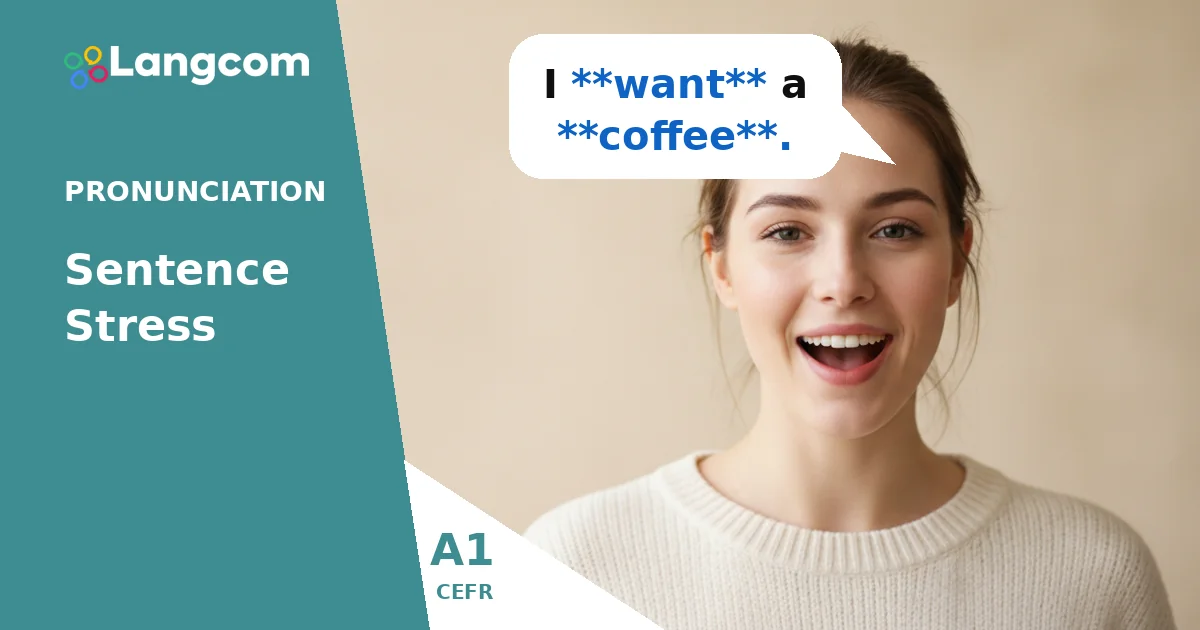
- I **want** a **coffee**.
- She **likes** **big** **dogs**.
- We **go** to **school** **every** **day**.
- **What** is **your** **name**?
- He **can** **swim** **well**.
Entraînement
💬 Vous avez besoin de conseils personnalisés ?
En tant que centre de préparation agréé par Cambridge, nous pouvons vous aider à choisir la formation et la certification qui vous conviennent. Discutez-en dès aujourd'hui avec nos conseillers.
Discutez avec un conseiller sur WhatsAppErreurs courantes chez les hispanophones
Many Spanish speakers often stress all words in a sentence almost equally. This is because Spanish is a 'syllable-timed' language, meaning each syllable takes roughly the same amount of time.
English, however, is 'stress-timed'. This means the time between stressed syllables is roughly equal, regardless of the number of unstressed syllables in between. Not using sentence stress can make your English sound flat or difficult for others to understand.
Incorrect : **I** **am** **going** **to** **the** **park**. (All words stressed)
Correct : I am going to the **park**. (Only 'park' is stressed, or 'going' and 'park' for emphasis on the action and destination).
Another example:
Incorrect : I **want** **a** **coffee**. (Stressing 'a')
Correct : I **want** a **coffee**. (Stressing 'want' and 'coffee')
Questions fréquemment posées
Why is sentence stress important for A1 learners?
It helps you speak English more clearly and naturally. When you stress the right words, native speakers can understand your message more easily. It's a basic step to good pronunciation.
Comment puis-je m'entraîner à l'accentuation des phrases ?
Listen carefully to native English speakers in movies, songs, or podcasts. Try to copy their rhythm. Read sentences aloud and identify the important words to stress. You can also record yourself and listen back.
What is the 'schwa' sound?
Les schwa (/ə/) is a very common, relaxed vowel sound in English. It sounds like 'uh' in words like about ou sofa. Unstressed words often use this sound, making them shorter and quieter.
Does sentence stress change the meaning of a sentence?
Sometimes, yes! For example, **I** didn't say that. (Someone else did) vs. I didn't **say** that. (I implied it). But for A1, focus on the basic rule: stress content words for clear communication.

0 commentaire