

What Are Nouns That Can Be Both Countable and Uncountable?
In English, most nouns are either strictly countable (e.g., a chair, two chairs) or strictly uncountable (e.g., water, information). However, some nouns are flexible.
These special nouns can function as both countable and uncountable, but their meaning shifts. This flexibility allows for richer expression and is a common feature in advanced English.
✍️ Vous ne savez pas quel est votre niveau ?
Passez notre test de niveau gratuit et recevez des commentaires personnalisés de la part d'examinateurs certifiés par Cambridge.
Passez notre test de niveau GRATUITWhy Is This Important for C1 English Learners?
At the C1 level, you need to use English with greater precision and nuance. Misunderstanding whether a noun is countable or uncountable can lead to:
- Incorrect grammar (e.g., using a/an or plural forms incorrectly).
- Miscommunication (e.g., confusing a general concept with a specific item).
- Difficulty in understanding complex texts or spoken English.
Mastering these nouns shows a deep understanding of English semantics.
Exploring Common Dual-Meaning Nouns
Let's look at some common nouns that can be both countable and uncountable, and how their meanings change:
Art
- Uncountable: Refers to the general concept of creative expression or skill.
Art is a powerful way to communicate emotions. - Countable: Refers to a specific piece of artwork or a particular type/form of art.
The gallery displayed several modern arts. (meaning different types of art, e.g., painting, sculpture)
She bought an art for her living room. (meaning an artwork, though a piece of art is more common)
Business
- Uncountable: Refers to the general activity of buying and selling goods or services, or a person's occupation.
Business is booming this quarter.
He travels a lot on business. - Countable: Refers to a specific company, shop, or enterprise.
My aunt owns a small business in the city center.
They are planning to open three new businesses next year.
Chicken
- Uncountable: Refers to the meat of the chicken, used as food.
Would you like some chicken for dinner? - Countable: Refers to the living bird.
The farmer has many chickens on his farm.
A chicken laid an egg this morning.
Disease
- Uncountable: Refers to illness in general, or the state of being ill.
Research into disease is crucial for public health. - Countable: Refers to a specific illness or medical condition.
Malaria is a serious disease that affects millions.
There are many different diseases that can affect humans.
Exercise
- Uncountable: Refers to physical activity in general, or the act of training.
Regular exercise is vital for a healthy lifestyle. - Countable: Refers to a specific physical movement, a task, or a problem given for practice.
I do three different exercises every morning.
The teacher gave us a difficult exercise to complete.
Speech
- Uncountable: Refers to the general ability to speak, or spoken language.
Human speech is a complex form of communication. - Countable: Refers to a formal talk given to an audience, or a specific utterance.
The president delivered an inspiring speech.
He gave a short speech at the wedding.
| Nom | Uncountable Meaning & Example | Countable Meaning & Example |
|---|---|---|
| Art | General creative expression: Art is subjective. | Specific artwork/type: The museum has many arts. |
| Business | General activity/occupation: Business is slow. | A company/enterprise: He owns a small business. |
| Chicken | Meat as food: I like chicken. | Living bird: We have three chickens. |
| Disease | Illness in general: Research into disease. | A specific illness: Malaria is a disease. |
| Exercise | Physical activity: Daily exercise is good. | Specific movement/task: Do these exercises. |
| Speech | Ability to speak: Human speech is unique. | A formal talk: He gave a great speech. |
Exemples
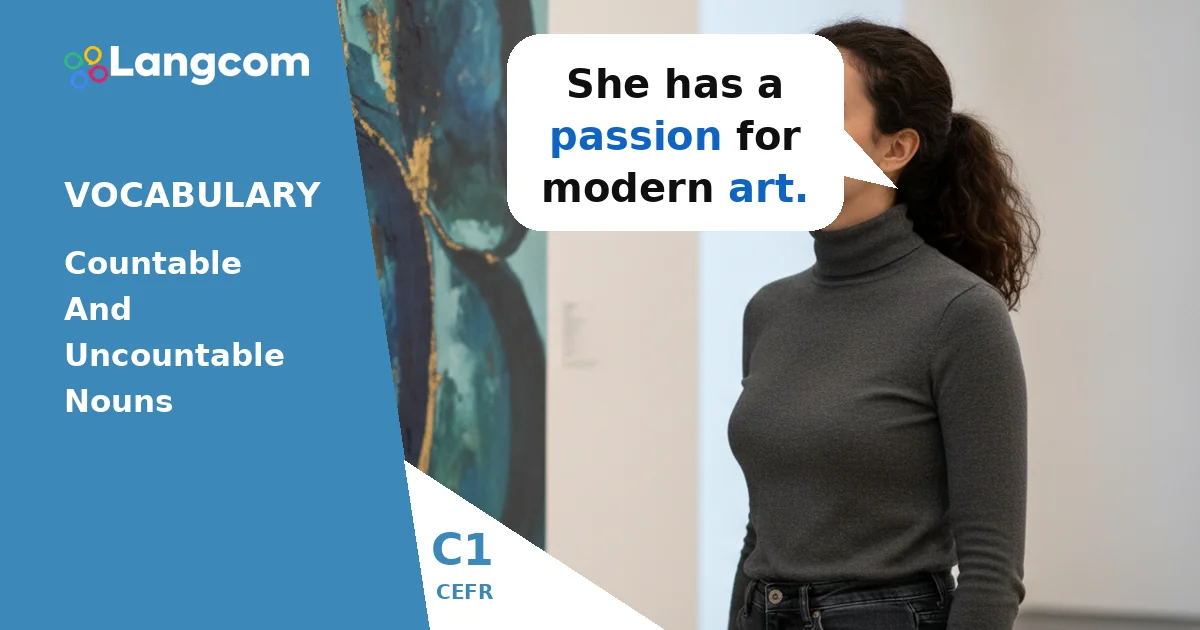
- She has a passion for modern art.
- The museum acquired several new arts for its collection.
- Starting a new business requires a lot of capital.
- Business is all about taking calculated risks.
- We had roast chicken for Sunday lunch.
- The fox tried to catch a chicken from the coop.
- Prevention is better than cure when it comes to disease.
- Heart disease is a leading cause of death worldwide.
- I need to get more exercise to stay fit.
- The warm-up included five different exercises.
- Freedom of speech is a fundamental right.
- Her speech lasted for almost an hour.
Entraînement
Prêt à obtenir votre certificat ?
Le cours Langcom prépare les étudiants aux examens de Cambridge, IELTS, TOEFL, DELE, SIELE et Michigan.
Commencez avec LangcomErreurs courantes chez les hispanophones
Spanish speakers sometimes make mistakes with these nouns because Spanish often treats similar concepts differently. Here are common errors:
- Using a/an with uncountable meanings:
❌ I need an advice.
✅ I need some advice. (ou a piece of advice) - Pluralizing uncountable nouns:
❌ We discussed many informations.
✅ We discussed a lot of information. (ou many pieces of information) - Confusing general concept with specific item:
If you mean the general concept of 'work' (uncountable), do not say a work. A work refers to a specific creation, like a painting or a book.
❌ I have a lot of works to do. (meaning tasks)
✅ I have a lot of work to do.
✅ Picasso's early works are fascinating. (meaning artworks)
Questions fréquemment posées
What is the main difference between countable and uncountable uses of the same noun?
The main difference lies in meaning and grammatical behavior. When a noun is uncountable, it refers to a general concept, a substance, or an activity (e.g., knowledge, water, music). It cannot be pluralized or used with a/an. When the same noun is countable, it refers to a specific item, instance, or type (e.g., a piece of knowledge, a bottle of water, a song). It can be pluralized and used with a/an.
How can I tell if a noun is countable or uncountable in a sentence?
Look at the context and the words around the noun. If you see a/an, a number, or a plural form, it's being used as countable. If you see quantifiers like much, little, some (without a/an), or no article, it's likely uncountable. Also, consider the meaning: is it a general idea or a specific item?
Are there any specific C1 Advanced exam tasks where this knowledge is tested?
Yes, this knowledge is vital across several parts of the C1 Advanced exam. In Reading and Use of English Part 1 (Multiple-choice cloze), you might need to choose the correct word form or quantifier. In Part 3 (Word formation), forming nouns from verbs or adjectives might require understanding their countable/uncountable nature. In Writing et Speaking, accurate use of these nouns is essential for clarity and achieving a high lexical resource score.



0 commentaire