
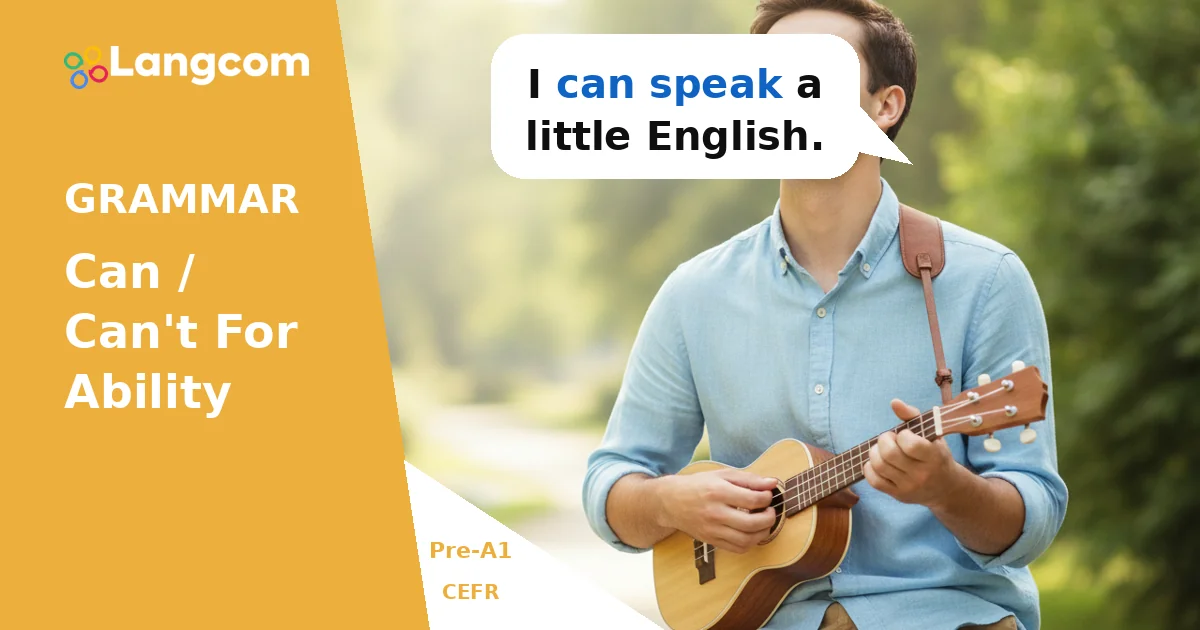

Que signifie ‘ Can ’ en anglais ?
Can C'est un mot très utile en anglais. On l'utilise pour parler des compétences. Une compétence, c'est quelque chose que l'on sait faire.
- Vous utilisez can pour toutes les matières : I, you, he, she, it, we, they.
- Après can, on utilise toujours la forme de base du verbe. Cela signifie le verbe sans to (par exemple, swim, et non to swim).
Regardez ces exemples :
- I can speak English. (Il s'agit d'une compétence.)
- She can play the guitar. (C'est son pouvoir.)
- We can run fast. (C'est notre capacité.)
🎓 Apprenez l'anglais grâce à la méthode mixte
Petits groupes · Tuteur IA disponible 24 h/24, 7 j/7 · Préparation aux examens de Cambridge
Plans provenant de $39 $79 par mois
Comment utilise-t-on ' Can't ' ?
Lorsque vous voulez dire que vous ne possédez pas une capacité, vous utilisez can't. Can't est l'abréviation de cannot.
- Can't signifie que tu ne sais pas comment faire quelque chose.
- Comme can, can't vient également avant la forme de base du verbe.
Voici quelques exemples :
- I can't swim. (Je n'ai pas cette capacité.)
- He can't drive a car. (Il ne sait pas comment faire.)
- They can't sing very well. (Ils ne chantent pas très bien.)
Comment poser des questions avec ' Can ' ?
Pour s'enquérir des capacités de quelqu'un, on dit : can au début de la phrase.
- La structure est la suivante : Can + Subject + base verb?
Regardez ces questions et ces réponses succinctes :
- Can you cook?
- Yes, I can. (Réponse affirmative brève)
- No, I can't. (Réponse courte négative)
Autres exemples :
- Can she dance?
- Yes, she can.
- Can they speak French?
- No, they can't.
| Question | Réponse affirmative | Réponse négative |
|---|---|---|
| Can you swim? | Yes, I can. | No, I can't. |
| Can she dance? | Yes, she can. | No, she can't. |
| Can they play football? | Yes, they can. | No, they can't. |
Exemples
- I can speak a little English.
- My brother can play football very well.
- Birds can fly.
- I can't draw.
- She can't ride a bicycle.
- Can you help me?
- Can he understand Spanish? Yes, he can.
Entraînement
💬 Vous avez besoin de conseils personnalisés ?
En tant que centre de préparation agréé par Cambridge, nous pouvons vous aider à choisir la formation et la certification qui vous conviennent. Discutez-en dès aujourd'hui avec nos conseillers.
Discutez avec un conseiller sur WhatsAppErreurs courantes chez les hispanophones
Les hispanophones commettent parfois les erreurs suivantes :
- Utilisation de ' to ' après can:
I can to swim. (Incorrect)
I can swim. (Correct) - Placer ' pas ' au mauvais endroit :
I not can speak English. (Incorrect)
I can't speak English. (Correct) - Modification can pour ' il ' ou ' elle ' :
She cans sing. (Incorrect)
She can sing. (Correct)
Questions fréquemment posées
À quoi sert le mot ' can ' ?
Can est utilisé pour parler de capacité, c'est-à-dire de quelque chose que l'on sait faire ou qui est possible.
Quelle est la forme abrégée de ' cannot ' ?
La forme abrégée de cannot est can't.
Le verbe ' can ' change-t-il selon qu'on utilise ' he ' ou ' she ' ?
Non, can ne change pas. C'est toujours can pour toutes les matières (I, you, he, she, it, we, they).

0 commentaire