

What Are Collocations and Why Are They Important for C1 English?
Collocations are words that frequently appear together. They are not random; native speakers use them constantly. Think of them as word partnerships.
For C1 learners, understanding collocations is a key step towards advanced fluency. It helps you:
- Sound natural: Using the right collocation makes your English sound authentic, like a native speaker.
- Improve accuracy: You avoid common mistakes that make your language sound awkward or incorrect.
- Enhance comprehension: You can better understand nuanced meanings in texts and conversations.
- Boost your exam score: Collocations are often tested in advanced English exams like the C1 Advanced.
✍️ Vous ne savez pas quel est votre niveau ?
Passez notre test de niveau gratuit et recevez des commentaires personnalisés de la part d'examinateurs certifiés par Cambridge.
Passez notre test de niveau GRATUITCommon Types of Collocations You Need to Know
Collocations come in many forms. Here are some of the most common types you will encounter at a C1 level:
- Adverb + Adjective: An adverb describes an adjective. For example, perfectly hideous, fully aware, highly successful.
- Adjective + Noun: An adjective describes a noun. For example, heavy rain, strong coffee, crucial decision.
- Verb + Noun: A verb is commonly used with a specific noun. For example, make a mistake, take a break, commit a crime.
- Noun + Noun: Two nouns often go together. For example, a round of applause, a sense of humour, traffic jam.
- Verb + Adverb: A verb is commonly described by an adverb. For example, study hard, drive carefully, think deeply.
Paying attention to these patterns will significantly expand your active vocabulary.
How Can You Learn and Remember Collocations?
Learning collocations takes time and practice. Here are some effective strategies:
- Read extensively: The more you read English books, articles, and news, the more you will naturally see and absorb collocations.
- Listen actively: Pay attention to how native speakers combine words in podcasts, movies, and conversations.
- Keep a collocation notebook: When you learn a new word, don't just write down its meaning. Write down common collocations it appears in. For example, for 'decision', write make a decision, come to a decision, a difficult decision.
- Use flashcards: Create flashcards with the collocation on one side and an example sentence on the other.
- Practice in context: Try to use new collocations in your speaking and writing. The more you use them, the better you will remember them.
| Collocation Type | Words | Example Sentence |
|---|---|---|
| Verb + Noun | pay attention | Please pay attention to the instructions. |
| Verb + Noun | commit a crime | He committed a serious crime. |
| Adjective + Noun | heavy traffic | We got stuck in heavy traffic on the way home. |
| Adverb + Adjective | highly recommended | This new restaurant is highly recommended by critics. |
| Verb + Adverb | think deeply | She had to think deeply about the complex problem. |
| Noun + Noun | round of applause | The audience gave the performers a huge round of applause. |
Exemples
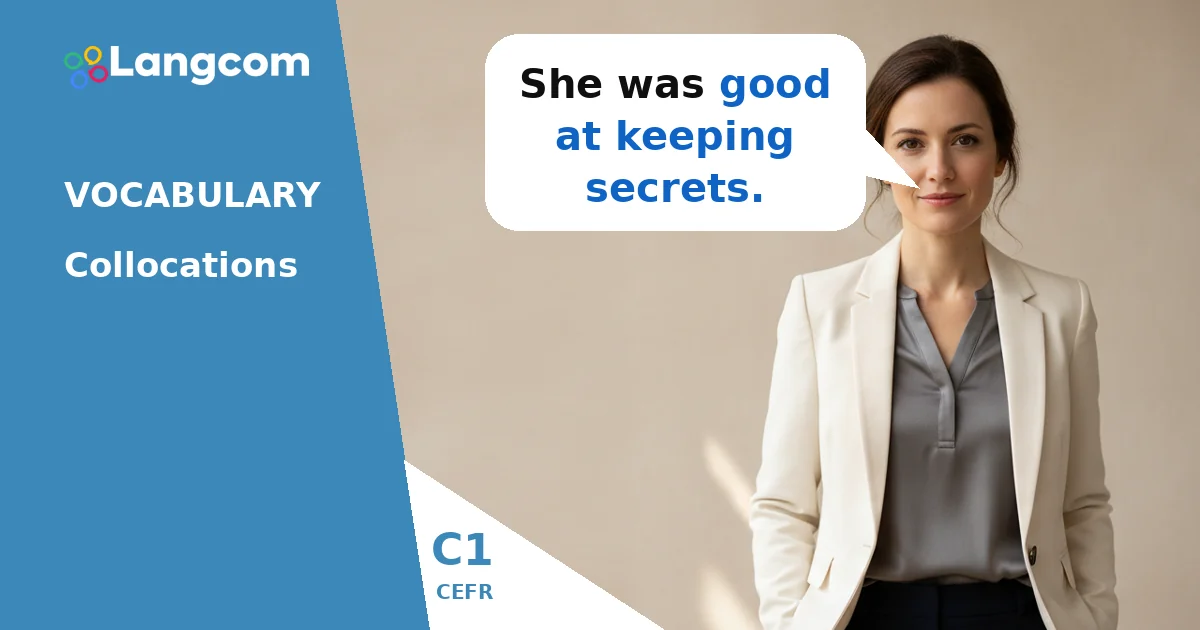
- She was good at keeping secrets.
- My father's new car can do 200 kph.
- I don't like people who break their promises.
- We're having a holiday in South America this year.
- Maximo made a fortune from computer software.
- The music from the festival kept me awake for ages last night.
- This ice cream tastes really good.
- Liliana spends too much time at her friend's house.
Entraînement
Prêt à obtenir votre certificat ?
Le cours Langcom prépare les étudiants aux examens de Cambridge, IELTS, TOEFL, DELE, SIELE et Michigan.
Commencez avec LangcomErreurs courantes chez les hispanophones
Spanish speakers often make direct translations from their native language, which can lead to unnatural-sounding English collocations. For example, in Spanish, you might say 'hacer una foto', but in English, the correct collocation is take a photo, et non make a photo.
Similarly, instead of do a decision, which is incorrect, we say make a decision. Another common error is using do an exam au lieu de take an exam ou sit an exam. Always remember that collocations are fixed patterns; they don't always follow logical rules based on individual word meanings.
Questions fréquemment posées
What is a collocation in English?
A collocation is a combination of two or more words that frequently occur together in English. These combinations sound natural to native speakers, such as heavy rain ou make a decision.
Why are collocations important for C1 learners?
For C1 learners, collocations are vital for achieving fluency and sounding natural. They help you express ideas more precisely, avoid awkward phrasing, and improve your overall communication skills, which is essential for advanced English proficiency.
How many collocations do I need to know?
There isn't a specific number, as learning collocations is an ongoing process. At C1 level, focus on recognizing and actively using common collocations across various topics. The more you learn, the richer and more natural your English will become.
Are collocations the same as idioms?
No, collocations are not the same as idioms. While both involve groups of words, idioms have a meaning that cannot be understood from the individual words (e.g., kick the bucket means 'to die'). Collocations, however, are simply words that frequently go together, and their meaning is usually clear from the individual words (e.g., strong tea).
How are collocations tested in the C1 Advanced exam?
Collocations are frequently tested in the C1 Advanced (CAE) exam, especially in the Reading and Use of English paper. You might find them in Part 1 (Multiple-choice cloze), where you choose the correct word to complete a phrase, or in Part 4 (Key word transformations), where you need to rephrase sentences using specific collocations. Mastering them will significantly improve your score.


0 commentaire