

What Are Adverbs of Manner and Degree?
These adverbs describe *how* an action is performed or *to what extent* something changes or happens. They provide specific details that make your sentences more vivid and informative.
- Adverbs of Manner explain the way something happens. They often answer the question ‘how?’. For example, gradually means slowly over time, while dramatically implies a sudden and significant change.
- Adverbs of Degree/Change describe the intensity or extent of an action, adjective, or another adverb. They often answer ‘how much?’ or ‘to what extent?’. For instance, increasingly shows a growing trend, and markedly indicates a clear, noticeable difference.
These adverbs typically modify verbs, adjectives, or other adverbs. Their placement can vary but often comes after the verb or before the adjective/adverb they modify.
✍️ Vous ne savez pas quel est votre niveau ?
Passez notre test de niveau gratuit et recevez des commentaires personnalisés de la part d'examinateurs certifiés par Cambridge.
Passez notre test de niveau GRATUITWhat Are Commenting Adverbs?
Commenting adverbs, also known as sentence adverbs, express the speaker's or writer's attitude, opinion, or judgment about the entire sentence or clause. They don't just modify a single word; they provide a perspective on the whole statement.
- Unquestionably means 'without any doubt' and expresses strong certainty.
- Potentially means 'possibly' or 'it is possible that' and indicates a likelihood or a future possibility.
These adverbs often appear at the beginning of a sentence, separated by a comma, or sometimes before the main verb. They are crucial for conveying subtle nuances of meaning and expressing your stance on a topic.
Why Use These Adverbs at C1 Level?
At the C1 level, your goal is to communicate with precision, sophistication, and a wide range of expression. These advanced adverbs help you achieve that.
- Precision: Instead of saying 'it changed a lot,' you can say it changed dramatically ou radically, conveying a more exact meaning.
- Nuance: They allow you to express subtle differences in degree (progressively vs. gradually) or certainty (unquestionably vs. potentially).
- Formal and Academic Tone: Many of these adverbs are common in academic writing, presentations, and formal discussions, helping you sound more authoritative and articulate.
| Adverb | Type | Meaning/Function |
|---|---|---|
| gradually | Manner/Degree | Slowly, over a period of time; step by step. |
| increasingly | Degree/Change | More and more; to a growing extent. |
| markedly | Degree/Change | Clearly, noticeably; to a significant extent. |
| potentially | Commenting | Possibly; it is possible that something will happen or be true. |
| radically | Manner/Degree | Completely and fundamentally; in a way that involves far-reaching changes. |
| unquestionably | Commenting | Without any doubt; certainly. |
| dramatically | Manner/Degree | Suddenly and noticeably; in a striking or impressive manner. |
| progressively | Manner/Degree | Continuously and increasingly; in a gradual but steady way. |
Exemples
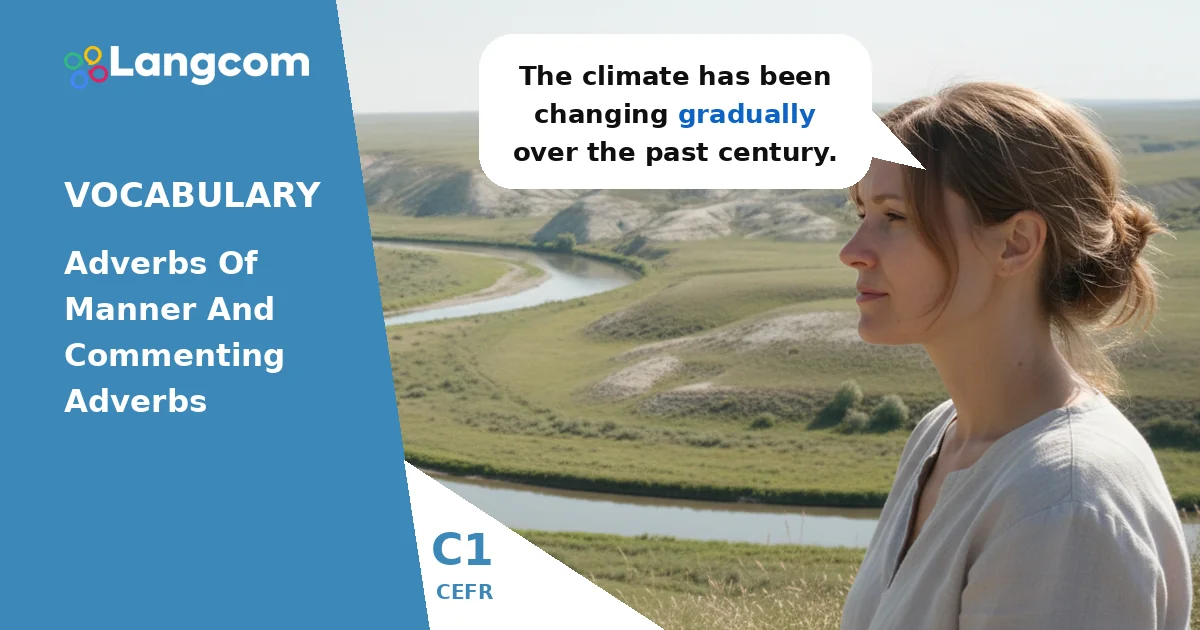
- The climate has been changing gradually over the past century.
- Sales figures increased dramatically after the new marketing campaign.
- The company decided to radically rethink its business model.
- The patient's condition is progressively improving.
- It is becoming increasingly difficult to find affordable housing in the city.
- Her performance in the second half was markedly better.
- Potentially, this new technology could revolutionize the industry.
- Unquestionably, hard work is key to success in any field.
Entraînement
Prêt à obtenir votre certificat ?
Le cours Langcom prépare les étudiants aux examens de Cambridge, IELTS, TOEFL, DELE, SIELE et Michigan.
Commencez avec LangcomErreurs courantes chez les hispanophones
Spanish speakers sometimes make specific errors when using these adverbs:
- Incorrect Placement: In English, commenting adverbs often start a sentence or are placed before the main verb. For example, saying I think potentially it will rain is less natural than Potentially, I think it will rain ou It will potentially rain.
- Confusion with Adjectives: Remember that adverbs modify verbs, adjectives, or other adverbs, while adjectives modify nouns. Do not confuse dramatic (adjective) with dramatically (adverb). For instance, It was a dramatic change (correct) vs. It changed dramatic (incorrect).
- Overuse or Underuse: While these adverbs add sophistication, using too many can make your writing sound unnatural. Conversely, sticking to simpler adverbs when a more precise C1 adverb is appropriate can limit your expression.
Questions fréquemment posées
What is the main difference between an adverb of manner and a commenting adverb?
An adverb of manner describes *how* an action is performed (e.g., He spoke dramatically). A commenting adverb expresses the speaker's opinion or attitude about the *entire sentence* (e.g., Dramatically, the situation worsened, implying the speaker finds the worsening significant).
Can I use these adverbs in formal academic writing?
Yes, absolutely. Adverbs like markedly, unquestionably, radically, et increasingly are very common and highly valued in formal and academic contexts because they allow for precise and nuanced expression.
Where should I usually place commenting adverbs in a sentence?
Commenting adverbs like potentially ou unquestionably are often placed at the beginning of a sentence, followed by a comma, or before the main verb. For example: Potentially, the project will succeed ou The project will unquestionably succeed.
How can I improve my use of these advanced adverbs for exams like IELTS or Cambridge C1 Advanced?
To improve, actively notice these adverbs when reading advanced texts or listening to academic lectures. Try to incorporate them into your own speaking and writing, paying close attention to their exact meaning and typical placement. Practice using them to convey specific nuances, which is often tested in writing and speaking tasks.



0 commentaire