

Why are Personality Adjectives Important?
Personality adjectives help us understand and talk about people’s unique characteristics. They are crucial for describing how someone thinks, feels, and behaves.
- Using the right adjective makes your descriptions more precise.
- It helps you express your opinions about others’ behaviour.
- This vocabulary is very common in everyday conversation and in formal writing.
✍️ Vous ne savez pas quel est votre niveau ?
Passez notre test de niveau gratuit et recevez des commentaires personnalisés de la part d'examinateurs certifiés par Cambridge.
Passez notre test de niveau GRATUITPositive Personality Adjectives
These words describe qualities that are generally seen as good or desirable in a person.
- Cheerful: Always happy and positive. She's always cheerful, even on a rainy day.
- Loyal: Stays faithful and supportive to friends, family, or a cause. A loyal friend will always stand by you.
- Optimistic: Always expects good things to happen; sees the positive side. He's optimistic about his chances of getting the job.
- Witty: Able to use words in a clever and amusing way. Her witty comments always make everyone laugh.
Negative Personality Adjectives
These adjectives describe qualities that are generally considered undesirable or problematic.
- Aggressive: Ready or likely to attack or confront; forceful and hostile. He can be very aggressive when he doesn't get his way.
- Bad-tempered: Easily annoyed or made angry. Don't disturb him; he's a bit bad-tempered this morning.
- Bossy: Always telling people what to do. My older sister was very bossy when we were children.
- Impatient: Easily annoyed by delays; unable to wait calmly. She gets impatient if she has to wait more than five minutes.
- Jealous: Feeling angry or unhappy because someone else has something you want, or because you are worried that someone you love might prefer another person. He was jealous of his brother's success.
- Lazy: Unwilling to work or use energy. My lazy cat sleeps all day long.
- Stubborn: Determined not to change your mind, even when others think you are wrong. He's too stubborn to admit he made a mistake.
- Unpopular: Not liked by many people. His unpopular opinions often cause arguments.
- Unreliable: Not able to be trusted or depended on. She's unreliable; she often cancels plans at the last minute.
Context-Dependent Adjectives
Some adjectives can be positive or negative depending on the situation or how extreme the trait is.
- Competitive: Wanting very much to win or be more successful than others. Being competitive can be good in sports, but not always in friendships.
| Positive Traits | Negative Traits | Context-Dependent |
|---|---|---|
| Cheerful | Aggressive | Competitive |
| Loyal | Bad-tempered | |
| Optimistic | Bossy | |
| Witty | Impatient | |
| Jealous | ||
| Lazy | ||
| Stubborn | ||
| Unpopular | ||
| Unreliable |
Exemples
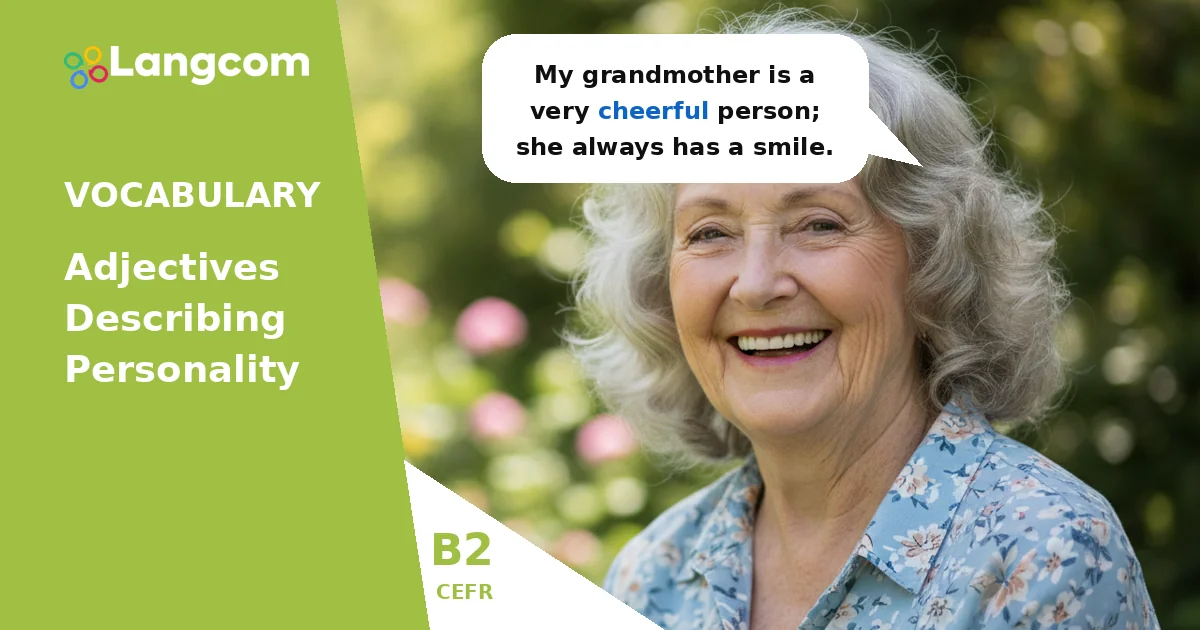
- My grandmother is a very cheerful person; she always has a smile.
- He's incredibly loyal to his team, even when they lose.
- Despite the difficulties, she remained optimistic about the future.
- The comedian's witty remarks kept the audience entertained.
- His aggressive behaviour made everyone uncomfortable.
- Be careful what you say, my boss is a bit bad-tempered today.
- I find her a bit bossy; she always wants to be in charge.
- He's so impatient that he can't wait for anything.
- She felt jealous when her friend won the lottery.
- My brother is too lazy to help with the housework.
- You can't convince him; he's too stubborn.
- The new policy was unpopular with the employees.
- Don't rely on him; he's completely unreliable.
- She's very competitive and always tries to win.
Entraînement
Prêt à obtenir votre certificat ?
Le cours Langcom prépare les étudiants aux examens de Cambridge, IELTS, TOEFL, DELE, SIELE et Michigan.
Commencez avec LangcomErreurs courantes chez les hispanophones
Spanish speakers sometimes confuse certain English adjectives due to similar-sounding words or direct translation issues:
- Sensible vs. Sensitive: In Spanish, 'sensible' often means sensitive (easily upset or emotional). However, in English, sensible means practical and reasonable. Incorrect: My friend is very sensible and cries easily. Correct: My friend is very sensitive and cries easily.
- Sympathetic vs. Nice: The Spanish word 'simpático' often means nice ou friendly. In English, sympathetic means showing understanding and care for someone else's problems. Incorrect: My new colleague is very sympathetic. (meaning friendly) Correct: My new colleague is very nice. (ou My new colleague is very sympathetic to my problems.)
- Stubborn vs. Determined: While both imply strong will, stubborn often has a negative connotation (unwilling to change), whereas determined is usually positive (focused on achieving a goal). He is stubborn to finish his project. (Better: He is determined to finish his project.)
Questions fréquemment posées
What is the difference between 'jealous' and 'envious'?
Jealous often implies a fear of losing something you have (like a partner or position) or resentment towards someone else's success, sometimes with a desire to protect what's yours. Envious is simpler; it means wanting what someone else has. Often, they are used interchangeably, but jealous can have a stronger, more protective meaning.
How can I use these adjectives in the B2 First exam?
You can use these personality adjectives in various parts of the B2 First exam. In the Speaking paper, you might describe people in pictures or talk about friends and family. In the Writing paper, you could use them in essays, reviews, or reports to describe characters or people's traits. For example, in a review of a book, you might describe a character as loyal ou stubborn.
Are there any neutral personality adjectives?
Yes, some adjectives are generally neutral and describe a trait without a strong positive or negative judgment. Examples include quiet, talkative, serious, ou reserved. Their positive or negative implication often depends on context or personal preference.
How can I remember new personality adjectives?
Try to associate new adjectives with people you know or characters from books/movies. Create example sentences that are relevant to your own life. You can also group them by positive and negative meanings, or by opposites (e.g., optimistic vs. pessimistic).


0 commentaire