

What are the key words for job applications?
When you look for a job, you will use specific vocabulary. These words describe the process of finding and applying for work.
-
Apply for (verb phrase): This means to make a formal request for a job or position.
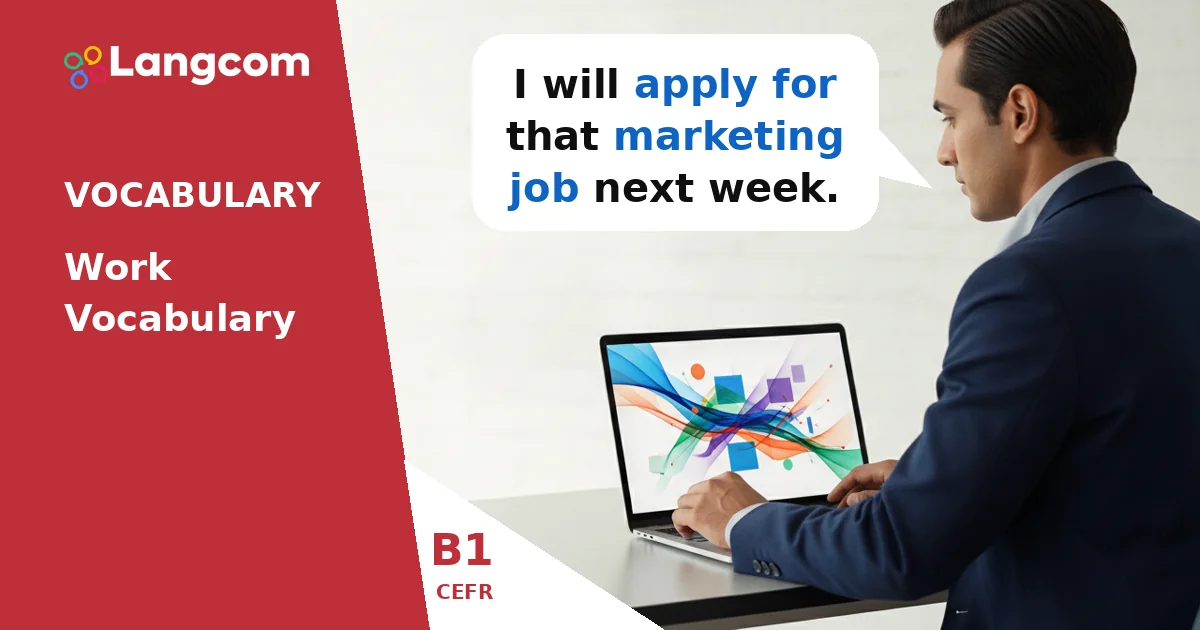
- I will apply for that marketing job next week.
-
Candidate (noun): This is a person who is trying to get a job or a position.
- We interviewed five candidates for the manager position.
-
CV (noun, abbreviation): This stands for ‘Curriculum Vitae’. It is a document that lists your education, work experience, and skills. In American English, people often say résumé.
- My CV includes all my previous jobs and qualifications.
-
Grades (noun): These are marks or scores you receive in school or university. Good grades can help you get a job.
- She got excellent grades in her English exams.
🎓 Apprenez l'anglais grâce à la méthode mixte
Petits groupes · Tuteur IA disponible 24 h/24, 7 j/7 · Préparation aux examens de Cambridge
Plans provenant de $39 $79 par mois
Who works in a company: Employees or Employers?
It is important to know the difference between the people who offer jobs and the people who do the jobs.
-
Employer (noun): This is a person, company, or organization that hires people to work.
- Our employer offers good benefits to all staff.
-
Employee (noun): This is a person who works for another person or a company in return for wages or a salary.
- The company has over 200 employees worldwide.
How do we talk about responsibilities and professional life?
These terms help you describe your role at work and your professional journey.
-
In charge of (phrase): This means to be responsible for something or someone.
- I am in charge of the sales department.
-
Career (noun): This refers to the series of jobs or professions that a person has in their life, especially in one particular field.
- She has had a successful career as a doctor.
-
Knowledge (noun): This is the information, understanding, and skills that you get through experience or education.
- His knowledge of computers is very impressive.
-
Business contacts (noun phrase): These are people you know in the business world who can help you with your career or business.
- Networking helps you build valuable business contacts.
| Category | English Term | Simple Meaning |
|---|---|---|
| People | Employer | The company or person who hires workers. |
| People | Employee | A person who works for an employer. |
| People | Candidate | A person applying for a job. |
| Documents | CV | A document with your work history and skills. |
| Documents | Grades | Scores from your education. |
Exemples
- I will apply for that marketing job next week.
- We interviewed five candidates for the manager position.
- My CV includes all my previous jobs and qualifications.
- She got excellent grades in her English exams.
- Our employer offers good benefits to all staff.
- The company has over 200 employees worldwide.
- I am in charge of the sales department.
- She has had a successful career as a doctor.
- His knowledge of computers is very impressive.
- Networking helps you build valuable business contacts.
Entraînement
✍️ Vous ne savez pas quel est votre niveau ?
Passez notre test de niveau gratuit et recevez des commentaires personnalisés de la part d'examinateurs certifiés par Cambridge.
Passez notre test de niveau GRATUITErreurs courantes chez les hispanophones
Spanish speakers sometimes confuse similar-sounding words or use direct translations that are incorrect in English.
-
Career vs. Race: In Spanish, 'carrera' can mean both 'career' and 'race'. In English, career is your professional path, while race is a competition of speed. Correct: She chose a career in law. Incorrect: She chose a race in law.
-
Knowledge (uncountable) vs. Knowledges: Knowledge is an uncountable noun in English, so it does not have a plural form. Correct: He has a lot of knowledge about history. Incorrect: He has many knowledges about history.
-
Apply for vs. Apply to: You apply for a job (the position) and apply to a company or university (the institution). Correct: I applied for the scholarship. Correct: I applied to the university.
Questions fréquemment posées
What is the difference between an 'employer' and an 'employee'?
An employer is the person or company that hires people to work. An employee is the person who works for the employer.
Can I use 'CV' and 'résumé' interchangeably?
Yes, you can. CV is more common in British English, while résumé is typically used in American English. Both refer to a document detailing your work history and skills.
How can I improve my work vocabulary for B1 exams?
To improve your work vocabulary for B1 exams, focus on reading job descriptions, news articles about the economy, and practicing describing your own work experience. Pay attention to collocations (words that often go together) like gain knowledge ou build contacts.
What does it mean to be 'in charge of' something?
To be in charge of something means you have the responsibility or control over it. For example, if you are in charge of a project, you are the leader and responsible for its success.



0 commentaire