
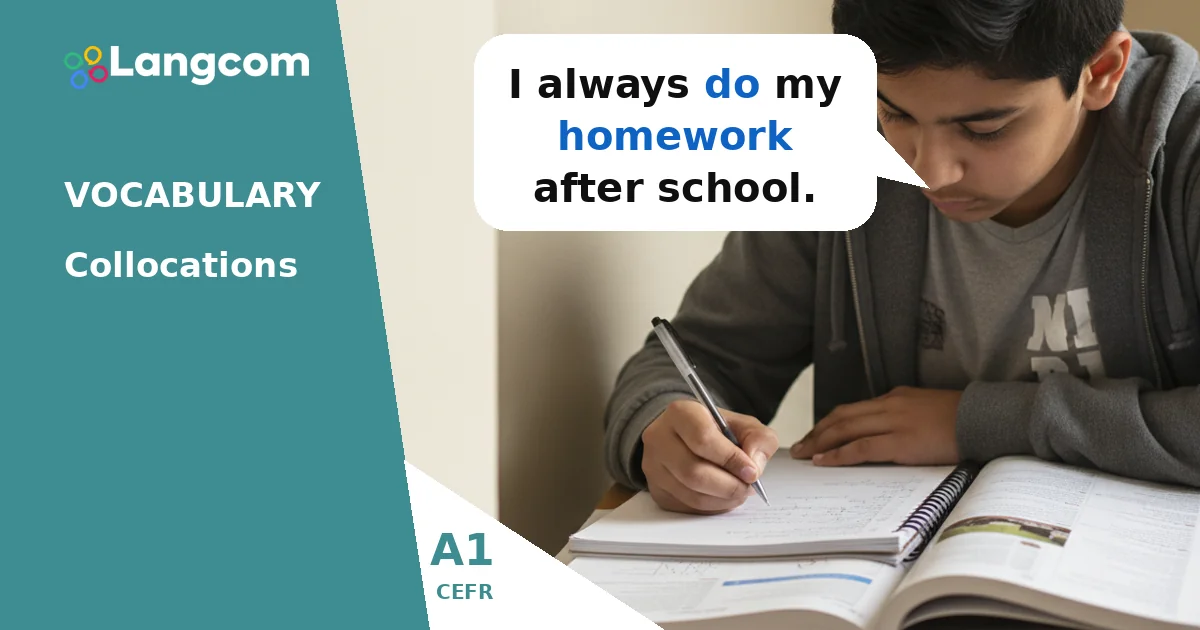

What Are English Collocations?
Collocations are groups of words that often appear together in English. They are not grammar rules, but rather natural word partnerships.
- Think of them as word friends that like to be together.
- For example, we say heavy rain, et non strong rain. Both words mean ‘a lot’, but only heavy sounds natural with rain.
🎓 Apprenez l'anglais grâce à la méthode mixte
Petits groupes · Tuteur IA disponible 24 h/24, 7 j/7 · Préparation aux examens de Cambridge
Plans provenant de $39 $79 par mois
Why Are Collocations Important for A1 Learners?
Learning collocations helps you speak English more naturally and understand others better.
- Sound natural: Your English will sound more like a native speaker.
- Improve fluency: You will speak more quickly and easily because you don't have to think about each word separately.
- Avoid mistakes: You will choose the correct word combinations.
- Expand vocabulary: You learn words in context, which helps you remember them better.
Common A1 Verb Collocations to Learn
Let's look at some very common verbs and the words they often go with. These are important for everyday conversations.
Verbs for Activities and Tasks: Do et Make
- Nous utilisons do for general activities, tasks, or duties. For example: do sport, do your homework.
- Nous utilisons make for creating or producing something. For example: make a list, make lunch.
Verbs for People and Places: Invite et Visit
- Utilisation invite when you ask someone to come to an event or place. For example: invite friends, invite someone to a party.
- Utilisation visit when you go to see a person or a place. For example: visit a friend, visit a museum.
Verbs for Art and Cleaning: Paint et Clean
- Paint is used for creating art or changing the color of something. For example: paint a picture, paint a wall.
- Clean is for making something tidy and free from dirt. For example: clean your flat, clean windows.
Verbs for Technology and Movement: Use et Go
- Use is for operating or applying something. For example: use your phone, use the Internet.
- Go is for moving from one place to another, often with an activity. For example: go for a walk, go shopping.
| Verbe | Collocations |
|---|---|
| do | sport, your homework |
| invite | friends, someone to a party |
| visit | a friend, a museum |
| make | a list, lunch |
| paint | a picture, a wall |
| clean | your flat, windows |
| use | your phone, the Internet |
| go | for a walk, shopping |
Exemples
- I always do my homework after school.
- Do you want to invite friends to my birthday party?
- We will visit a museum next Saturday.
- Can you make a list of things we need?
- My sister likes to paint pictures of flowers.
- Please clean your flat before your parents arrive.
- I use my phone to check emails.
- Let's go for a walk in the park.
- She needs to go shopping for new clothes.
- I often do sport on the weekend.
Entraînement
💬 Vous avez besoin de conseils personnalisés ?
En tant que centre de préparation agréé par Cambridge, nous pouvons vous aider à choisir la formation et la certification qui vous conviennent. Discutez-en dès aujourd'hui avec nos conseillers.
Discutez avec un conseiller sur WhatsAppErreurs courantes chez les hispanophones
Many Spanish speakers try to translate directly from Spanish, which can lead to mistakes with collocations.
- Erreur : Expression make sport (from 'hacer deporte').
Correct : You should say do sport. - Erreur : Expression do lunch (from 'hacer el almuerzo').
Correct : You should say make lunch. - Erreur : Expression visit to a friend.
Correct : You should say visit a friend (no 'to').
Always try to learn verbs and nouns together as a pair, not just individual words.
Questions fréquemment posées
What is the easiest way to learn collocations?
The easiest way is to learn new words in context. When you learn a new verb, also learn the nouns it often goes with. For example, don't just learn 'do', but also learn do homework et do sport.
Why can't I just use any verb with any noun?
While grammar might allow it, native speakers have preferred ways of combining words. Using the wrong collocation, like strong tea instead of strong coffee (we say strong tea, but strong coffee is also correct, a better example would be heavy rain pas strong rain), can make your English sound unnatural or even confusing. Collocations make your speech sound smooth and correct.
How do matching exercises help with collocations?
Matching exercises, like the one in this lesson, are excellent for learning collocations. They help you connect verbs with their correct noun partners, reinforcing the natural pairs in your memory. This practice helps you quickly recognize and use common collocations.
Are there rules for collocations?
Not really strict rules like grammar rules. Collocations are more about common usage and what sounds 'right' to native speakers. The best way to learn them is through exposure (reading, listening) and practice.

0 commentaire