

When do we use the Present Simple Affirmative?
We use the Present Simple Affirmative to talk about things that are true all the time or happen regularly.
- Daily routines and habits: Things you do every day or often. I get up at seven o’clock.
- Facts and general truths: Things that are always true. The sun rises in the east.
- Schedules and timetables: Fixed events. The train leaves at 9 AM.
🎓 Apprenez l'anglais grâce à la méthode mixte
Petits groupes · Tuteur IA disponible 24 h/24, 7 j/7 · Préparation aux examens de Cambridge
Plans provenant de $39 $79 par mois
How do we form the Present Simple Affirmative?
The form of the verb changes for He, She, et It.
- For I, You, We, They, we use the base form of the verb. I watch TV.
- For He, She, It, we add -s ou -es to the base form of the verb. She watches TV.
Here are some rules for adding -s ou -es:
- Most verbs: Add -s. work → works, eat → eats
- Verbs ending in -s, -ss, -sh, -ch, -x, -o: Add -es. watch → watches, go → goes
- Verbs ending in a consonant + -y: Change -y à -ies. study → studies (but play → plays because it's a vowel + -y)
Special verb: 'have'
Le verbe have is special in the Present Simple Affirmative.
- For I, You, We, They, we use have. I have breakfast.
- For He, She, It, we use has. He has breakfast.
We often use have to talk about meals, like have breakfast, have lunch, ou have dinner. You can also use eat for meals, but have is very common.
| Objet | Verb: <span data-no-translation>WORK</span> | Verb: <span data-no-translation>WATCH</span> | Verb: <span data-no-translation>STUDY</span> | Verb: <span data-no-translation>HAVE</span> |
|---|---|---|---|---|
| I | work | watch | study | have |
| You | work | watch | study | have |
| He | works | watches | studies | has |
| She | works | watches | studies | has |
| It | works | watches | studies | has |
| We | work | watch | study | have |
| They | work | watch | study | have |
Exemples
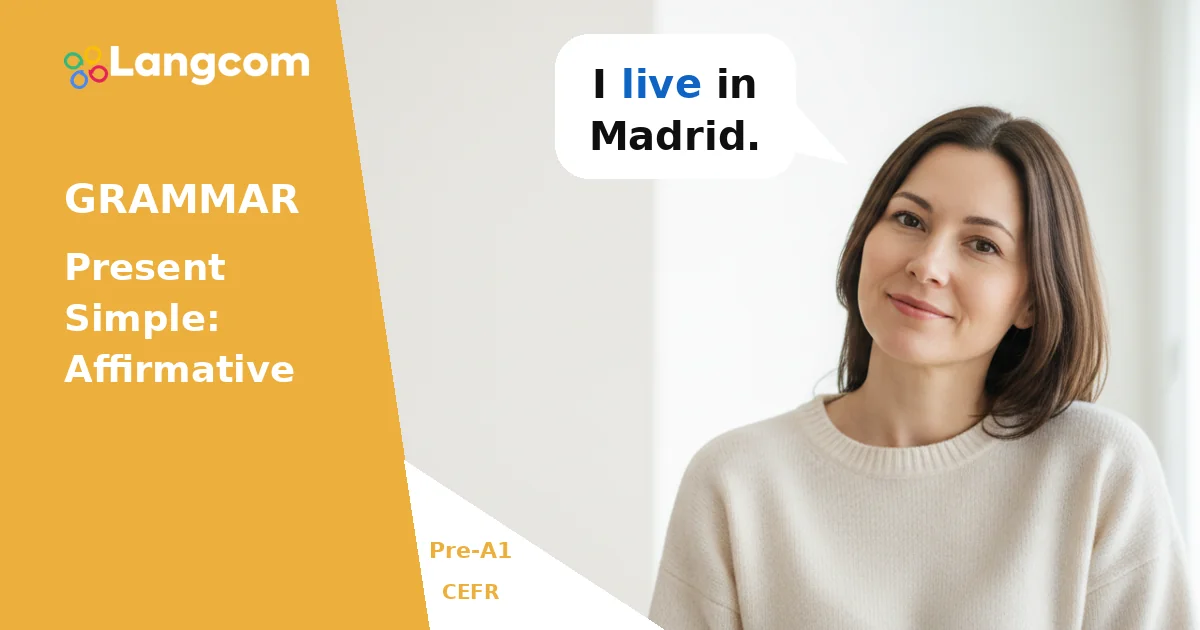
- I live in Madrid.
- You study English at Langcom.
- He works in an office.
- She watches TV every evening.
- It rains a lot in winter.
- We get up early on weekdays.
- They have two children.
Entraînement
💬 Vous avez besoin de conseils personnalisés ?
En tant que centre de préparation agréé par Cambridge, nous pouvons vous aider à choisir la formation et la certification qui vous conviennent. Discutez-en dès aujourd'hui avec nos conseillers.
Discutez avec un conseiller sur WhatsAppErreurs courantes chez les hispanophones
Forgetting the -s for He/She/It
A common mistake for Spanish speakers is to forget to add -s ou -es to the verb when the subject is He, She, ou It. In Spanish, verb endings change for all subjects, but in English, the change is mostly for the third person singular.
- Incorrect : She live in London.
- Correct : She lives in London.
- Incorrect : He watch TV.
- Correct : He watches TV.
Using 'have' instead of 'has' for He/She/It
Remember that have changes to has for He, She, et It.
- Incorrect : He have breakfast at 8 AM.
- Correct : He has breakfast at 8 AM.
Questions fréquemment posées
What is the main use of the Present Simple Affirmative?
The main use is to talk about daily routines, habits, and facts that are generally true. For example, I drink water every day.
Do all verbs add -s for He/She/It?
Most verbs add -s. However, some verbs add -es (comme watch → watches) or change -y à -ies (comme study → studies). The verb have changes to has.
Why is the Present Simple important for Pre-A1 learners?
It is fundamental because it allows you to describe basic information about yourself, your family, and your daily life, which is essential for early communication in English. It's a building block for more complex sentences.
Can I use 'eat' instead of 'have' for meals?
Yes, you can use eat for meals (e.g., I eat breakfast). However, have (par exemple, I have breakfast) is also very common and natural in English.



0 commentaire