
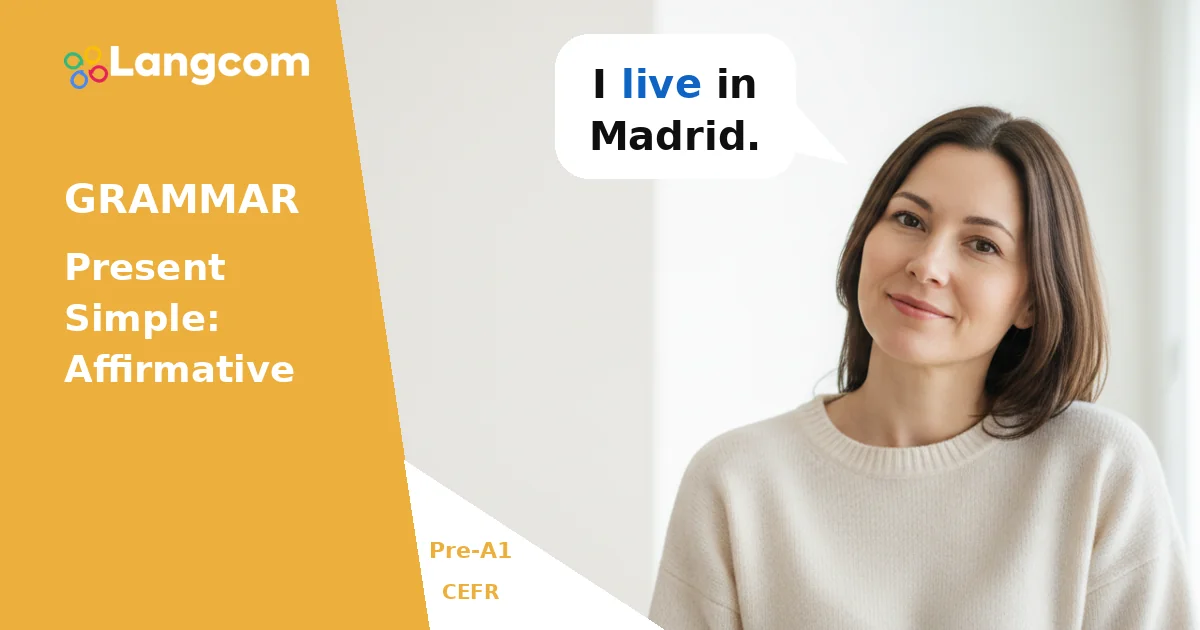

Wann verwenden wir die bejahende Form im Präsens?
Wir verwenden die bejahende Form des Present Simple, um über Dinge zu sprechen, die immer zutreffen oder regelmäßig vorkommen.
- Alltagsabläufe und Gewohnheiten: Dinge, die du jeden Tag oder oft machst. I get up at seven o’clock.
- Fakten und allgemeine Wahrheiten: Dinge, die immer wahr sind. The sun rises in the east.
- Zeitpläne und Fahrpläne: Feste Termine. The train leaves at 9 AM.
🎓 Englisch lernen mit der Blended-Methode
Kleingruppen · KI-Tutor rund um die Uhr · Vorbereitung auf die Cambridge-Prüfungen
Pläne von $39 $79 pro Monat
Wie bildet man die bejahende Form im Präsens?
Die Verbform ändert sich bei He, She, und It.
- Für I, You, We, They, verwenden wir die Grundform des Verbs. I watch TV.
- Für He, She, It, fügen wir hinzu -s oder -es zur Grundform des Verbs. She watches TV.
Hier sind einige Regeln für das Hinzufügen von -s oder -es:
- Die meisten Verben: Hinzufügen -s. work → works, eat → eats
- Verben, die auf -s, -ss, -sh, -ch, -x, -o: Hinzufügen -es. watch → watches, go → goes
- Verben, die auf einen Konsonanten enden + -y: Ändern -y zu -ies. study → studies (aber play → plays because it's a vowel + -y)
Special verb: 'have'
Das Verb have ist im Präsens (bejahende Form) etwas Besonderes.
- Für I, You, We, They, wir verwenden have. I have breakfast.
- Für He, She, It, wir verwenden has. He has breakfast.
Wir verwenden oft have um über Mahlzeiten zu sprechen, zum Beispiel have breakfast, have lunch, oder have dinner. Sie können auch eat für Mahlzeiten, aber have kommt sehr häufig vor.
| Betreff | Verb: <span data-no-translation>WORK</span> | Verb: <span data-no-translation>WATCH</span> | Verb: <span data-no-translation>STUDY</span> | Verb: <span data-no-translation>HAVE</span> |
|---|---|---|---|---|
| I | work | watch | study | have |
| You | work | watch | study | have |
| He | works | watches | studies | has |
| She | works | watches | studies | has |
| It | works | watches | studies | has |
| We | work | watch | study | have |
| They | work | watch | study | have |
Beispiele
- I live in Madrid.
- You study English at Langcom.
- He works in an office.
- She watches TV every evening.
- It rains a lot in winter.
- We get up early on weekdays.
- They have two children.
Übung
💬 Benötigen Sie eine individuelle Beratung?
Als autorisiertes Cambridge-Vorbereitungszentrum können wir Ihnen helfen, den richtigen Kurs und die passende Zertifizierung zu finden. Chatten Sie noch heute mit unseren Beratern.
Chatten Sie mit einem Berater auf WhatsAppHäufige Fehler bei Spanischsprechern
Das „-s“ bei „He/She/It“ weglassen
Ein häufiger Fehler bei Spanischsprechern ist es, zu vergessen, -s oder -es zum Verb, wenn das Subjekt He, She, oder It. Im Spanischen ändern sich die Verbendungen bei allen Subjekten, im Englischen hingegen betrifft die Änderung meist nur die dritte Person Singular.
- Falsch: She live in London.
- Richtig: She lives in London.
- Falsch: He watch TV.
- Richtig: He watches TV.
Using 'have' instead of 'has' for He/She/It
Denken Sie daran, dass have Änderungen an has für He, She, und It.
- Falsch: He have breakfast at 8 AM.
- Richtig: He has breakfast at 8 AM.
Häufig gestellte Fragen
Wozu wird das Präsens (bejahende Form) hauptsächlich verwendet?
Sie werden hauptsächlich verwendet, um über Alltagsabläufe, Gewohnheiten und allgemein gültige Tatsachen zu sprechen. Zum Beispiel:, I drink water every day.
Wird bei allen Verben bei „er/sie/es“ ein -s angehängt?
Bei den meisten Verben wird -s. Bei einigen Verben wird jedoch -es (wie watch → watches) oder ändern -y zu -ies (wie study → studies). Das Verb have Änderungen an has.
Warum ist das Präsens für Lernende auf dem Niveau Pre-A1 wichtig?
Das ist von grundlegender Bedeutung, da es dir ermöglicht, grundlegende Informationen über dich selbst, deine Familie und deinen Alltag zu beschreiben – was für die ersten Schritte in der Kommunikation auf Englisch unerlässlich ist. Es ist ein Baustein für komplexere Sätze.
Kann ich bei Mahlzeiten 'essen' anstelle von 'haben' verwenden?
Ja, du kannst eat für Mahlzeiten (z. B., I eat breakfast). Allerdings, have (z. B., I have breakfast) ist im Englischen ebenfalls sehr gebräuchlich und natürlich.



0 Kommentare