
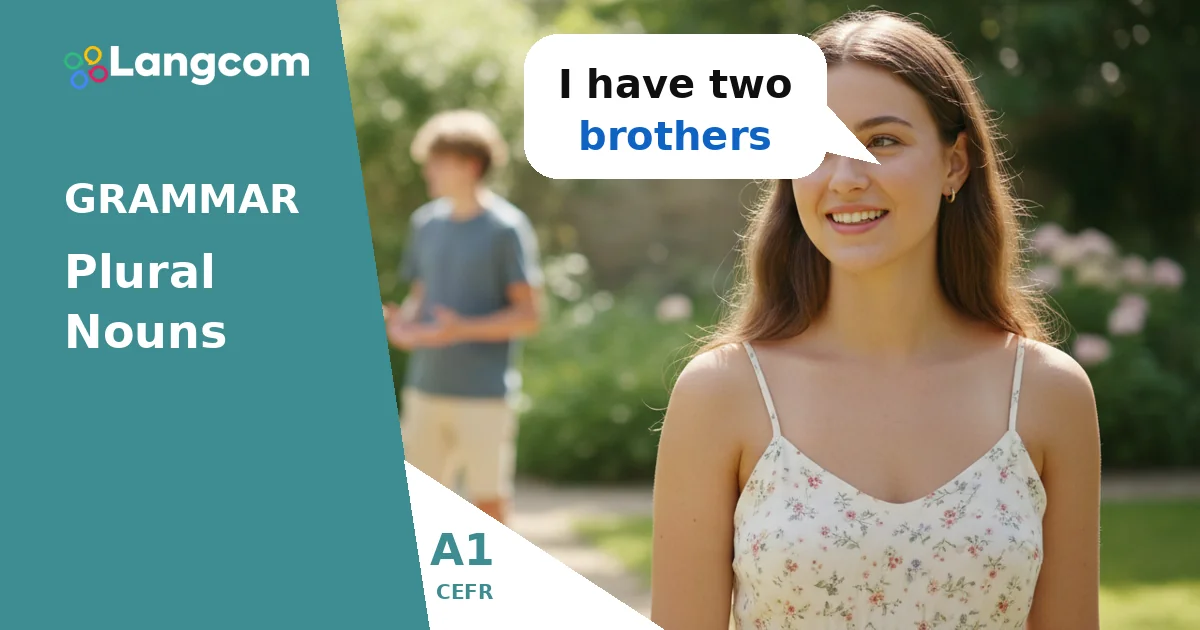

What Are Plural Nouns?
In English, nouns can be singular or plural. A singular noun means there is only one of something. A plural noun means there is more than one.
- One book (singular)
- Two books (plural)
It is important to use the correct form to show quantity.
🎓 Aprende inglés con el método mixto
Grupos reducidos · Tutor de IA disponible las 24 horas del día, los 7 días de la semana · Preparación para los exámenes de Cambridge
Planes de $39 $79 al mes
How Do We Make Most Nouns Plural?
For most nouns in English, we simply add -s hasta el final de la palabra.
- dog → dogs
- table → tables
- car → cars
- flower → flowers
What About Nouns Ending in -s, -ss, -x, -ch, -sh?
When a noun ends with -s, -ss, -x, -ch, o -sh, añadimos -es to make it plural. This makes the word easier to say.
- bus → buses
- dress → dresses
- box → boxes
- watch → watches
- brush → brushes
Nouns Ending in -y?
If a noun ends in -y and the letter before -y is a consonant (like b, d, r, t), we change the -y a -i and add -es.
- baby → babies
- city → cities
- party → parties
But if the letter before -y is a vowel (like a, e, i, o, u), we just add -s.
- toy → toys
- day → days
Irregular Plural Nouns: Special Cases
Some nouns do not follow the regular rules. They change their form in different ways or stay the same. You need to learn these special words.
- man → men
- woman → women
- child → children
- foot → feet
- tooth → teeth
- mouse → mice
Some nouns have the same singular and plural form:
- sheep → sheep
- fish → fish
| Rule | Singular Example | Plural Example |
|---|---|---|
| Add -s | book | books |
| Add -es | bus | buses |
| -y to -ies | baby | babies |
| Irregular | man | men |
| No Change | sheep | sheep |
Ejemplos
- I have two brothers and one sister.
- There are many buses in the city.
- The children are playing with their toys.
- My feet are tired after walking all day.
- She bought three new dresses for the parties.
Práctica
💬 ¿Necesitas asesoramiento personalizado?
Como centro autorizado de preparación para los exámenes de Cambridge, podemos orientarte para que elijas el curso y la certificación más adecuados. Habla hoy mismo con nuestros asesores.
Chatea con un asesor por WhatsAppErrores habituales de los hispanohablantes
Spanish speakers sometimes make common mistakes with English plural nouns:
- Añadir -s to all nouns: Remember to use -es for words ending in -s, -ss, -x, -ch, -sh.
✗ Two bus.
✓ Two buses. - Not changing -y a -ies: If a noun ends in -y after a consonant, it changes.
✗ Many citys.
✓ Many cities. - Forgetting irregular forms: Irregular plurals must be memorized.
✗ Three mans.
✓ Three men.
Preguntas más frecuentes
What is the most common way to make a noun plural in English?
The most common way is to add -s to the end of the noun. For example, apple se convierte en apples.
When do I add -es instead of -s?
Se añade -es when a noun ends in -s, -ss, -x, -ch, o -sh. Por ejemplo, fox se convierte en foxes.
Are there any nouns that do not change in the plural form?
Yes, some nouns have the same form for both singular and plural. Common examples for A1 are sheep y fish.
How do I know if a noun is irregular?
Irregular nouns do not follow the standard rules. You need to learn them by heart. Examples include man/men y child/children.


0 Comentarios