

What Do “Too” and “Enough” Mean?
These words are called “degree modifiers.” They change the meaning of adjectives, adverbs, or nouns.
They tell us if something is more or less than what is needed or wanted.
🎓 Aprende inglés con el método mixto
Grupos reducidos · Tutor de IA disponible las 24 horas del día, los 7 días de la semana · Preparación para los exámenes de Cambridge
Planes de $39 $79 al mes
When Do We Use "Too"?
- Utilizamos too to say that something is *more than necessary* or *more than wanted*.
- It often has a negative meaning, showing a problem or a bad result.
- Think of too as meaning "excessively."
- Too always comes *before* an adjective or an adverb.
When Do We Use "Enough"?
- Utilizamos enough to say that something is *sufficient* or *the right amount*.
- It can have a positive or negative meaning, depending on if it's used with not.
- Enough has two positions:
- *After* an adjective or an adverb.
- *Before* a noun.
Using "Too" with Adjectives and Adverbs
The structure is always too + adjective/adverb.
This shows that the quality is in excess.
- The coffee is too hot to drink. (The coffee is excessively hot.)
- He walks too slowly. (His walking speed is excessively slow.)
- This box is too heavy for me to lift. (The box has excessive weight.)
Using "Enough" with Adjectives and Adverbs
The structure is always adjective/adverb + enough.
This shows that the quality is sufficient or not sufficient.
- Are you warm enough? (Are you sufficiently warm?)
- He isn't tall enough to reach the shelf. (He is not sufficiently tall.)
- She doesn't speak loudly enough. (Her speaking volume is not sufficiently loud.)
Using "Enough" with Nouns
The structure is always enough + noun.
This shows that there is a sufficient or not sufficient quantity of something.
- Do we have enough food for everyone? (Do we have a sufficient quantity of food?)
- I don't have enough money to buy that car. (I don't have a sufficient quantity of money.)
- There isn't enough time to finish the test. (There isn't a sufficient quantity of time.)
| Palabra | Position | Example with Adjective/Adverb | Example with Noun |
|---|---|---|---|
| Too | before + adjective/adverb | too hot | (not used with nouns directly) |
| Enough | adjective/adverb + enough enough + noun |
hot enough | enough money |
Ejemplos
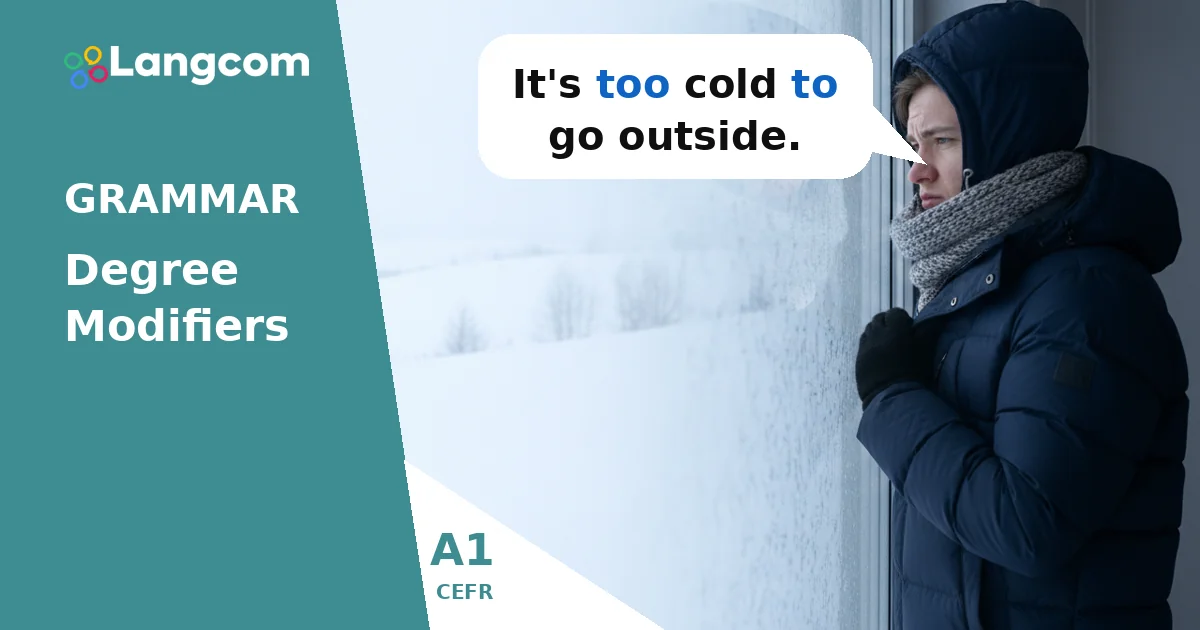
- It's too cold to go outside.
- She drives too fast.
- This shirt is too small for me.
- Are you warm enough?
- He isn't strong enough to open the jar.
- Do you have enough water?
- We don't have enough chairs.
Práctica
💬 ¿Necesitas asesoramiento personalizado?
Como centro autorizado de preparación para los exámenes de Cambridge, podemos orientarte para que elijas el curso y la certificación más adecuados. Habla hoy mismo con nuestros asesores.
Chatea con un asesor por WhatsAppErrores habituales de los hispanohablantes
Here are some common mistakes Spanish speakers make when using too y enough:
- Wrong position for enough: Spanish speakers often put enough *before* the adjective, like in Spanish ("bastante fuerte"). In English, it must go *after*.
- Wrong: He is enough strong.
- Right: He is strong enough.
- Confuso too con very: Too means "excessively" and implies a problem. Very just means "a lot" and is neutral.
- It's very hot. (Just a fact, maybe you like it.)
- It's too hot. (It's a problem, you can't sleep.)
- Uso de too much/many en lugar de too with adjectives: Too much/many is for nouns. Too is for adjectives/adverbs.
- Wrong: The soup is too much salty.
- Right: The soup is too salty.
Preguntas más frecuentes
What is the main difference between "too" and "enough"?
Too means "more than needed or wanted" (excessive). Enough means "the right amount" (sufficient).
Where do I put "too"?
Too always goes *before* adjectives and adverbs. For example, too big o too quickly.
Where do I put "enough"?
Enough goes *after* adjectives and adverbs (e.g., big enough, quickly enough) but *before* nouns (e.g., enough money, enough time).
Can I use "too" or "enough" with verbs?
Not directly. You use them with adjectives, adverbs, or nouns. For example, you can say He eats too much (with the adverb much), but not He too eats.




0 Comentarios