

What is the Present Simple used for?
En Present Simple helps us talk about things that are always true or happen regularly. It describes routines and facts.
- Hábitos y rutinas: Actions you do often. For example, I drink coffee every morning.
- Hechos y verdades generales: Things that are always true. For instance, Water boils at 100 degrees Celsius.
- Horarios y calendarios: Fixed events like public transport or cinema times. For example, The train leaves at 7:00 AM.
- Verbs of State (Non-Action Verbs): These verbs describe states, feelings, or opinions, not actions. They usually do not use continuous forms. Examples include know, love, believe, understand.
✍️ ¿No sabes en qué nivel estás?
Realiza nuestra prueba de nivel gratuita y recibe comentarios personalizados de examinadores certificados por Cambridge.
Realice nuestra prueba de nivel GRATUITA¿Cómo se forma el presente simple?
The structure of the Present Simple is straightforward. Remember the -s for third-person singular subjects.
- Positive Form:
- For I, you, we, they, use the base form of the verb: They play football.
- For he, she, it, añadir -s o -es to the verb: She plays tennis. - Negative Form:
- Use do not (don't) o does not (doesn't) + the base form of the verb.
- I don't like pizza.
- He doesn't speak French. - Question Form:
- Use Do o Does + subject + base form of the verb.
- Do you live here?
- Does she work on Saturdays?
What is the Present Continuous used for?
En Present Continuous (also called Present Progressive) describes actions that are in progress. It focuses on temporary situations.
- Actions Happening Now: Something happening at the exact moment of speaking. For example, I am writing an email right now.
- Temporary Situations: Actions that are happening around now but not necessarily at this precise second. For instance, She is studying for her exams this month.
- Changing Situations: Trends or developments. For example, The climate is changing rapidly.
- Future Plans (Fixed Arrangements): When you have already decided and arranged something for the future. For instance, We are meeting John tomorrow.
How do we form the Present Continuous?
En Present Continuous always uses a form of the verb to be and the -ing form of the main verb.
- Positive Form:
- Subject + am/is/are + verb + -ing.
- I am reading a book.
- They are watching TV. - Negative Form:
- Subject + am/is/are + not + verb + -ing.
- I am not sleeping.
- He isn't listening. - Question Form:
- Am/Is/Are + subject + verb + -ing?
- Are you working?
- Is she coming?
Key Differences: When to use which?
Understanding the core difference is essential for B1 learners. Think about whether the action is regular or happening now.
- Regular vs. Now:
- Present Simple: For things that happen often, always, or are generally true. I usually walk to work.
- Present Continuous: For things happening at this moment or temporarily. I am walking to work today because my car is broken. - Permanent vs. Temporary:
- Present Simple: For permanent situations. My brother lives in London.
- Present Continuous: For temporary situations. My brother is living with friends for a few months. - Time Expressions as Clues:
- Present Simple: always, usually, often, sometimes, never, every day/week/month, on Mondays.
- Present Continuous: now, right now, at the moment, currently, this week/month/year, today.
| Característica | Present Simple | Present Continuous |
|---|---|---|
| Main Use | Habits, routines, facts, permanent situations, schedules. | Actions happening now, temporary situations, changing situations, future plans. |
| Form | Verb (base form or -s/-es) | am/is/are + verb + -ing |
| Keywords | always, usually, often, every day, never, on Mondays. | now, right now, at the moment, currently, this week, today. |
| Example | He works in a bank. | He is working on a report. |
Ejemplos
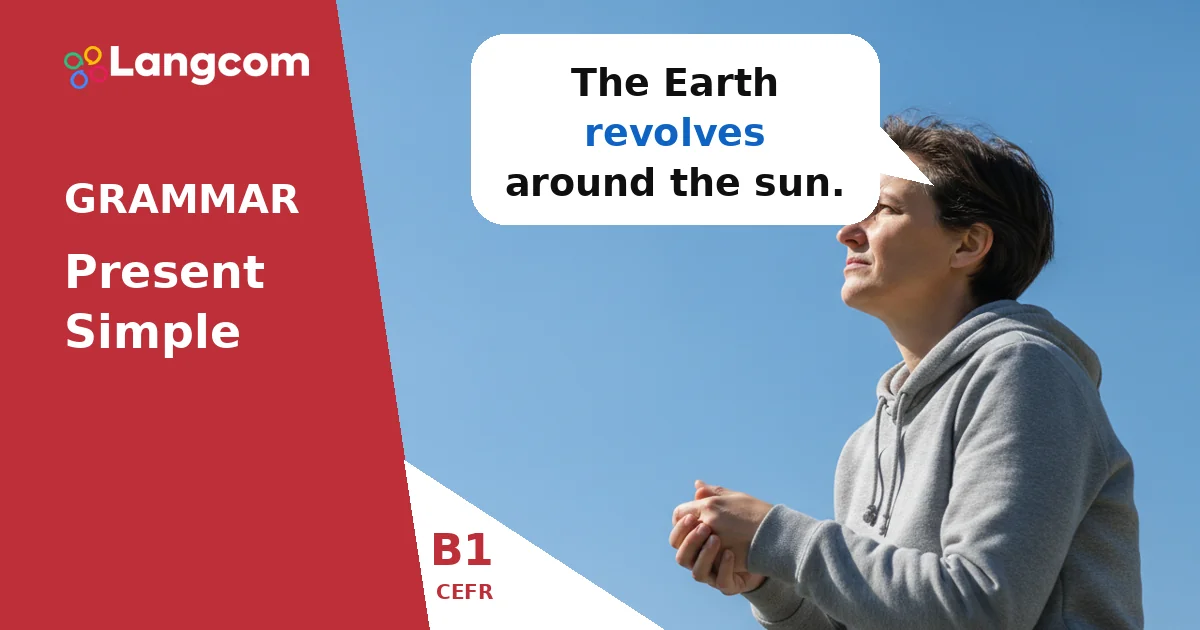
- The Earth revolves around the sun.
- She always drinks tea in the morning.
- What are you doing at the moment?
- I am not feeling well today.
- Does he play the guitar?
- They are building a new hospital in our town.
- My sister studies engineering at university.
- Look! It is snowing.
Práctica
¿Estás listo para obtener tu certificado?
El curso Langcom prepara a los alumnos para los exámenes de Cambridge, IELTS, TOEFL, DELE, SIELE y Michigan.
Empieza a utilizar LangcomErrores habituales de los hispanohablantes
Spanish speakers sometimes make specific mistakes when choosing between these two tenses.
- Using Present Simple for actions happening now:
- Incorrect: I eat dinner now.
- Correct: I am eating dinner now. (The action is in progress.) - Using Present Continuous for habits:
- Incorrect: She is always going to the gym. (Unless you mean an annoying habit.)
- Correct: She always goes to the gym. (It's a regular habit.) - Using Continuous forms with Verbs of State:
- Incorrect: I am knowing the answer.
- Correct: I know the answer. (Knowledge is a state, not an action.)
- Remember that verbs like love, hate, want, need, believe, understand, remember are usually not used in continuous forms.
Preguntas más frecuentes
What is the main difference between Present Simple and Present Continuous?
En Present Simple is for regular actions, facts, and permanent situations. The Present Continuous is for actions happening now, temporary situations, or future plans.
Can I use Present Continuous for future events?
Yes, you can use the Present Continuous for future plans or fixed arrangements, especially with a time expression. For example, I am visiting my parents next weekend.
Why don't some verbs use the Present Continuous?
Some verbs, called verbs of state o non-action verbs, describe states, feelings, or opinions rather than physical actions. They typically do not have continuous forms. Examples include know, believe, love, hate, understand, seem.
How is this grammar point relevant for the B1 Preliminary exam?
Understanding the Present Simple y Present Continuous is crucial for tasks like the Reading and Writing Part 6 (Open Cloze), where you fill in missing words. You need to choose the correct tense based on context and time expressions to complete sentences accurately.


0 Comentarios