

What is the Present Continuous for?
We use the Present Continuous to talk about things happening at the moment of speaking. Imagine you are looking out the window. What do you see?
- The sun is shining.
- A bird is singing.
It also describes temporary actions happening around now, even if not at the exact second.
- I am studying English this month. (Not necessarily right now, but in this period.)
- They are building a new house in my street. (The construction is ongoing.)
🎓 Aprende inglés con el método mixto
Grupos reducidos · Tutor de IA disponible las 24 horas del día, los 7 días de la semana · Preparación para los exámenes de Cambridge
Planes de $39 $79 al mes
How do we form the Present Continuous?
The Present Continuous has three parts: the subject, the verb to be, and the main verb with -ing.
Affirmative (Positive) Sentences
Uso Subject + am/is/are + verb-ing.
- I am watching TV.
- He is playing football.
- They are eating dinner.
Negative Sentences
Añadir not después de am/is/are. Use Subject + am/is/are + not + verb-ing.
- I am not working.
- She is not sleeping. (o She isn't sleeping.)
- We are not listening. (o We aren't listening.)
Questions
Put am/is/are before the subject. Use Am/Is/Are + Subject + verb-ing?
- Are you studying?
- Is he cooking?
- What are you doing?
Common Time Expressions with Present Continuous
These words often tell you to use the Present Continuous:
- now
- right now
- at the moment
- today
- this week / this month / this year
- Look!
- Listen!
| Asunto | Afirmativo | Negativo | Pregunta |
|---|---|---|---|
| I | I am working. | I am not working. | Am I working? |
| He/She/It | He is working. | He is not working. | Is he working? |
| We/You/They | We are working. | We are not working. | Are we working? |
Ejemplos
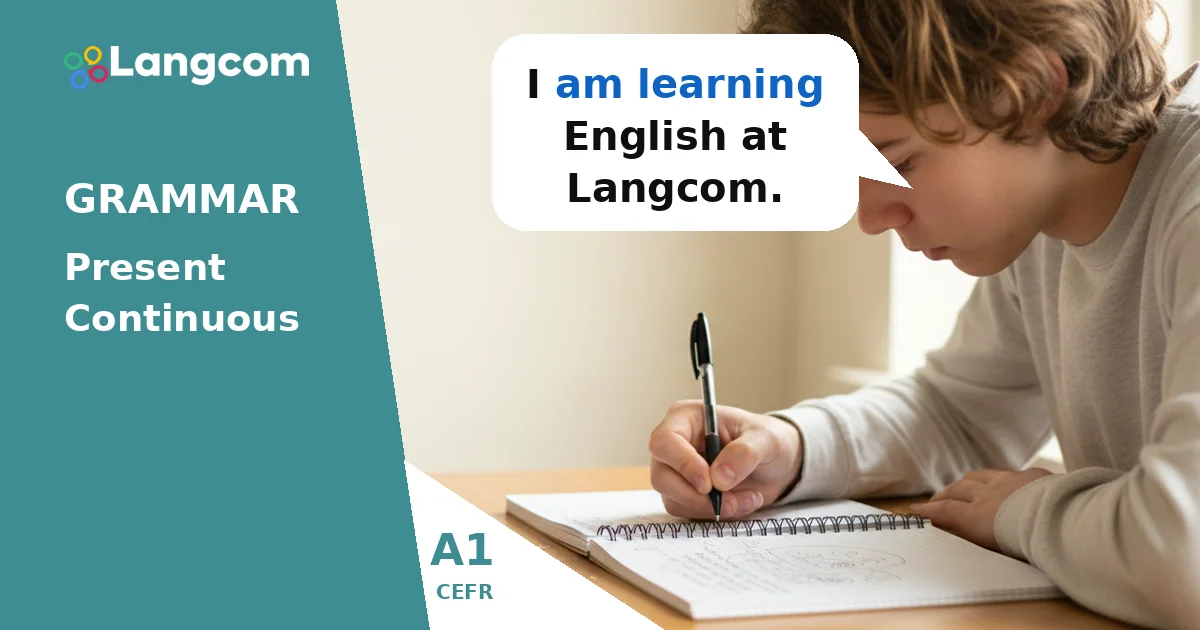
- I am learning English at Langcom.
- My brother is playing video games right now.
- The students are not talking during the exam.
- Is it raining outside?
- What are you wearing today?
- Look! The cat is chasing a mouse!
Práctica
💬 ¿Necesitas asesoramiento personalizado?
Como centro autorizado de preparación para los exámenes de Cambridge, podemos orientarte para que elijas el curso y la certificación más adecuados. Habla hoy mismo con nuestros asesores.
Chatea con un asesor por WhatsAppErrores habituales de los hispanohablantes
Spanish speakers sometimes use the Simple Present tense for actions happening now. In English, this is incorrect.
- Incorrecto: I study English now.
- Correcto: I am studying English now.
Remember to always include the correct form of the verb to be (am, is, are) before the -ing verb.
- Incorrecto: She cooking dinner.
- Correcto: She is cooking dinner.
Preguntas más frecuentes
¿Cuál es el uso principal del presente continuo?
The main use of the Present Continuous is to talk about actions happening at the moment of speaking, or temporary actions happening around now. For example, I am drinking coffee.
How do I make a negative sentence in the Present Continuous?
To make a negative sentence, you add not después de am, is, o are. Por ejemplo, He is not sleeping o They are not working.
Can I use the Present Continuous for future plans?
Yes, at higher levels (B1 and above), you can use the Present Continuous for definite future plans, especially with a future time expression. For example, I am meeting my friend tomorrow. However, for A1, focus on actions happening now.



0 Comentarios