

What Are Possessive Pronouns?
Possessive pronouns are words that show ownership. They tell you “who owns what.”
They help you avoid repeating nouns. This makes your sentences sound more natural.
- Example: Instead of This is my pen. That pen is my pen.
- You can say: This is my pen. That pen is mine.
🎓 Aprende inglés con el método mixto
Grupos reducidos · Tutor de IA disponible las 24 horas del día, los 7 días de la semana · Preparación para los exámenes de Cambridge
Planes de $39 $79 al mes
List of Possessive Pronouns
Here are the possessive pronouns in English:
- mine (para I)
- yours (para you - singular and plural)
- his (para he)
- hers (para she)
- its (para it - less common as a pronoun)
- ours (para we)
- theirs (para they)
How to Use Possessive Pronouns
Possessive pronouns always stand alone. They do not need a noun after them.
They replace a possessive adjective + a noun.
- This is my phone. (Possessive adjective + noun)
- This phone is mine. (Possessive pronoun)
They can be the subject or the object of a sentence.
- Subject: Yours is on the table. (Your book is on the table.)
- Object: I like hers. (I like her idea.)
| Subject Pronoun | Possessive Adjective | Possessive Pronoun |
|---|---|---|
| I | my | mine |
| You | your | yours |
| He | his | his |
| She | her | hers |
| It | its | its |
| We | our | ours |
| They | their | theirs |
Ejemplos
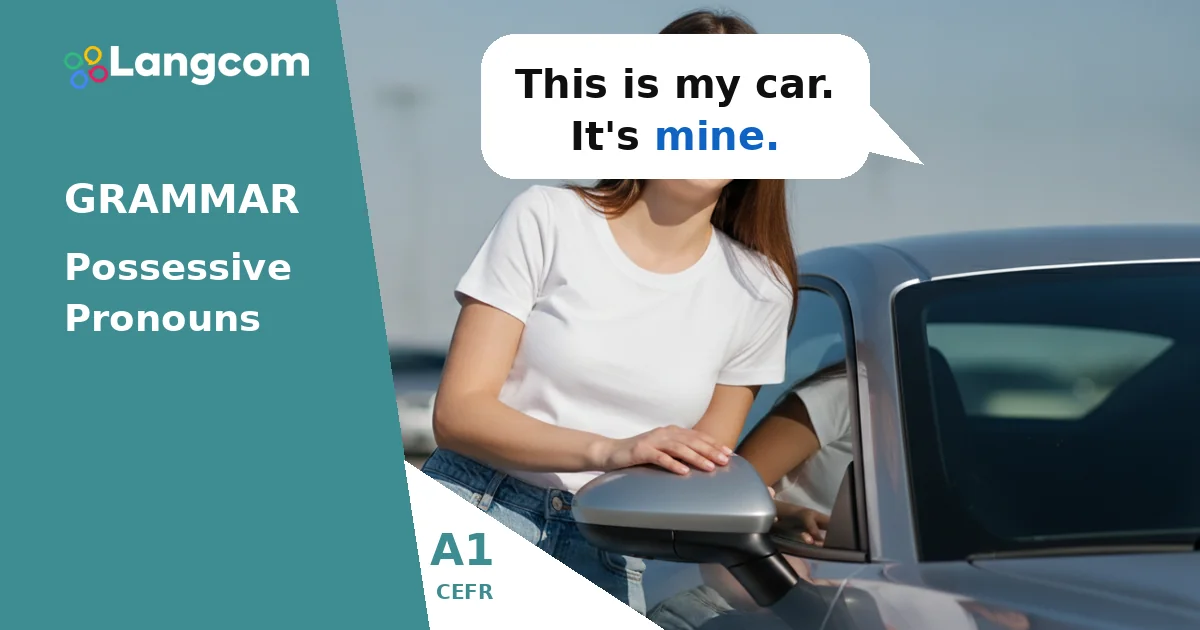
- This is my car. It's mine.
- Is this your bag? Yes, it's yours.
- He found his keys. The keys are his.
- She lost her umbrella. I think this one is hers.
- We bought a new house. It's ours now.
- They live in that apartment. That apartment is theirs.
- The dog played with its toy. The toy is its.
Práctica
💬 ¿Necesitas asesoramiento personalizado?
Como centro autorizado de preparación para los exámenes de Cambridge, podemos orientarte para que elijas el curso y la certificación más adecuados. Habla hoy mismo con nuestros asesores.
Chatea con un asesor por WhatsAppErrores habituales de los hispanohablantes
Los hispanohablantes a veces cometen estos errores:
- Using an article before the pronoun: In Spanish, you might say "la mía" or "el tuyo". In English, we do not use "the" before possessive pronouns.
- WRONG: The book is the mine.
- CORRECT: The book is mine.
- Confusing possessive adjectives and possessive pronouns: Remember, adjectives come before a noun, pronouns stand alone.
- WRONG: This is mine book.
- CORRECT: This is my book.
- CORRECT: This book is mine.
Preguntas más frecuentes
What is the difference between 'my' and 'mine'?
'My' is a possessive adjective. It always comes before a noun, like my book. 'Mine' is a possessive pronoun. It stands alone and replaces 'my + noun', like The book is mine.
Do possessive pronouns change for plural nouns?
No, the possessive pronouns themselves do not change. For example, mine is used for one thing (This is mine.) and for many things (These are mine.). The pronoun stays the same.
Can I use 'its' as a possessive pronoun?
Sí, its can be a possessive pronoun, but it is much less common than other possessive pronouns. You might hear The dog found its ball. The ball is its. but it is rare. Usually, we just repeat the noun or use a different structure.



0 Comentarios