

¿Qué son los países y las nacionalidades?
Los países son nombres de lugares. Son zonas geográficas con sus propios gobiernos.
- Ejemplos: Brazil, China, Spain.
Las nacionalidades son términos que describen a las personas procedentes de esos países. Nos indican de dónde es una persona.
- Ejemplos: Brazilian, Chinese, Spanish.
🎓 Aprende inglés con el método mixto
Grupos reducidos · Tutor de IA disponible las 24 horas del día, los 7 días de la semana · Preparación para los exámenes de Cambridge
Planes de $39 $79 al mes
¿Cómo se utilizan los nombres de países y las nacionalidades en las oraciones?
Utilizamos los países y las nacionalidades para referirnos al origen. Esto resulta muy útil cuando conoces a gente nueva.
- Uso "I am from + Country" para indicar tu origen.
- Ejemplo: I am from Colombia.
- Uso "I am + Nationality" para indicar tu nacionalidad.
- Ejemplo: I am Colombian.
También puedes preguntar a otras personas:
- Where are you from?
- What is your nationality?
¿Por qué son importantes los países y las nacionalidades?
Conocer estas palabras te ayuda a presentarte y a entender a los demás. Es un aspecto básico de la conversación.
- Puedes contarles cosas sobre ti: I am from Mexico. I am Mexican.
- Puedes saber dónde viven otras personas o dónde nacieron.
- Este vocabulario es imprescindible para viajar y hacer nuevos amigos.
| País | Nacionalidad |
|---|---|
| Spain | Spanish |
| Mexico | Mexican |
| United States | American |
| United Kingdom | British |
| Brazil | Brazilian |
| China | Chinese |
| Japan | Japanese |
| Russia | Russian |
| Colombia | Colombian |
Ejemplos
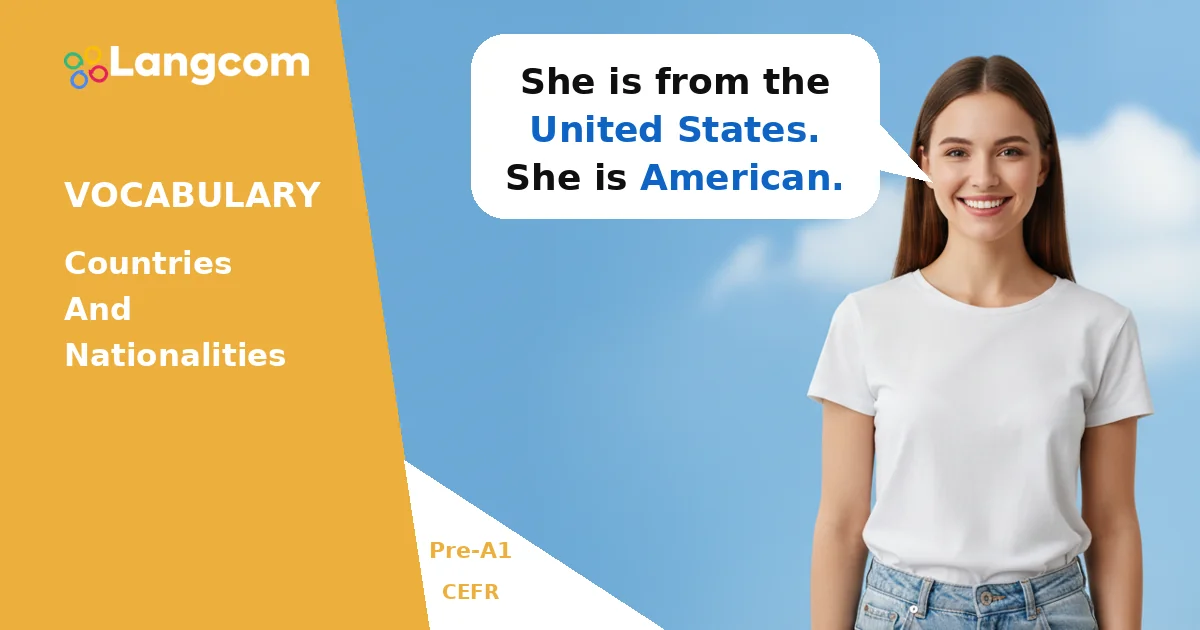
- She is from the United States. She is American.
- He is from Japan. He is Japanese.
- They are from Brazil. They are Brazilian.
- Are you from China? Are you Chinese?
- I am from Mexico. I am Mexican.
- We are from the United Kingdom. We are British.
Práctica
💬 ¿Necesitas asesoramiento personalizado?
Como centro autorizado de preparación para los exámenes de Cambridge, podemos orientarte para que elijas el curso y la certificación más adecuados. Habla hoy mismo con nuestros asesores.
Chatea con un asesor por WhatsAppErrores habituales de los hispanohablantes
Los hispanohablantes a veces cometen estos errores:
- No escribir con mayúscula los nombres de los países ni las nacionalidades: En inglés, estas palabras siempre se escriben con mayúscula.
- INCORRECTO: i am spanish.
- DERECHA: I am Spanish.
- INCORRECTO: she is from mexico.
- DERECHA: She is from Mexico.
- El uso de "el" delante de una nacionalidad cuando se habla de una sola persona: No se utiliza "el" cuando se hace referencia a la nacionalidad de una sola persona.
- INCORRECTO: I am the Spanish.
- DERECHA: I am Spanish.
- (Utilizamos "el" para los grupos, como "the Spanish people" o "the British", pero no por la nacionalidad de una sola persona.)
Preguntas más frecuentes
¿Cuál es la diferencia entre un país y una nacionalidad?
Un país es un lugar, como Spain. «Nacionalidad» es una palabra que describe a una persona originaria de ese país, como Spanish.
¿Siempre hay que escribir con mayúscula los nombres de los países y las nacionalidades?
Sí, escribe siempre con mayúscula inicial los nombres de los países (p. ej., Colombia) y palabras relacionadas con la nacionalidad (p. ej., Colombian) en inglés.
¿Cómo le pregunto a alguien de dónde es?
Puedes preguntar: "Where are you from?" o "What is your nationality?"




0 Comentarios