
por Raúl | Sep 20, 2026 | B2 First (FCE)
Degree modifiers like enough, too, very, so, and such tell us about the intensity or extent of an adjective, adverb, or noun. They add crucial detail to your sentences, helping you express exactly how much or how little of something you mean. For example, you might...

por Raúl | Sep 20, 2026 | B2 First (FCE)
Phrasal verbs with come and go are common and important for B2 English, especially for the B2 First (FCE) exam. These verbs combine come or go with a preposition or adverb, changing their original meaning significantly. For example, come means ‘move towards the...
por Raúl | Sep 20, 2026 | B2 First (FCE)
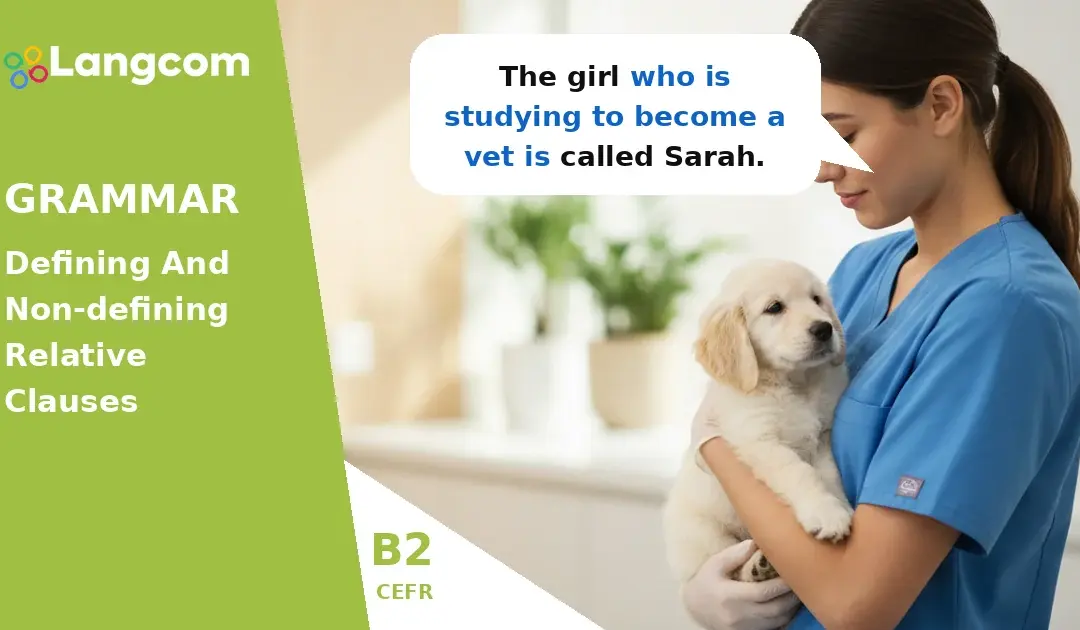
Relative clauses add information to a noun, but it’s crucial to understand if that information is essential (defining) or extra (non-defining), as this changes punctuation and pronoun choice. Defining relative clauses give necessary details about a noun. Without...

por Raúl | Sep 20, 2026 | B2 First (FCE)
Understanding phrasal verbs and expressions with look is essential for B2 English learners. The verb look is incredibly versatile, changing its meaning significantly when combined with different prepositions or adverbs. These combinations, known as phrasal verbs, are...

por Raúl | Sep 20, 2026 | B2 First (FCE)
Using the correct prepositions (in, on, at, for, during) and knowing when to use or omit articles (the) are key to mastering English time expressions. For specific times, use at (e.g., at 3 pm). For days and dates, use on (e.g., on Tuesday, on June 24th). Use in for...

por Raúl | Sep 20, 2026 | B2 First (FCE)
To show possession in English, you can use three main structures: the possessive ‘s, the preposition of, or a compound noun (noun + noun). The choice depends on what you are talking about. We typically use ‘s for people, animals, time, and some...
