
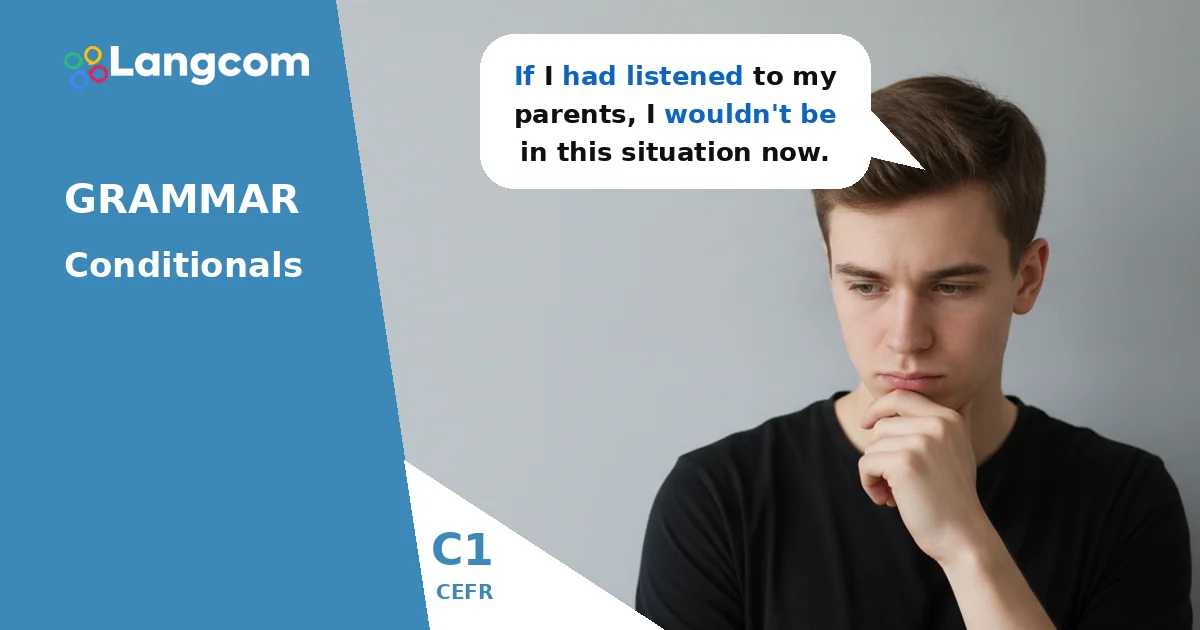

What are Mixed Conditionals?
Mixed conditionals combine elements from different conditional types (First, Second, Third) to express more complex relationships between events. They are essential for C1 learners to communicate precise meanings.
There are two main types of mixed conditionals, each connecting different time frames.
- Past Condition, Present Result: This type describes a hypothetical past action or situation and its imagined result in the present. The structure is If + past perfect, would + base verb.
- Present Condition, Past Result: This type describes a hypothetical present condition or general truth and its imagined result in the past. The structure is If + simple past, would have + past participle.
✍️ ¿No sabes en qué nivel estás?
Realiza nuestra prueba de nivel gratuita y recibe comentarios personalizados de examinadores certificados por Cambridge.
Realice nuestra prueba de nivel GRATUITAHow to Use Continuous Forms in Conditionals?
Continuous forms add an important layer of meaning to conditional sentences. They emphasize that an action was ongoing, temporary, or in progress at a specific time.
- In the 'if' clause (condition): You can use the past continuous or past perfect continuous.
- If + past continuous: Describes an ongoing action in the past that is the condition for a past or present result. For example, If I were working today, I couldn't go to the beach.
- If + past perfect continuous: Describes an action that was ongoing up to a specific point in the past. For example, If it hadn't been snowing all morning, we would have gone for a walk.
- In the main clause (result): Puedes utilizar would be + -ing o would have been + -ing.
- would be + -ing: Describes an ongoing hypothetical action in the present or future. For example, If I had studied, I would be enjoying the party now.
- would have been + -ing: Describes an ongoing hypothetical action in the past. For example, If you had called me, I would have been waiting for you.
Why Use Continuous Conditionals at C1 Level?
Using continuous forms in conditionals allows for greater precision and naturalness in your English. It helps you express nuances that simple forms cannot.
- To show duration: Emphasize that an action continued for some time, not just a single event. For example, If she hadn't been living abroad for so long, her Spanish wouldn't be so fluent.
- To describe a temporary state: Indicate that a condition or result was not permanent. For example, If he wasn't feeling so tired, he would join us.
- To set a scene: Provide background information for the main conditional event. For example, If the sun had been shining, the picnic would have been perfect.
| Tipo | Structure | Significado | Ejemplo |
|---|---|---|---|
| Past Condition, Present Result | If + past perfect, would + base verb | A hypothetical past action or situation affects the present. | If I had taken that job, I would be living in London now. |
| Present Condition, Past Result | If + simple past, would have + past participle | A hypothetical present condition or general truth affects the past. | If I weren't so afraid of heights, I would have tried bungee jumping. |
| Continuous in 'if' clause (Past) | If + past perfect continuous, ... | An ongoing past action is the condition. | If it hadn't been raining, we would have gone for a walk. |
| Continuous in 'if' clause (Present) | If + past continuous, ... | An ongoing present action/state is the condition. | If he were still working, he would be very tired. |
| Continuous in main clause (Present) | ... would be + -ing | An ongoing hypothetical action in the present/future. | If I had saved money, I would be traveling right now. |
| Continuous in main clause (Past) | ... would have been + -ing | An ongoing hypothetical action in the past. | If you had called, I would have been waiting for you. |
Ejemplos
- If I had listened to my parents, I wouldn't be in this situation now.
- If she weren't so busy, she would have helped us yesterday.
- If you had been paying attention, you would know the answer.
- If it weren't raining, we would be playing outside.
- If he hadn't been driving so fast, he wouldn't have gotten a ticket.
- I would be traveling the world if I had won the lottery last year.
- They would have been celebrating if their team had won the championship.
Práctica
¿Estás listo para obtener tu certificado?
El curso Langcom prepara a los alumnos para los exámenes de Cambridge, IELTS, TOEFL, DELE, SIELE y Michigan.
Empieza a utilizar LangcomErrores habituales de los hispanohablantes
Spanish speakers often make mistakes with mixed conditionals due to direct translation or confusion with standard conditional types.
- Confusing time frames: A common error is using a past result with a present condition when a past condition is needed. For example, saying If I was rich (present), I would have bought that car (past). This should be If I had been rich (past), I would have bought that car (past). Or, for a true mixed conditional: If I were rich (present condition), I would buy that car (present/future result).
- Incorrect continuous forms: Sometimes, learners might use a simple form when a continuous form is more appropriate to emphasize duration. For example, If it didn't rain, we would go. (Simple) vs. If it weren't raining, we would be going. (Continuous, emphasizing ongoing action).
- Mixing 'would' and 'had' in the 'if' clause: Recuerda que, would is for the main clause (result), and had is for the 'if' clause (condition) in third conditionals and mixed conditionals with a past condition. Avoid If I would have known...; use If I had known...
Puntos clave
- Mixed conditionals combine two different time frames in a single sentence.
- Past condition to present result: If plus past perfect, would plus base verb.
- Present condition to past result: If plus simple past, would have plus past participle.
- Continuous forms (would be plus -ing, would have been plus -ing) add emphasis on duration or a temporary state.
- Never mix would into the if-clause - use If I had known, not If I would have known.
Preguntas más frecuentes
What is the difference between 'If I were' and 'If I had been'?
If I were is used for hypothetical present or future situations (Second Conditional), as in If I were taller, I would play basketball. If I had been is used for hypothetical past situations (Third Conditional), as in If I had been there, I would have helped. In mixed conditionals, If I were can be a present condition for a past result.
Can I use 'was' instead of 'were' in conditional sentences?
In informal English, especially spoken, you might hear If I was. However, for C1 level and formal writing, If I were is the grammatically correct and preferred form for all persons (I, he, she, it) in the second conditional and mixed conditionals expressing a present hypothetical condition. For example, If he were here, he would agree.
How are mixed conditionals tested in the C1 Advanced exam?
In the C1 Advanced (CAE) exam, mixed conditionals often appear in the Use of English paper, particularly in Part 2 (Open Cloze) and Part 4 (Key Word Transformations). You might need to complete sentences or rewrite them using a given word, demonstrating your ability to combine different conditional forms correctly and naturally.
Are continuous forms always necessary in conditionals?
No, continuous forms are not always necessary. They are used to add specific meaning, such as duration, an ongoing action, or a temporary state. If you want to express a simple, completed action or a general truth, simple forms are correct. For example, If I had studied, I would pass the exam. (Simple result) vs. If I had studied, I would be passing the exam now. (Ongoing result).


0 Comentarios