

Why is Pronunciation Important for Common Objects?
When you learn new words, it is important to learn how to say them correctly. Good pronunciation helps people understand you easily.
- Small differences in sounds can sometimes change the meaning of a word.
- Clear pronunciation makes you feel more confident when you speak English.
🎓 Aprende inglés con el método mixto
Grupos reducidos · Tutor de IA disponible las 24 horas del día, los 7 días de la semana · Preparación para los exámenes de Cambridge
Planes de $39 $79 al mes
How Do I Say the Short 'A' Sound (as in 'bag')?
The short 'a' sound in English is different from the 'a' sound in Spanish. In Spanish, 'a' is usually a clear, open sound.
- For the English short 'a', open your mouth wider. Your tongue should be flatter in your mouth.
- It sounds like the 'a' in cat o apple.
- Practice saying: bag, glass.
What About the 'CK' Sound (as in 'clock')?
When you see ck together in English, it makes one sound. It sounds like a single 'k' sound.
- Do not say two separate sounds (c-k). Just make one short, sharp 'k' sound.
- It is the same sound as the 'k' in kick.
- Practice saying: clock.
How Do I Pronounce the 'OO' Sound (as in 'football')?
En oo in words like football makes a long 'u' sound. It is similar to the 'u' in the Spanish word 'luna'.
- Round your lips when you make this sound.
- It sounds like the 'oo' in moon o food.
- Practice saying: football.
Understanding the Hard 'G' Sound (as in 'guitar' and 'bag')
In English, the letter 'g' often makes a 'hard g' sound. This sound is like the 'g' in the English word go or the Spanish word 'gato'.
- This sound is made at the back of your throat.
- At the end of words, like bag, the 'g' is also a hard sound.
- Practice saying: guitar, bag.
| Object | Key Sound | Tip |
|---|---|---|
| bag | Short 'a' | Open your mouth wide, flatten your tongue. |
| clock | 'ck' sound | Make a short, sharp 'k' sound, no extra vowel. |
| football | 'oo' sound | Round your lips, like saying 'u' in 'blue'. |
| guitar | Hard 'g' | Sound like the 'g' in 'go', from the back of your throat. |
| glass | Short 'a' | Open your mouth wide, flatten your tongue. |
Ejemplos
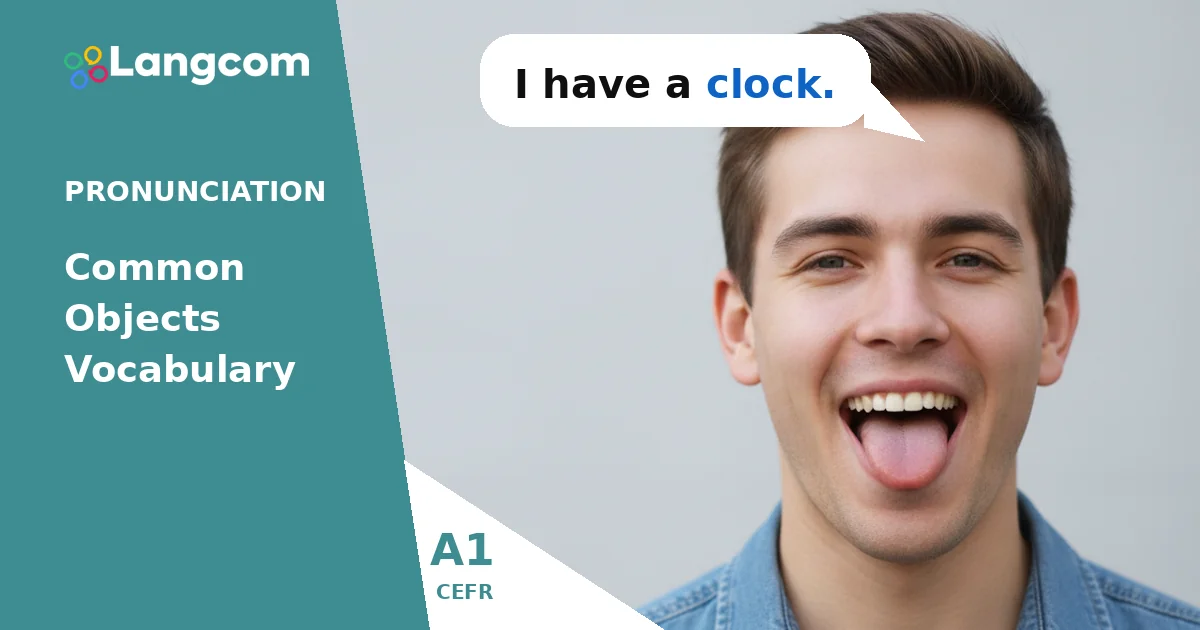
- I have a clock.
- I play with a football.
- I play the guitar.
- I have a bag.
- I drink a glass of water.
Práctica
💬 ¿Necesitas asesoramiento personalizado?
Como centro autorizado de preparación para los exámenes de Cambridge, podemos orientarte para que elijas el curso y la certificación más adecuados. Habla hoy mismo con nuestros asesores.
Chatea con un asesor por WhatsAppErrores habituales de los hispanohablantes
Spanish speakers sometimes make these common pronunciation mistakes:
- Short 'A' Sound: You might pronounce the 'a' in bag like the Spanish 'a' (e.g., baag). Remember to open your mouth wider for the English short 'a' sound (bæg).
- Ending Consonants: Sometimes, an extra vowel sound is added at the end of words that finish with a consonant. For example, saying cloc-eh instead of a sharp, clear klɒk para clock.
- 'G' Sound at the End: You might pronounce the 'g' at the end of bag like a Spanish 'j' (e.g., baj). Remember it is a hard 'g' sound (bæg).
Preguntas más frecuentes
Why is English pronunciation so different from Spanish?
English has many more vowel sounds than Spanish. It also has different consonant sounds and stress patterns. This makes it sound different to your ear.
How can I practice these sounds effectively?
Listen to native English speakers carefully. Repeat the words and sentences many times. You can also record yourself and listen back to compare your pronunciation with a native speaker's.
Do I need perfect pronunciation at A1 level?
No, you do not need perfect pronunciation. The goal at A1 is to be understood. Focusing on clear pronunciation of key sounds will help you communicate effectively.
What kind of exercise will help me with this?
Exercises like 'Speak the Words' are very helpful. They allow you to say sentences aloud and get immediate feedback on your pronunciation, helping you improve.

0 Comentarios