

What is the Present Subjunctive and How Does it Form?
The present subjunctive is a special verb form in English that expresses a wish, a demand, a suggestion, or a statement of importance. It is used in formal situations to give authority to what you say.
Unlike other verb forms, the present subjunctive has a very simple structure:
- It uses the base form of the verb for all subjects. This means you do not add -s for third-person singular subjects (he, she, it).
- For the verb to be, the present subjunctive form is always be, no matter the subject.
- To make it negative, you put not before the base form of the verb.
✍️ Not sure which level you are?
Take our free placement test and get personalized feedback from certified Cambridge examiners.
Take our FREE Placement TestWhen Do We Use the Present Subjunctive?
The present subjunctive is typically found in that-clauses. These clauses follow certain verbs, nouns, or adjective phrases that express a strong opinion, a request, or a necessity.
After Verbs of Demand, Suggestion, or Recommendation:
Use the present subjunctive after verbs like advise, ask, demand, insist, propose, recommend, request, suggest, and urge.
After Nouns of Demand, Suggestion, or Recommendation:
You will also see the present subjunctive after nouns that come from these types of verbs. Common nouns include demand, insistence, proposal, recommendation, request, and suggestion.
After Adjective Phrases Expressing Importance or Necessity:
The present subjunctive is used in clauses following phrases like it is essential that, it is imperative that, it is important that, it is necessary that, and it is vital that.
| Category | Examples of Triggers | Example Sentence |
|---|---|---|
| Verbs | demand, insist, suggest, recommend, advise, ask | They demanded that he resign immediately. |
| Nouns | demand, insistence, suggestion, recommendation, request | Her suggestion was that he be more careful. |
| Adjectives | essential, important, vital, imperative, necessary | It is vital that she understand the rules clearly. |
Examples
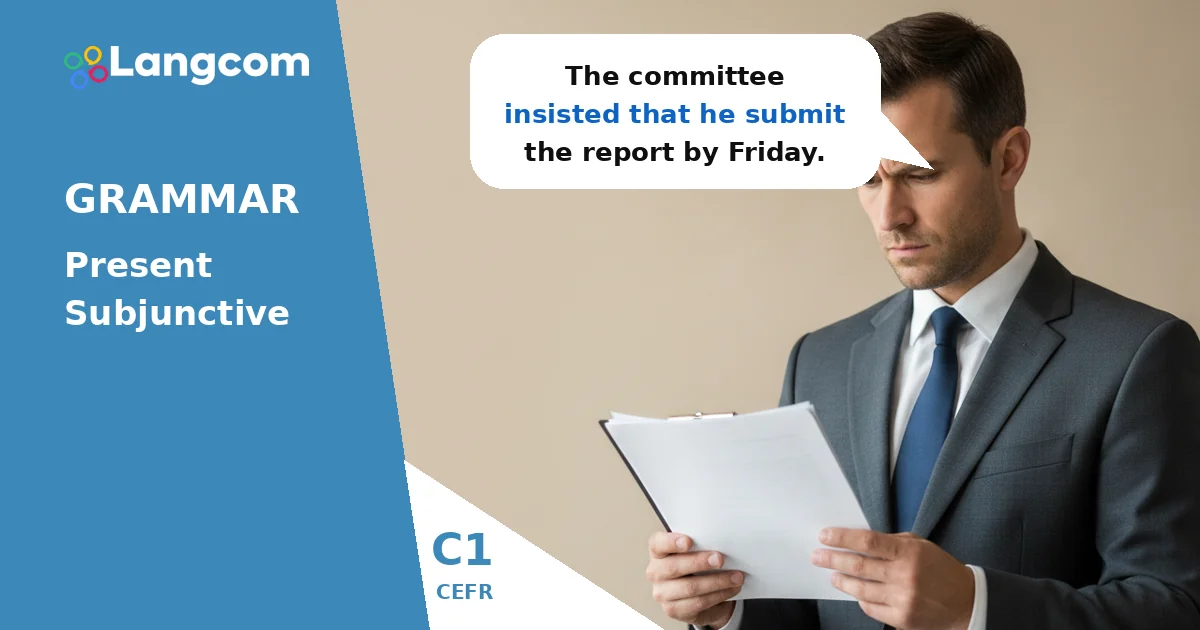
- The committee insisted that he submit the report by Friday.
- We recommend that she be present at the next meeting.
- I suggest that you not worry about the small details.
- Her demand that all employees arrive on time was clear.
- There was a strong suggestion that the project be delayed.
- It is vital that every team member understand the new policy.
- It is important that he be informed immediately of any changes.
Practice
Ready to earn your certificate?
Langcom prepares students for Cambridge, IELTS, TOEFL, DELE, SIELE and Michigan exams.
Get started with LangcomCommon mistakes for Spanish speakers
Spanish speakers often make two common mistakes when using the present subjunctive in English.
First, they might add an -s to the verb for third-person singular subjects, similar to the simple present tense. However, the subjunctive always uses the base form of the verb.
- INCORRECT: The company demands that he submits the proposal.
- CORRECT: The company demands that he submit the proposal.
Second, for the verb to be, the subjunctive form is always be, not is, are, or am. This can feel unnatural because it doesn't change with the subject.
- INCORRECT: It is essential that she is ready.
- CORRECT: It is essential that she be ready.
- INCORRECT: They requested that we are there.
- CORRECT: They requested that we be there.
Frequently asked questions
What is the main difference between the present subjunctive and the indicative?
The main difference is in form and function. The present subjunctive uses the base form of the verb for all subjects (e.g., he go, it be), while the indicative changes (e.g., he goes, it is). The subjunctive expresses demands, suggestions, or importance, often in formal contexts, whereas the indicative states facts or opinions.
Is the present subjunctive common in everyday English speech?
No, the present subjunctive is generally more formal and less common in everyday spoken English. You will encounter it more often in written English, especially in official documents, academic texts, or formal speeches. In casual conversation, people often use should instead (e.g., I suggest that he should go instead of I suggest that he go).
Can I use 'should' instead of the present subjunctive?
Yes, in many cases, especially in less formal contexts, you can use should + base form as an alternative to the present subjunctive (e.g., I recommend that he should study harder instead of I recommend that he study harder). However, the subjunctive form is more emphatic and formal, particularly after verbs like insist or demand.
How might the present subjunctive be tested in a C1 English exam?
In a C1 exam, you might encounter tasks that require you to complete sentences with the correct verb form, identify errors in sentences using the subjunctive, or transform sentences to use more formal language. For example, you might need to choose between insists that he goes and insists that he go.



0 Comments