


How Do We Make Present Simple Questions?
We use special words to ask questions in the present simple. These words are do and does. They come before the subject of the sentence.
- For subjects I, you, we, they, we use do.
- For subjects he, she, it, we use does.
The main verb in the question always stays in its base form. This means it does not change, even for he, she, it.
🎓 Learn English with the Blended method
Small groups · 24/7 AI Tutor · Cambridge preparation
Plans from $39 $79 per month
What is the Structure for Present Simple Questions?
The basic structure for present simple questions is simple:
- Do/Does + Subject + Base Form of Verb + ...?
Remember that the main verb never has an -s ending in questions, even with he, she, it. The -s is already in does.
When Do We Use Present Simple Questions?
We ask present simple questions to talk about different things:
- Habits and Routines: Things you do every day or often. For example, Do you wake up early?
- Facts and General Truths: Things that are always true. For example, Does the sun rise in the east?
- Opinions: What someone thinks or likes. For example, Do they like pizza?
How Do We Give Short Answers?
When someone asks a do or does question, we can give a short answer. This is a quick way to say yes or no.
- For 'Yes' answers: Yes, + subject + do/does.
- For 'No' answers: No, + subject + don't/doesn't.
We use don't for do not and doesn't for does not.
| Question | Affirmative Answer | Negative Answer |
|---|---|---|
| Do you like milk? | Yes, I do. | No, I don't. |
| Does he like coffee? | Yes, he does. | No, he doesn't. |
| Does she like tea? | Yes, she does. | No, she doesn't. |
| Do cats like milk? | Yes, they do. | No, they don't. |
Examples
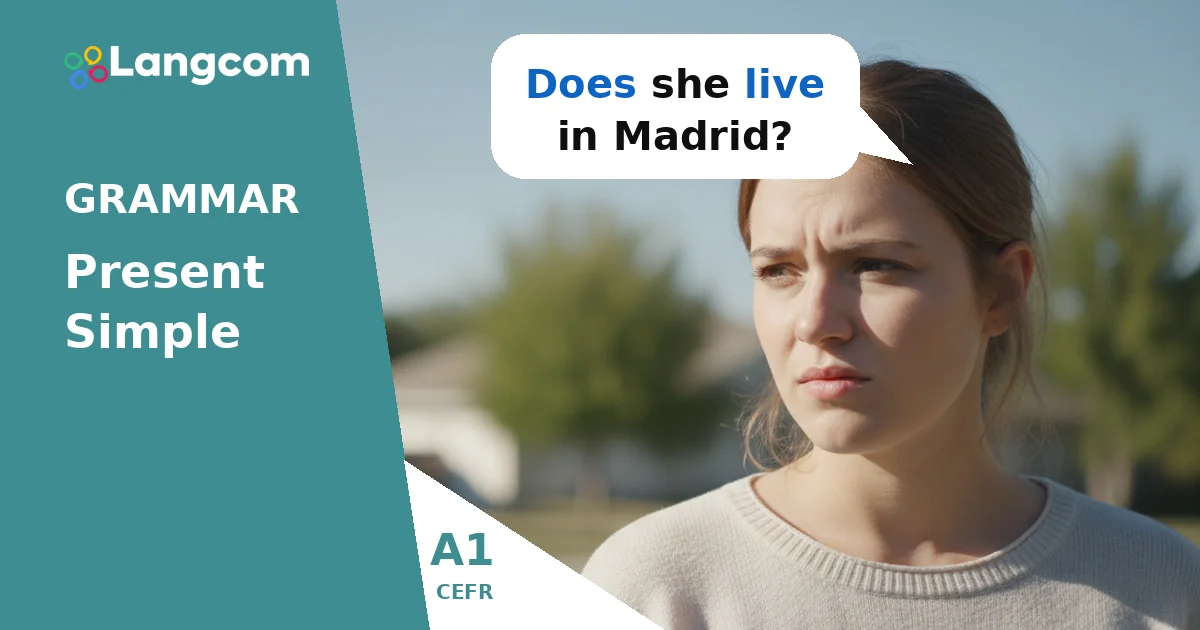
- Do you live in Madrid?
- Does he play football on Sundays?
- Do they speak English well?
- Does she work at the hospital?
- Do we need more milk?
- Does it rain often in winter?
Practice
💬 Need personalized guidance?
As an Authorized Cambridge Preparation Centre, we can guide you to the right course and certification. Chat with our advisors today.
Chat with an Advisor on WhatsAppCommon mistakes for Spanish speakers
Spanish speakers sometimes make two common mistakes with present simple questions:
- Forgetting do or does: In Spanish, you just change your voice to ask a question. In English, you must use do or does.
Wrong: You like coffee?
Right: Do you like coffee? - Adding -s to the main verb for he/she/it: The -s is only for affirmative sentences. In questions, the main verb is always in its base form.
Wrong: Does he likes pizza?
Right: Does he like pizza?
Frequently asked questions
What is the main word we use to ask questions in the present simple?
The main words are do and does. We put them at the start of the question.
When do I use 'do' and when do I use 'does'?
Use do for I, you, we, they. Use does for he, she, it.
Does the verb change in a present simple question?
No, the main verb always stays in its base form (the infinitive without 'to'). For example, Do you *eat*?, not Do you *eats*?
How do I answer a 'do/does' question with 'yes'?
You say Yes, I do., Yes, he does., Yes, they do., etc.
How do I answer a 'do/does' question with 'no'?
You say No, I don't., No, she doesn't., No, we don't., etc.

0 Comments