

What Are Prepositions of Place?
Prepositions of place are words that describe the position or location of a person, object, or place in relation to another. They answer the question ‘Where?’
These words are essential for giving clear instructions and descriptions. They help listeners or readers understand exactly where something is.
✍️ Not sure which level you are?
Take our free placement test and get personalized feedback from certified Cambridge examiners.
Take our FREE Placement TestCommon B1 Prepositions of Place
Here are some of the most important prepositions of place you need to know at B1 level:
- In: We use in for enclosed spaces, large areas, or containers. Think of something being 'inside' a space.
- The keys are in my bag.
- She lives in London.
- The children are playing in the garden.
- On: We use on for surfaces, for something resting on top of another object, or for a specific floor in a building.
- The book is on the table.
- My phone is on the bed.
- The office is on the second floor.
- Under: We use under for something that is below another object, often covered by it.
- The cat is sleeping under the chair.
- There's a surprise under the blanket.
- Next to / Beside: These mean 'at the side of' or 'very close to' something. Next to is more common.
- The café is next to the bank.
- He sat beside his friend.
- Between: We use between when something is in the middle of two other objects or places.
- The park is between the library and the school.
- She stood between her parents.
- In front of: This means 'directly before' or 'facing' something.
- The car is parked in front of the house.
- The teacher stands in front of the class.
- Behind: This means 'at the back of' something. It is the opposite of in front of.
- The dog is hiding behind the tree.
- My office is behind the main reception desk.
- Above: We use above for something at a higher level than something else, but not necessarily directly over it and not touching.
- The birds are flying above the clouds.
- There's a picture above the fireplace.
- Below: This means 'at a lower level than' something else, but not necessarily directly under it and not touching. It is the opposite of above.
- The temperature is below zero.
- The basement is below the ground floor.
Why Are Prepositions of Place Important for B1 Learners?
Understanding and using prepositions of place correctly is vital for several reasons at the B1 level.
- Clear Communication: They help you describe locations precisely, whether you are talking about your home, giving directions, or explaining where an item is.
- Listening Comprehension: In conversations or listening tasks, correctly identifying prepositions helps you understand where actions are happening or where things are located.
- B1 Preliminary Exam: For the B1 Preliminary (PET) exam, you might need to describe a picture (Speaking Part 2) or write an email describing a place (Writing Part 2). Accurate use of prepositions shows good control of English grammar and vocabulary.
| Preposition | Meaning / Usage | Example |
|---|---|---|
| In | Inside an enclosed space, container, or large area | The water is in the bottle. |
| On | On a surface, or for a specific floor | The keys are on the table. |
| Under | Below something, often covered by it | The ball is under the bed. |
| Next to | At the side of, or very close to | The lamp is next to the sofa. |
| Between | In the middle of two things | The shop is between the bank and the post office. |
| In front of | Directly before, or facing something | The car is in front of the garage. |
| Behind | At the back of something | The cat is behind the curtain. |
Examples
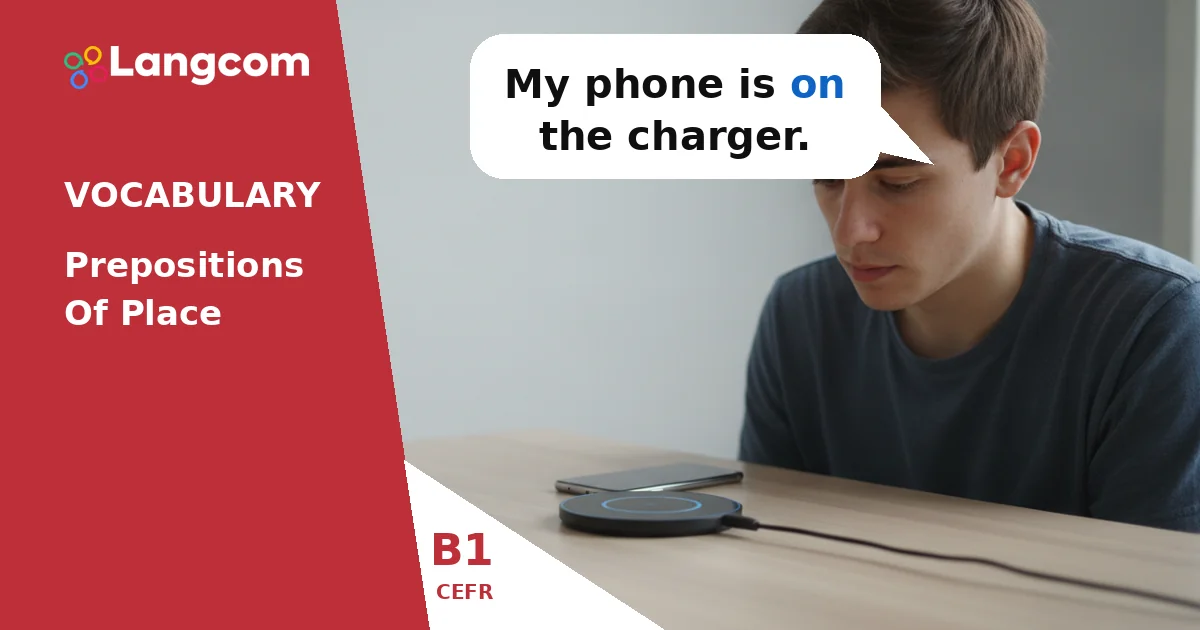
- My phone is on the charger.
- The remote control is under the sofa.
- We live in a small apartment.
- The bus stop is next to the supermarket.
- The cat is sleeping behind the curtains.
- There's a lamp above the bed.
Practice
Ready to earn your certificate?
Langcom prepares students for Cambridge, IELTS, TOEFL, DELE, SIELE and Michigan exams.
Get started with LangcomCommon mistakes for Spanish speakers
Spanish speakers often make specific mistakes with prepositions of place due to direct translation:
- In vs. On: In Spanish, 'en' can mean both 'in' and 'on'. This causes confusion.
- Incorrect: The pen is in the table.
- Correct: The pen is on the table. (For surfaces)
- Correct: I'm sitting on the chair. (For sitting on a seat)
- At vs. In: For general locations or specific points, at is often used, not in.
- Incorrect: I am in home.
- Correct: I am at home. (This is an idiomatic phrase)
- Correct: Let's meet at the station. (For a specific point)
Frequently asked questions
What is the main difference between 'in' and 'on'?
The main difference is about enclosure versus surface. We use in for something inside an enclosed space (like in a box or in a room). We use on for something resting on a surface (like on the floor or on the wall).
How can I practice prepositions of place effectively?
You can practice by describing your own environment. Look around your room and say where objects are, for example: The clock is on the wall. My shoes are under the bed. You can also try describing pictures or scenes from movies.
Are prepositions of place important for the B1 Preliminary exam?
Yes, absolutely! Prepositions of place are very important for the B1 Preliminary (PET) exam. You will need them to describe pictures in the Speaking part, understand locations in the Listening part, and write clear descriptions in the Writing part. Correct usage shows good control of the English language.



0 Comments