
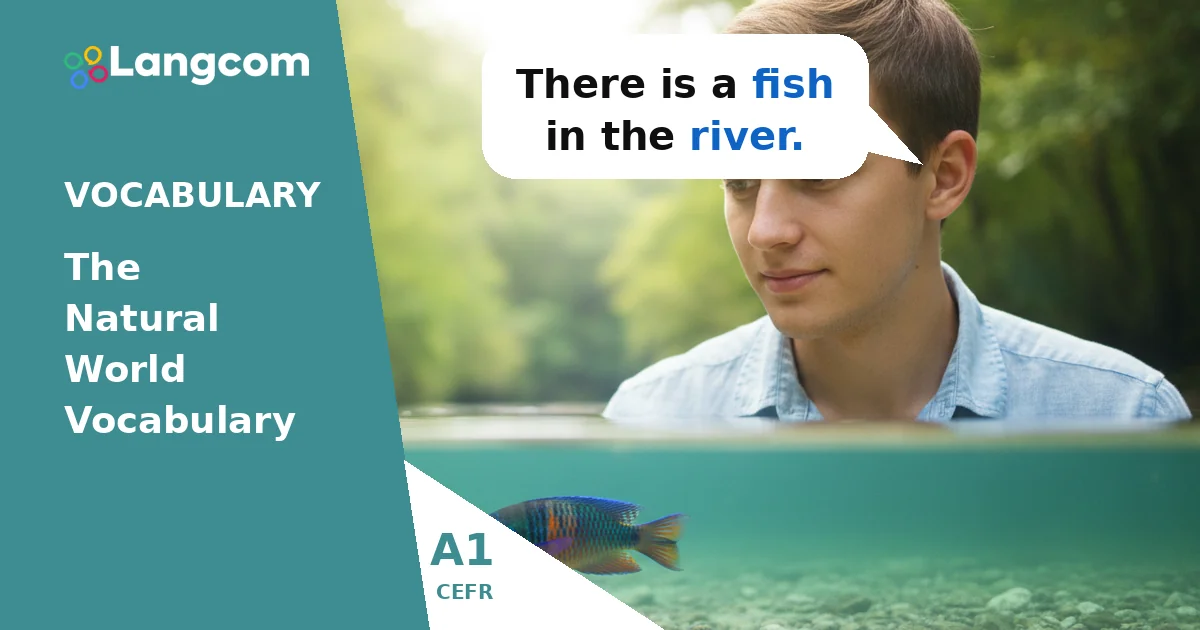

What Are Prepositions in and on?
Prepositions are small words that tell us about location, time, or direction. For example, they tell us where something is.
Today, we focus on in and on. These prepositions are very common when we talk about places in nature.
🎓 Learn English with the Blended method
Small groups · 24/7 AI Tutor · Cambridge preparation
Plans from $39 $79 per month
When to Use in with Nature Words?
We use in when something is *inside* a place or *surrounded* by it. Think of it like being within boundaries.
- in the river: This means something is in the water.
- in the sky: This means something is up in the air, surrounded by the sky.
- in the forest: This means something is among the trees.
When to Use on with Nature Words?
We use on when something is *on the surface* of another thing. Think of it like touching the top or side.
- on the mountain: This means something is on the side or top of the mountain.
- on a tree: This means something is on a branch or the trunk of a tree.
- on the ground: This means something is touching the earth's surface.
Quick Tips for in vs. on
Remember these simple ideas to choose the correct preposition:
- Use in for spaces you can be *inside* or *surrounded by*.
- Use on for surfaces you can be *on top of* or *attached to*.
| Nature Word | Preposition | Example Sentence |
|---|---|---|
| river | in | The fish swims in the river. |
| sky | in | The sun is in the sky. |
| forest | in | Deer live in the forest. |
| mountain | on | There is a path on the mountain. |
| tree | on | A bird built a nest on the tree. |
| ground | on | My dog likes to play on the ground. |
Examples
- There is a fish in the river.
- The clouds are in the sky.
- Many birds live in the forest.
- We saw snow on the mountain.
- An apple is growing on the tree.
- The leaves fell on the ground.
Practice
💬 Need personalized guidance?
As an Authorized Cambridge Preparation Centre, we can guide you to the right course and certification. Chat with our advisors today.
Chat with an Advisor on WhatsAppCommon mistakes for Spanish speakers
A common mistake for Spanish speakers is using on when in is correct, or vice-versa. This is because the Spanish word "en" can mean both in and on.
- Incorrect: The boat is on the river.
- Correct: The boat is in the river. (It is in the water, surrounded by it.)
- Incorrect: There are flowers in the mountain.
- Correct: There are flowers on the mountain. (They are on the surface of the mountain.)
Frequently asked questions
What is a preposition?
A preposition is a word that connects a noun or pronoun to another word in a sentence. It often shows location, time, or direction. Examples are in, on, at, under.
Why are in and on difficult for Spanish speakers?
In Spanish, the word "en" can be used for both in and on. This means learners need to remember when to choose in and when to choose on in English, based on the specific meaning of 'inside' or 'on the surface'.
Can I say on the sky?
No, you cannot say on the sky. The correct preposition is in the sky because things like clouds or birds are surrounded by the sky, not just on its surface.




0 Comments