

How Do We Say Numbers from 100 to 999?
For numbers between 100 and 999, we use the word hundred.
You always say the number before hundred. Then, for numbers after hundred, we often use the word and (especially in British English).
- 100 is one hundred.
- 250 is two hundred and fifty.
- 789 is seven hundred and eighty-nine.
🎓 Learn English with the Blended method
Small groups · 24/7 AI Tutor · Cambridge preparation
Plans from $39 $79 per month
How Do We Say Numbers from 1,000 to 999,999?
For numbers from 1,000 up to 999,999, we use the word thousand.
We use a comma (,) to separate thousands from hundreds. This makes numbers easier to read.
- 1,000 is one thousand.
- 5,000 is five thousand.
- 10,000 is ten thousand.
- 25,400 is twenty-five thousand, four hundred.
- 123,456 is one hundred and twenty-three thousand, four hundred and fifty-six.
How Do We Say 1,000,000?
When a number reaches 1,000,000, we use the word million.
Just like with hundred and thousand, you say the number before million.
- 1,000,000 is one million.
- 2,000,000 is two million.
When Do We Use 'and' in Numbers?
In British English, we use and after hundred and thousand when there are more numbers that follow.
- 101: one hundred and one.
- 520: five hundred and twenty.
- 1,005: one thousand and five.
- 2,345: two thousand, three hundred and forty-five.
If the number ends exactly on a hundred or thousand, you do not use and.
- 200: two hundred. (NOT two hundred and)
- 3,000: three thousand. (NOT three thousand and)
| Number | How to Say It |
|---|---|
| 100 | one hundred |
| 500 | five hundred |
| 1,000 | one thousand |
| 10,000 | ten thousand |
| 100,000 | one hundred thousand |
| 1,000,000 | one million |
Examples
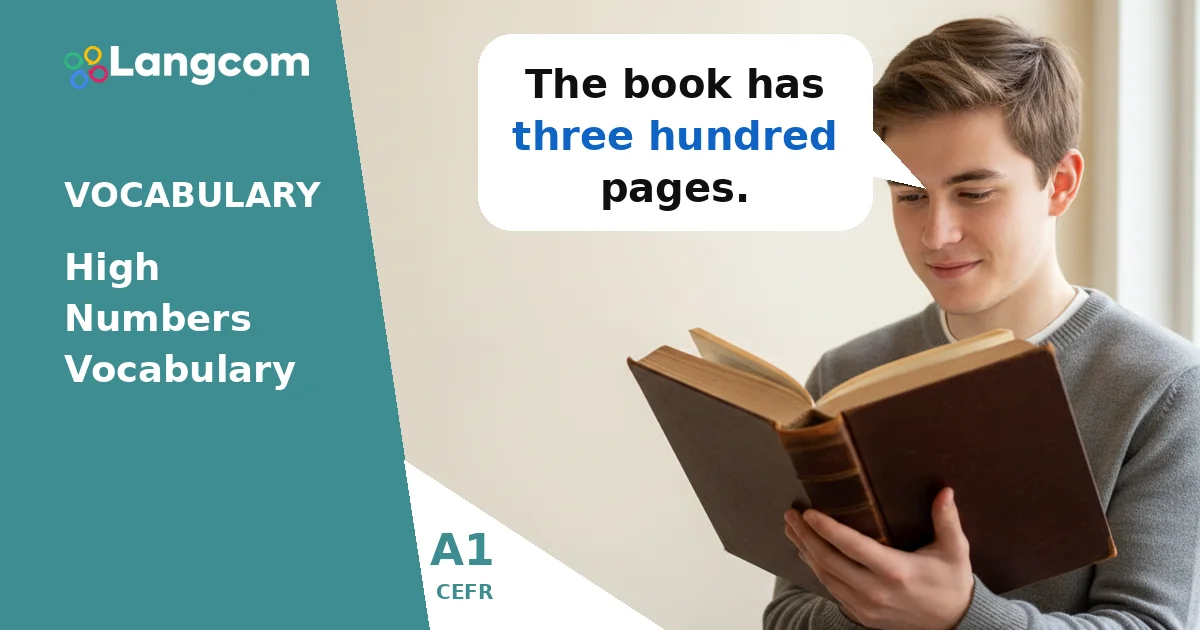
- The book has three hundred pages.
- The car costs fifteen thousand euros.
- There are one hundred and fifty students in the school.
- The population of the city is eight hundred thousand people.
- My phone number is five hundred and fifty-five, one thousand, two hundred and thirty-four.
- The company made two million dollars last year.
Practice
💬 Need personalized guidance?
As an Authorized Cambridge Preparation Centre, we can guide you to the right course and certification. Chat with our advisors today.
Chat with an Advisor on WhatsAppCommon mistakes for Spanish speakers
Spanish speakers sometimes make these mistakes:
- Not using 'and': In British English, it's common to use and after hundred.
Incorrect: four hundred twenty
Correct: four hundred and twenty - Adding 's' to numbers like 'hundred' or 'thousand' when counting: When you say a specific number of hundreds, thousands, or millions, these words stay singular.
Incorrect: two hundreds
Correct: two hundred
Incorrect: five thousands
Correct: five thousand
(We only use hundreds of, thousands of, millions of when talking about an approximate, large quantity, e.g., hundreds of people.)
Frequently asked questions
Do I always use 'and' in numbers?
In British English, yes, you usually use and after hundred or thousand if there are more numbers following. For example, one hundred and five.
Do 'hundred', 'thousand', and 'million' become plural?
No, not when you are counting a specific number. You say two hundred, not two hundreds. They only become plural (hundreds, thousands) when you mean an unspecified large amount, like hundreds of birds.
What is the difference between British and American English for numbers?
The main difference for these numbers is the use of and. British English uses and (e.g., one hundred and fifty). American English often omits and (e.g., one hundred fifty). Both are understood.




0 Comments