

What Are -ed and -ing Adjectives?
Many adjectives in English are formed from verbs by adding -ed or -ing. These are called participles when they function as adjectives.
- Adjectives ending in -ed, like bored or interested, describe a feeling or an emotion. They tell us how someone feels.
- Adjectives ending in -ing, like boring or interesting, describe the thing or person that causes the feeling. They tell us about the quality of something.
✍️ Not sure which level you are?
Take our free placement test and get personalized feedback from certified Cambridge examiners.
Take our FREE Placement TestWhen Do We Use -ed Adjectives?
We use -ed adjectives to talk about how a person or an animal feels. They describe the emotional state of a subject.
- I was surprised by the news. (I felt surprise.)
- She felt very tired after the long journey. (She experienced tiredness.)
- The children were excited about their holiday. (They had a feeling of excitement.)
Common -ed adjectives include bored, interested, excited, tired, surprised, annoyed, confused, disappointed, embarrassed, frightened, frustrated, shocked, and worried.
When Do We Use -ing Adjectives?
We use -ing adjectives to describe the person, thing, or situation that causes a particular feeling. They describe a characteristic or quality.
- The news was surprising. (The news caused surprise.)
- The journey was very tiring. (The journey caused tiredness.)
- Their holiday plans sound exciting. (The plans cause excitement.)
Common -ing adjectives include boring, interesting, exciting, tiring, surprising, annoying, confusing, disappointing, embarrassing, frightening, frustrating, shocking, and worrying.
Key Differences and Examples
It is important to remember the core difference: -ed for the person experiencing the feeling, -ing for the thing causing it.
- The lecture was boring. I felt bored during the lecture.
- She is an interesting person. I am very interested in her stories.
- That film was really frightening. We were all frightened by the monster.
- My job is often frustrating. I get frustrated when things go wrong.
| Adjective | Describes... |
|---|---|
| Bored | How a person feels |
| Boring | What causes the feeling |
| Interested | How a person feels |
| Interesting | What causes the feeling |
| Excited | How a person feels |
| Exciting | What causes the feeling |
| Tired | How a person feels |
| Tiring | What causes the feeling |
Examples
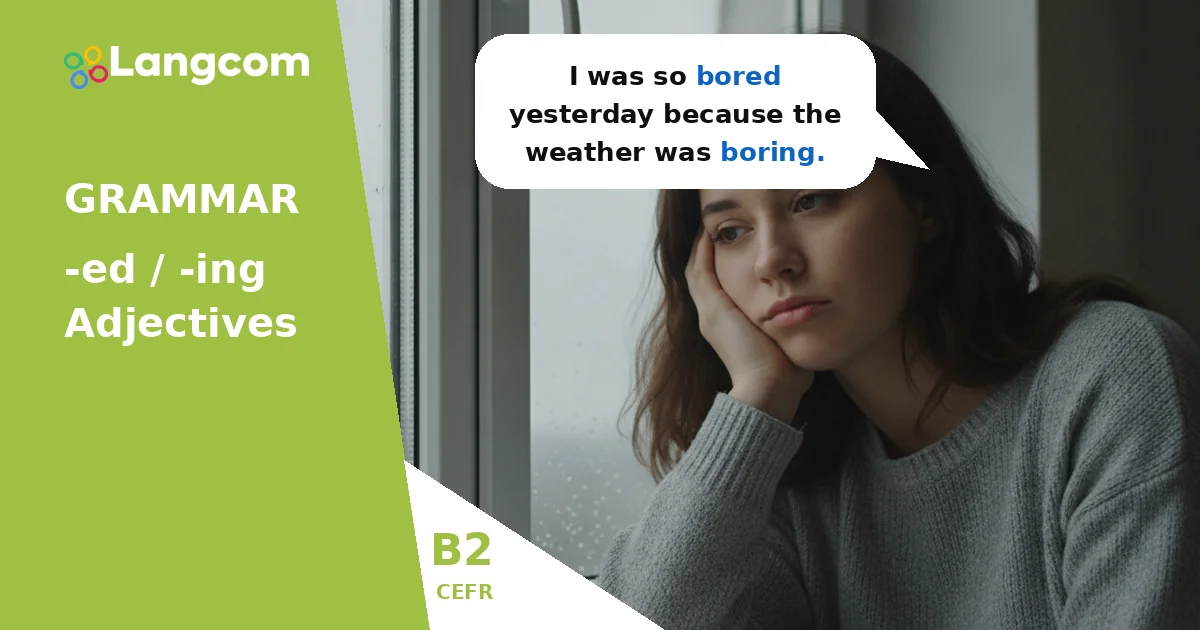
- I was so bored yesterday because the weather was boring.
- The children were excited to see the exciting circus performance.
- She found the book very interesting, so she was interested in reading more.
- His constant complaining is annoying; I'm very annoyed by it.
- The news about the accident was shocking, and everyone felt shocked.
- It was an embarrassing moment for him; he felt so embarrassed.
Practice
Ready to earn your certificate?
Langcom prepares students for Cambridge, IELTS, TOEFL, DELE, SIELE and Michigan exams.
Get started with LangcomCommon mistakes for Spanish speakers
A very common mistake for Spanish speakers is to confuse I am boring with I am bored. In Spanish, you might say 'Estoy aburrido/a' to mean you feel bored. However, in English:
- I am boring. (Incorrect if you mean you feel bored) This means you cause other people to feel bored. You are not an interesting person.
- I am bored. (Correct) This means you feel uninterested or tired of something.
Always remember: if you are describing your feeling, use -ed. If you are describing a quality of yourself or something else that causes a feeling in others, use -ing.
Frequently asked questions
Can -ed adjectives describe things?
Generally, -ed adjectives describe how a person or animal feels. While some past participles can describe the state of an object (e.g., a broken window, a finished project), these are not describing emotions. For adjectives describing emotional impact, -ed is for the experiencer, -ing for the cause.
Are there any verbs that don't form both -ed and -ing adjectives?
Yes, not every verb can form both types of adjectives in this emotional sense. For example, you wouldn't typically say I am eating as an adjective for a feeling, nor an eaten meal to describe something causing a feeling. The rule primarily applies to verbs related to emotions and states, like bore, interest, excite, surprise, etc.
How are -ed and -ing adjectives tested in the B2 First (FCE) exam?
These adjectives are frequently tested in the B2 First exam, particularly in the Use of English Part 3 (Word Formation). You might be given a base verb like 'bore' and need to decide whether to form bored or boring based on the context of the sentence. They can also appear in Part 2 (Open Cloze) or Part 4 (Key Word Transformation).


0 Comments