

What are Comparative Adjectives?
Comparative adjectives help us compare two people, places, animals, or things. They show which one has more or less of a particular quality.
We use comparative adjectives to highlight a difference. For example, My brother is taller than me.
- For most short adjectives, we add -er (e.no-translation>g., tall becomes taller).
- For longer adjectives (usually two or more syllables), we use more before the adjective (e.no-translation>g., interesting becomes more interesting).
- Always use than after the comparative adjective when you mention the second item in the comparison. For example, This book is more exciting than that one.
✍️ Not sure which level you are?
Take our free placement test and get personalized feedback from certified Cambridge examiners.
Take our FREE Placement TestWhat are Superlative Adjectives?
Superlative adjectives describe one item that has the highest or lowest degree of a quality within a group of three or more. They show something is unique or extreme.
We use superlative adjectives to say something is 'the most' or 'the least' of its kind. For instance, Mount Everest is the highest mountain in the world.
- For most short adjectives, we add -est (e.no-translation>g., tall becomes tallest).
- For longer adjectives, we use the most before the adjective (e.no-translation>g., interesting becomes the most interesting).
- Always use the before the superlative adjective. For example, She is the smartest student in the class.
How Do We Form Comparative and Superlative Adjectives?
The way we form comparative and superlative adjectives depends on the number of syllables in the base adjective. Here are the main rules:
- Most One-Syllable Adjectives: Add -er for comparative and -est for superlative.
- Example: small → smaller → smallest
- Adjectives Ending in -e: Add -r for comparative and -st for superlative.
- Example: large → larger → largest
- Short Adjectives with Vowel + Consonant: Double the final consonant, then add -er or -est.
- Example: hot → hotter → hottest
- Two-Syllable Adjectives Ending in -y: Change y to i, then add -er or -est.
- Example: heavy → heavier → heaviest
- Some Two-Syllable Adjectives (e.no-translation>g., ending in -ow, -le, -er, or words like polite, quiet, common, stupid): You can often use both forms.
- Example: polite → politer OR more polite → politest OR the most polite
- Longer Adjectives (two or more syllables, or ending in -ful): Use more for comparative and the most for superlative.
- Example: beautiful → more beautiful → the most beautiful
Refer to the table below for more examples and a quick overview of these rules.
| Rule | Base Adjective | Comparative | Superlative |
|---|---|---|---|
| Most one-syllable adjectives: add -er or -est. | small | smaller Italy is smaller than Spain. |
the smallest Vatican City is the smallest country in the world. |
| Short adjectives ending in -e: add -r or -st. | large | larger Canada is larger than China. |
the largest Russia is the largest country in the world. |
| Short adjectives with vowel + consonant: double the consonant, add -er or -est. | hot | hotter Algeria is hotter than Mexico. |
the hottest Libya is the hottest country in the world. |
| Two-syllable adjectives ending in -y: change y to i, add -er or -est. | heavy | heavier Elephants are heavier than crocodiles. |
the heaviest Blue whales are the heaviest animals in the world. |
| Some two-syllable adjectives (e.no-translation>g., ending in -ow, -le, -er, or polite, quiet, common, stupid): add -er/-est OR use more/the most. | polite | politer OR more polite Mia is more polite than me. |
politest OR the most polite Mia is the most polite girl in the class. |
| Longer adjectives (two+ syllables, or ending in -ful): use more or the most. | beautiful | more beautiful This painting is more beautiful than that one. |
the most beautiful She wore the most beautiful dress. |
Examples
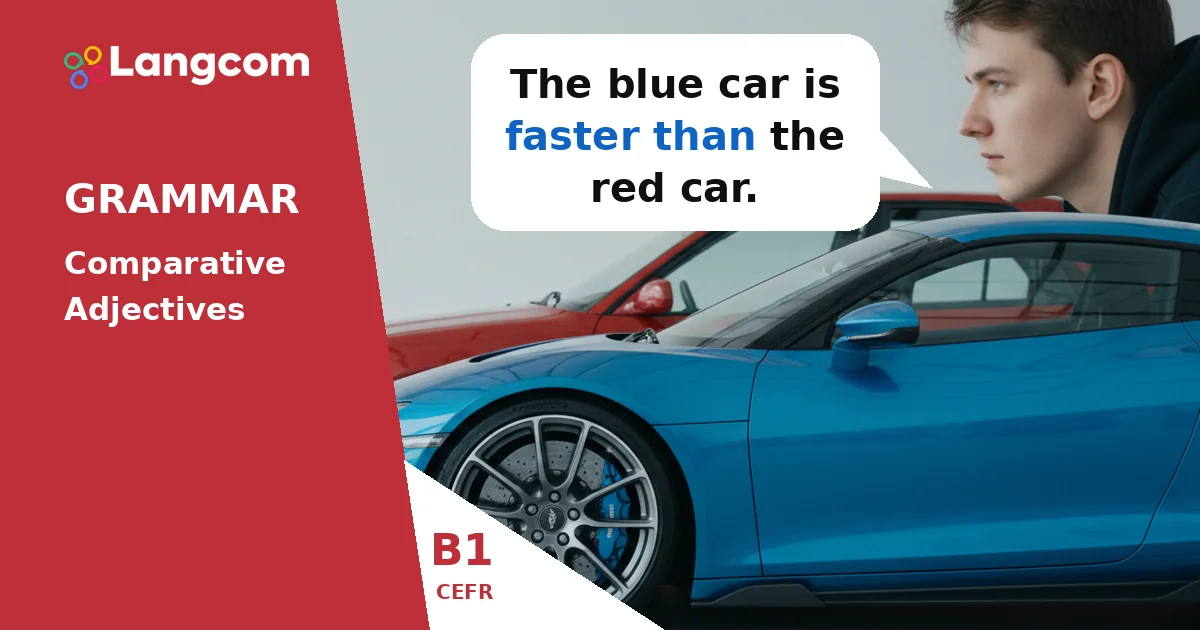
- The blue car is faster than the red car.
- Mount Everest is the highest mountain in the world.
- Italy is smaller than Spain.
- Vatican City is the smallest country in the world.
- Canada is larger than China.
- Russia is the largest country in the world.
- Algeria is hotter than Mexico.
- Libya is the hottest country in the world.
- Elephants are heavier than crocodiles.
- Blue whales are the heaviest animals in the world.
- Mia is more polite than me.
- Mia is the most polite girl in the class.
- Learning English is more interesting than learning Latin.
- This is the most difficult exercise in the book.
Practice
Ready to earn your certificate?
Langcom prepares students for Cambridge, IELTS, TOEFL, DELE, SIELE and Michigan exams.
Get started with LangcomCommon mistakes for Spanish speakers
Common Mistakes for Spanish Speakers
When learning comparative and superlative adjectives, Spanish speakers often make a few common errors:
- Using more with -er: In Spanish, you always use más. In English, you choose one form.
- Incorrect: This is more faster.
- Correct: This is faster.
- Forgetting than: After a comparative adjective, you must use than.
- Incorrect: She is taller me.
- Correct: She is taller than me.
- Forgetting the with superlatives: The is always needed before a superlative adjective.
- Incorrect: He is tallest student.
- Correct: He is the tallest student.
- Confusing -er/-est with more/most: Remember the rules for short vs. long adjectives.
- Incorrect: This is difficulter.
- Correct: This is more difficult.
Frequently asked questions
What is the main difference between a comparative and a superlative adjective?
A comparative adjective compares two things (e.no-translation>g., bigger), while a superlative adjective compares one thing to a group of three or more, showing it is the extreme (e.no-translation>g., the biggest).
Are there any adjectives that don't follow these rules?
Yes, there are a few irregular adjectives like good (better, best) and bad (worse, worst). These must be learned separately.
Why is 'than' important after a comparative adjective?
Than is crucial because it clearly indicates the second item in your comparison. Without it, the sentence is incomplete or grammatically incorrect, like My house is bigger my friend's.
Why do I need 'the' before a superlative adjective?
The is used because a superlative adjective refers to a specific, unique item within a group. It's "the one" that stands out, like the tallest or the most beautiful.
How can I practice comparative and superlative adjectives for the B1 Preliminary exam?
For the B1 Preliminary exam, you might find these in the Reading and Writing parts, especially in tasks like "Open Cloze" or "Word Formation." Practice identifying the correct form based on context and the number of items being compared.


0 Comments