
by Raúl | Sep 6, 2026 | A1 Beginner English
Adjectives are words that describe nouns. They tell us more about people, places, or things. For example, if you say “house,” an adjective can tell you what kind of house it is, like “a big house” or “an old house.” In English, adjectives usually come *before* the...
by Raúl | Sep 6, 2026 | C1 Advanced English
Mastering the distinction between tense and lax vowels is a key step for C1 English learners to achieve native-like pronunciation and improve listening comprehension. Tense vowels, often called ‘long’ vowels, are produced with more muscular effort, a more...
by Raúl | Sep 6, 2026 | C1 Advanced English
Connected speech is how English words join together when spoken naturally, making the language flow smoothly. The most important part of connected speech for C1 learners is linking, where the end of one word connects to the beginning of the next. This happens...
by Raúl | Sep 6, 2026 | Pre A1 Beginner English for Kids
Object pronouns are words like me, you, him, her, it, us, and them. We use them to replace a noun that receives the action of a verb or comes after a preposition. Think of them as the ‘receiver’ of the action in a sentence. For example, in the sentence She...
by Raúl | Sep 6, 2026 | B1 Intermediate English
In English, important words are stressed, and their vowels are clear. Unstressed words often have reduced vowels, especially the schwa sound /ə/. This fundamental principle of English pronunciation is essential for sounding natural and being understood. Function...
by Raúl | Sep 6, 2026 | A2 Key (KET)
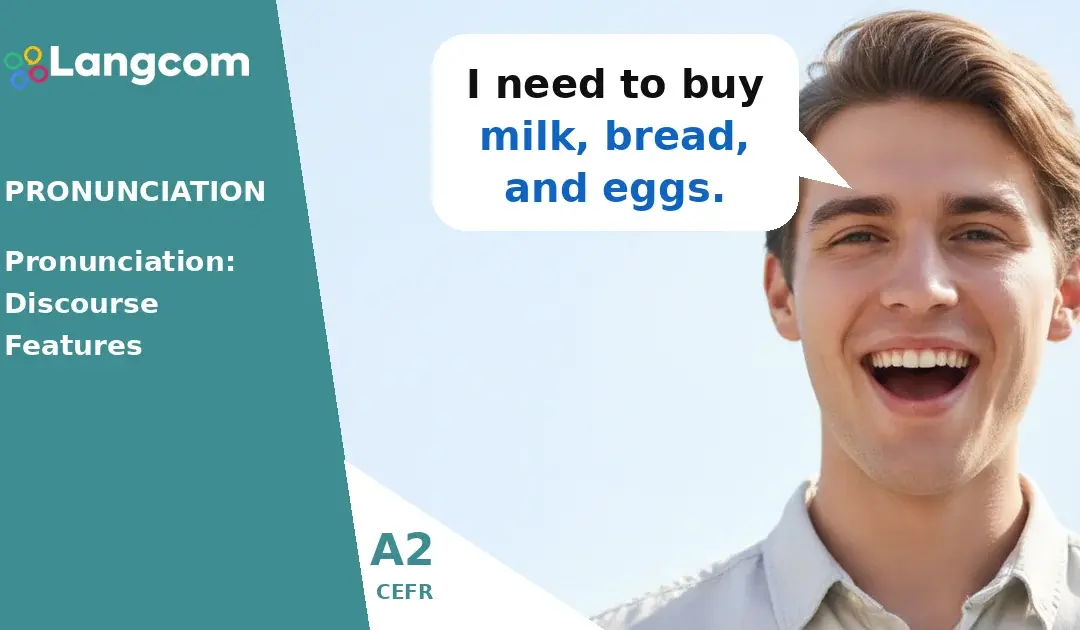
When you speak in English and list several items, your voice usually goes up for each item until the very last one, where it goes down. This pattern is called ‘list intonation’. It helps listeners understand that you are still talking and have more items...
