

What Are Adjectives for Places?
Adjectives are words that describe nouns. Nouns are people, places, or things.
When we talk about places, adjectives tell us about their qualities. They help us say what a place is like.
- We use adjectives to describe cities, rooms, parks, or countries.
- You can say, “The park is beautiful.”
- Or, “My house is small.”
🎓 Learn English with the Blended method
Small groups · 24/7 AI Tutor · Cambridge preparation
Plans from R$39 R$79 per month
Common Adjectives for Places (A1)
Here are some important adjectives to describe places. Many of these words come in pairs of opposites.
- Clean / Dirty
- Clean means not dirty. Example: The kitchen is clean.
- Dirty means not clean. Example: The street is dirty.
- Quiet / Noisy
- Quiet means not much sound. Example: The library is quiet.
- Noisy means a lot of sound. Example: The party is noisy.
- Boring / Exciting
- Boring means not interesting. Example: This town is boring.
- Exciting means very interesting or fun. Example: New York is exciting!
- Cheap / Expensive
- Cheap means not costing much money. Example: The market is cheap.
- Expensive means costing a lot of money. Example: This restaurant is expensive.
- Wet / Dry
- Wet means covered in water. Example: The floor is wet.
- Dry means not wet. Example: The desert is dry.
How Do We Use Adjectives for Places?
We usually put adjectives after the verb to be. The verb to be changes with the subject.
- For one place (singular), use is: The park is clean.
- For many places (plural), use are: The streets are noisy.
You can also use adjectives before a noun. For example, “It is a clean park.” or “It is a noisy street.”
| Adjective | Opposite |
|---|---|
| clean | dirty |
| quiet | noisy |
| boring | exciting |
| cheap | expensive |
| wet | dry |
Examples
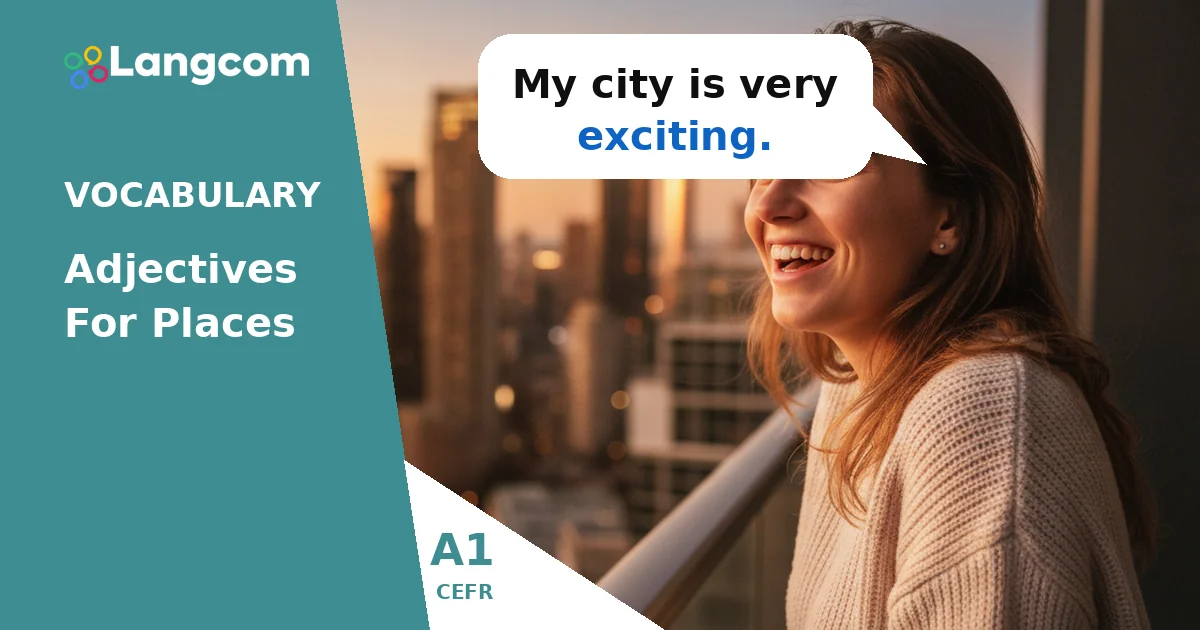
- My city is very exciting.
- The beach is clean and beautiful.
- This cafe is quiet, perfect for studying.
- That hotel is too expensive for me.
- After the rain, the ground is wet.
- The old market is cheap, but it can be dirty.
- I don't like noisy places.
- The museum was boring, but the gift shop was exciting.
Practice
💬 Need personalized guidance?
As an Authorized Cambridge Preparation Centre, we can guide you to the right course and certification. Chat with our advisors today.
Chat with an Advisor on WhatsAppCommon mistakes for Spanish speakers
A common mistake for Spanish speakers is forgetting the verb to be when using adjectives. In English, you must always use a form of to be (like is or are) with an adjective to describe a noun.
- Incorrect: The park clean.
- Correct: The park is clean.
Another mistake is placing the adjective after the noun when you use it directly before the noun.
- Incorrect: It is a park clean.
- Correct: It is a clean park.
Frequently asked questions
What is an adjective?
An adjective is a word that describes a noun. It tells you more about a person, place, or thing. For example, “big,” “happy,” or “clean” are adjectives.
Where do adjectives go in a sentence?
Adjectives usually go after the verb to be (e.g., “The room is clean.”) or before a noun (e.g., “It is a clean room.”).
Can I use these adjectives for other things, not just places?
Yes, some of these adjectives can describe other things too! For example, a person can be exciting or boring. A shirt can be clean or dirty. But for this lesson, we focus on places.
How can I practice these new words?
You can practice by describing places around you, like your home, school, or favorite park. Try to use two or three adjectives for each place. For example, “My bedroom is quiet and clean.”




0 Comments