
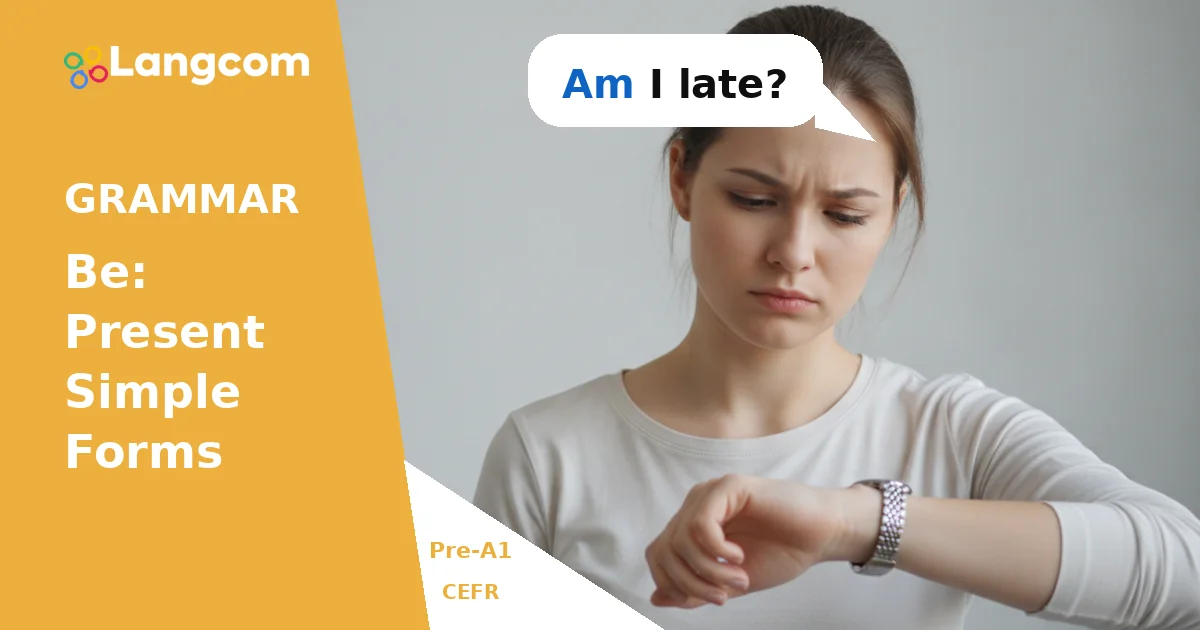

How Do We Form Yes/No Questions with ‘Be’?
Yes/No questions are simple. They ask for a ‘yes’ or ‘no’ answer.
- Начните с Am, Is, или Are.
- Then add the subject (who or what).
- Finish with the rest of the sentence.
- Пример: Are you happy?
🎓 Изучайте английский по смешанной методике
Небольшие группы · ИИ-репетитор 24/7 · Подготовка к экзаменам Кембриджского университета
Планы от $39 $79 в месяц
What Are Short Answers to 'Be' Questions?
When someone asks a Yes/No question with be, we often use short answers.
- They are positive (e.g., Yes, I am) or negative (e.g., No, I'm not).
- Remember to use the correct form of be for the subject.
- Important: Do not use contractions in positive short answers. For example, say Yes, I am, а не Yes, I'm.
How Do We Form Wh-Questions with 'Be'?
Wh-questions ask for specific information, not just 'yes' or 'no'.
- Start with a question word: What, Where, Who, When, Why, How.
- Then add am, is, или are.
- Finally, add the subject and the rest of the sentence.
- Пример: Where are you from?
| Verb Be | Тема | Rest of Sentence? | Positive Short Answer | Отрицательный краткий ответ |
|---|---|---|---|---|
| Am | I | ready? | Yes, you are. | No, you aren't. |
| Is | he/she/it | cold? | Yes, he/she/it is. | No, he/she/it isn't. |
| Are | you | a teacher? | Yes, I am. | No, I'm not. |
| Are | we/they | here? | Yes, we/they are. | No, we/they aren't. |
Примеры
- Am I late?
- Is she a student?
- Are they friends?
- What is your name?
- Where are you from?
- How old is he?
- Who is that?
Практика
💬 Нужна индивидуальная консультация?
Являясь официальным центром подготовки к экзаменам Кембриджского университета, мы поможем вам выбрать подходящий курс и программу сертификации. Свяжитесь с нашими консультантами уже сегодня.
Общайтесь с консультантом в WhatsAppРаспространенные ошибки у носителей испанского языка
Spanish speakers sometimes put the subject before the verb in questions, like in Spanish. This is incorrect in English.
- Неправильно: You are happy?
- Правильно: Are you happy?
Another common mistake is forgetting to use the verb to be when asking about age. This is often a direct translation from Spanish.
- Неправильно: How old you have?
- Правильно: How old are you?
Also, remember not to use contractions in positive short answers.
- Неправильно: Yes, I'm.
- Правильно: Yes, I am.
Часто задаваемые вопросы
What is the basic rule for 'be' questions?
The basic rule is to put the verb be (am, is, are) before the subject. For example, Is he happy?
Can I use contractions in 'be' questions?
Yes, you can use contractions in negative questions, like Isn't she here? или Aren't you ready? However, we usually do not contract am not in questions.
How do I answer a Yes/No question with 'be'?
Use short answers. For example, if someone asks Are you a student?, можно сказать Yes, I am или No, I'm not. Remember, no contractions in positive short answers.
What are some common question words with 'be'?
Common question words include What (for things), Where (for places), Who (for people), When (for time), and How (for manner or age).

0 Комментариев