

What is the Verb Be?
The verb be is very common in English. It helps you describe things and people. It also tells you where things are.
Think of be like “ser” and “estar” in Spanish. English uses only one verb for both ideas.
🎓 Изучайте английский по смешанной методике
Небольшие группы · ИИ-репетитор 24/7 · Подготовка к экзаменам Кембриджского университета
Планы от $39 $79 в месяц
How Do We Use Be in Positive Sentences?
The verb be changes its form depending on the subject. There are three forms for the present simple:
- Мы используем am с I.
- Пример: I am happy.
- Мы используем is с he, she, it, and singular nouns (one person, one thing).
- Пример: He is a student.
- Пример: It is cold.
- Мы используем are с you, we, they, and plural nouns (more than one person, more than one thing).
- Пример: You are kind.
- Пример: They are friends.
How Do We Use Be in Negative Sentences?
To make a sentence negative, we add not after the verb be.
- With I: am not
- Пример: I am not sad.
- With he, she, it: is not
- Пример: She is not from Spain.
- With you, we, they: are not
- Пример: We are not tired.
What Are Contractions with Be?
In spoken English and informal writing, we often use contractions. Contractions are shorter forms of words.
- For positive sentences:
- I am становится I'm (например, I'm a student.)
- He is становится He's (например, He's tall.)
- She is становится She's (например, She's my sister.)
- It is становится It's (например, It's sunny.)
- You are становится You're (например, You're welcome.)
- We are становится We're (например, We're friends.)
- They are становится They're (например, They're at home.)
- For negative sentences:
- I am not становится I'm not (например, I'm not hungry.)
- He is not становится He isn't или He's not (например, He isn't here. или He's not here.)
- She is not становится She isn't или She's not
- It is not становится It isn't или It's not
- You are not становится You aren't или You're not (например, You aren't right. или You're not right.)
- We are not становится We aren't или We're not
- They are not становится They aren't или They're not
When Do We Use the Verb Be?
Мы используем be for many things. Here are some common uses:
- To talk about identity or names:
- I am Maria.
- He is a doctor.
- To talk about age:
- She is ten years old.
- They are 25.
- To talk about feelings or descriptions:
- We are happy.
- It is a big house.
- To talk about location:
- You are at home.
- The book is on the table.
| Тема | Positive Form | Отрицательная форма | Positive Contraction | Negative Contraction |
|---|---|---|---|---|
| I | am | am not | I'm | I'm not |
| He / She / It | is | is not | He's / She's / It's | isn't / He's not / She's not / It's not |
| You / We / They | are | are not | You're / We're / They're | aren't / You're not / We're not / They're not |
Примеры
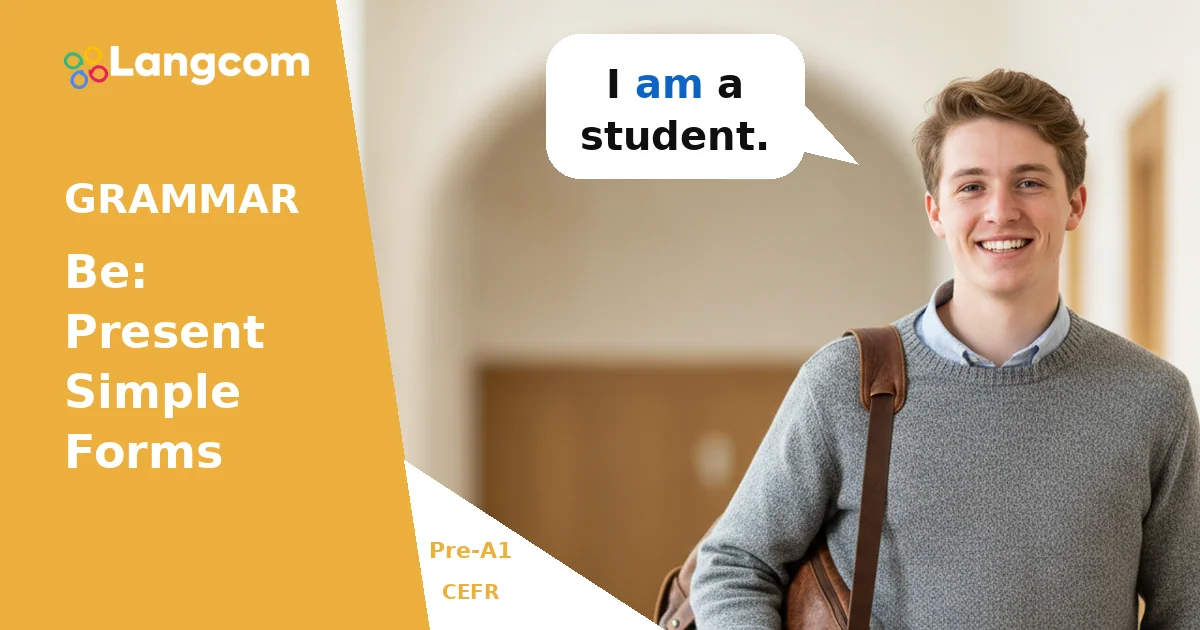
- I am a student.
- He is my brother.
- She is happy.
- It is a cat.
- You are tall.
- We are friends.
- They are in the park.
- I am not tired.
- He isn't here.
- They aren't sad.
Практика
💬 Нужна индивидуальная консультация?
Являясь официальным центром подготовки к экзаменам Кембриджского университета, мы поможем вам выбрать подходящий курс и программу сертификации. Свяжитесь с нашими консультантами уже сегодня.
Общайтесь с консультантом в WhatsAppРаспространенные ошибки у носителей испанского языка
Spanish speakers sometimes make these mistakes with be:
- Использование have for age: In Spanish, you say "Tengo X años". In English, we use be.
- Неправильно: I have 10 years.
- Справа: I am 10 years old.
- Forgetting the subject pronoun: In Spanish, you can often omit the subject (e.g., "Es feliz"). In English, you always need a subject.
- Неправильно: Is happy.
- Справа: He is happy. или She is happy.
- Сбивающее с толку ser и estar: Remember, English uses only be for both.
- Spanish: "Soy alto" (ser) and "Estoy cansado" (estar).
- English: I am tall. и I am tired.
Часто задаваемые вопросы
What are the three present forms of be?
The three present forms are am, is, и are.
How do I make I am negative?
You add not: I am not или I'm not.
Can I use isn't and is not?
Да, isn't is a contraction for is not. Both are correct, but isn't is more common in speaking.
When do I use is?
Вы используете is with singular subjects like he, she, it, or one person/thing (e.g., The dog is big.).



0 Комментариев