

What are common words for giving directions?
When you give directions, you tell people how to move. These are some basic verbs and phrases:
- To change direction, use turn left ou turn right.
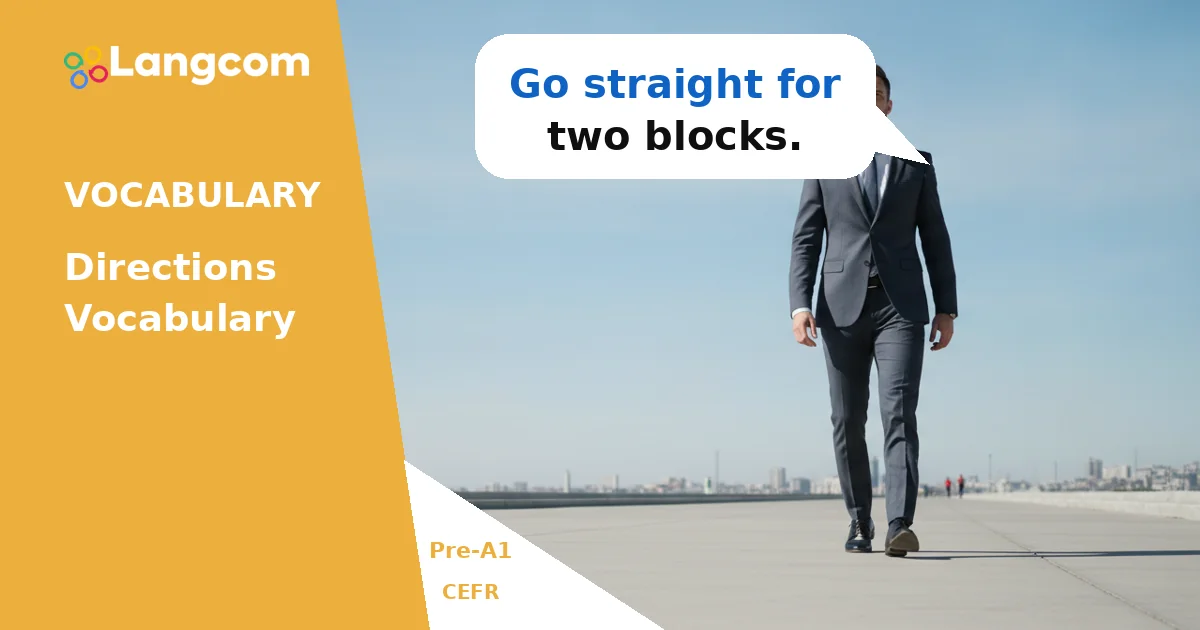
- To continue moving forward, use go straight.
- To move from one side to another, use cross ou go over.
You can also say where something is located using on the left ou on the right.
🎓 Aprenda inglês com o método misto
Grupos pequenos · Tutor de IA 24 horas por dia, 7 dias por semana · Preparação para os exames de Cambridge
Planos de $39 $79 por mês
What are important places on a map?
When you ask for or give directions, you often talk about places you see on the street.
-
Traffic lights: These are red, yellow, and green lights that control cars and people.
-
Roundabout: This is a circular road where traffic goes around a central island.
-
Bridge: This is a structure that goes over water or another road.
-
Crossing: This is a special part of the road where people can walk across safely. It is also called a crosswalk.
-
Square: This is an open public area in a town or city, often with shops or cafes around it.
How do I ask for directions in English?
It is important to be polite when you ask for help. Start with Excuse me.
- Uso Where is...? to ask about a place.
- Uso How do I get to...? to ask for instructions to a place.
How do I give simple directions in English?
When you give directions, use the words you learned. Speak clearly and slowly.
- Start with an action, like Go straight.
- Then add a place, like Turn left at the traffic lights.
- Finally, say where the place is, like The shop is on the right.
| Palavra em inglês | Significado |
|---|---|
| Turn left | Change direction to the left. |
| Turn right | Change direction to the right. |
| Go straight | Continue forward without turning. |
| On the left | To your left side. |
| On the right | To your right side. |
| Traffic lights | Lights that control cars and people on the road. |
| Roundabout | A circular road junction where traffic moves in one direction. |
| Bridge | A structure built over a river, road, or railway. |
| Crossing | A marked place for people to cross a street safely. |
| Square | An open public area in a town or city. |
Exemplos
- Go straight for two blocks.
- Turn left at the next street.
- Turn right after the bank.
- The shop is on the left.
- The park is on the right.
- Cross the street carefully.
- Go over the bridge.
- Turn left at the traffic lights.
- Take the second exit at the roundabout.
- Walk over the bridge.
- Use the crossing to go to the other side.
- The big square is in the city center.
- Excuse me, where is the museum?
- How do I get to the bus station?
Prática
💬 Precisa de orientação personalizada?
Como Centro Autorizado de Preparação para os Exames de Cambridge, podemos orientá-lo na escolha do curso e da certificação mais adequados. Entre em contato com nossos orientadores hoje mesmo.
Converse com um consultor pelo WhatsAppErros comuns entre falantes de espanhol
Os falantes de espanhol às vezes cometem estes erros:
-
Using 'go to left' or 'go to right': In English, we say turn left ou turn right. We do not use 'go to'.
Incorreto: Go to left here.
Correto: Turn left here. -
Using 'in the left' or 'in the right': For position, we use on the left ou on the right.
Incorreto: The shop is in the right.
Correto: The shop is on the right. -
Confusing 'plaza' with 'square': While 'plaza' is sometimes understood, the common English word for an open public space in a town is square.
Incorreto: Meet me in the plaza.
Correto: Meet me in the square.
Perguntas frequentes
What is the difference between left and right?
Left is the opposite of right. For example, your heart is on the left side of your body.
What does go straight mean?
It means to continue walking or driving forward, without turning. You do not change direction.
Can I say walk straight?
Yes, walk straight is correct when you are on foot. Go straight works for both walking and driving.
What is a crossing?
A crossing is a special place on the road where people can walk safely from one side to the other. It is also called a crosswalk.
Will I need this vocabulary for the Cambridge A2 Key (KET) exam?
Yes, this vocabulary is very useful for the Cambridge A2 Key (KET) exam, especially in speaking parts where you might describe a picture or answer questions about places and directions.

0 Comentários